Reality Clarity
The story inside a message
A friend replies, “Okay.”
The observable event contains one word and a timestamp. Your body supplies heat. Memory supplies the last disagreement. Fear supplies a future in which the friendship is ending. Within seconds, one small fact has become a complete world, and you are already living inside the ending rather than inside the word.
Reality Clarity began as my attempt to slow that construction down. I needed a way to respect emotional experience without promoting every interpretation to fact, and I needed a way to explore intuition and symbolism without allowing them to overrule behaviour, evidence, consent, or material conditions. The protocol asks a disciplined question: what kind of claim am I making right now?
Holding that question against a single word turns out to be hard. The word is a fact. The heat is a fact of experience. The friendship-ending is an inference wearing the costume of certainty. If I cannot keep them apart, the word does the work of the whole catastrophe, and I answer a future that has not happened yet.
Ten classes of claim
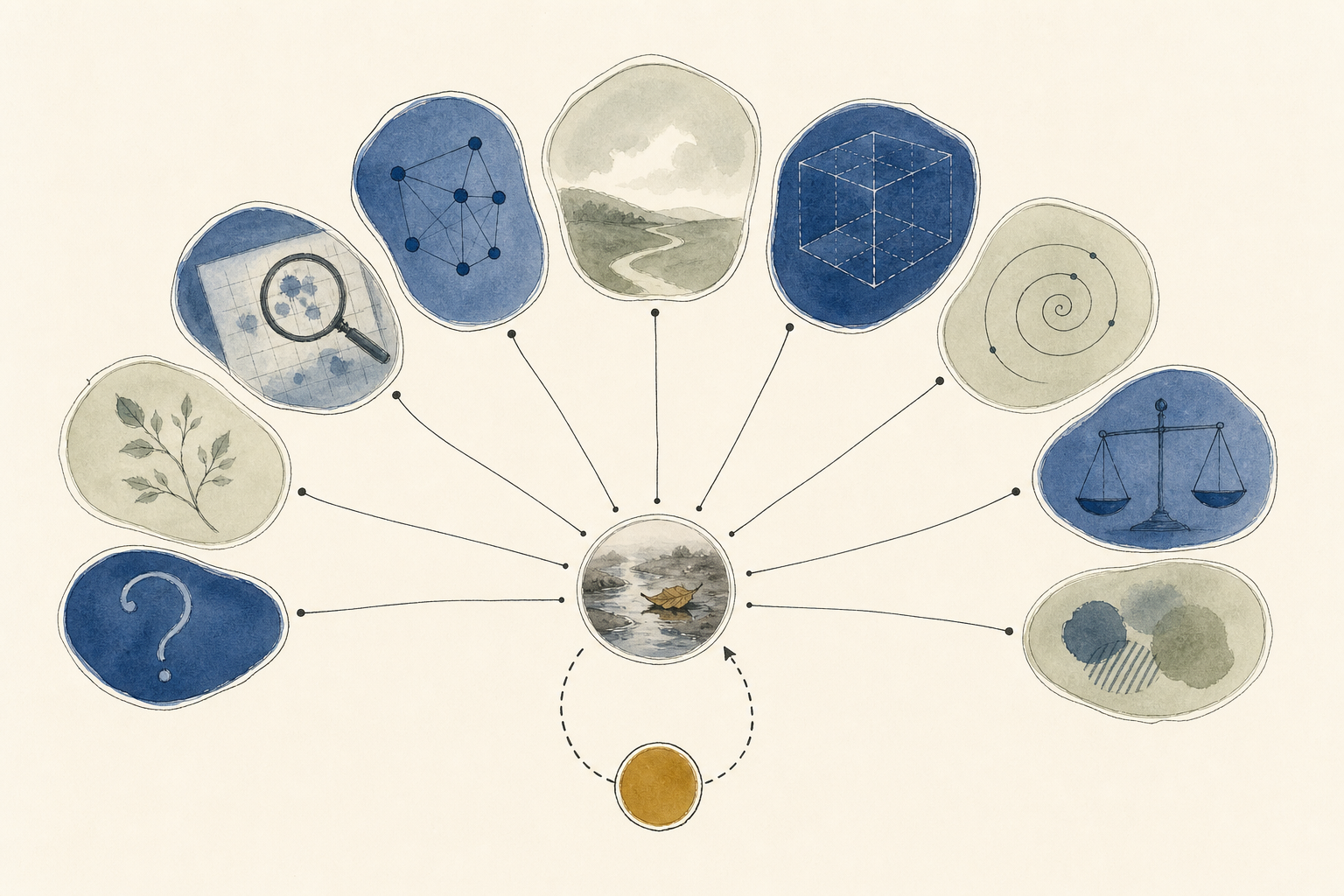
The discipline rests on a small map of claim classes. I learned to sort any sentence into one of ten standings before I let it drive me. An observable fact can be checked through direct record, shared observation, or reliable evidence — the message contains the word “Okay.” An autobiographical fact reports your own experience, memory, feeling, or intention — I felt dismissed. A supported inference connects facts through reasoning while naming its evidence and its alternatives. Established research or expert consensus depends on systematic study, specialized methods, or professional knowledge, and it requires a source and a scope. A psychological model proposes a mechanism for thought, feeling, behaviour, learning, or protection. A phenomenological description tells how experience appears from the inside. A symbolic interpretation asks what an image, story, dream, ritual, or event could mean. A spiritual or metaphysical hypothesis proposes something about consciousness, Source, souls, timelines, nonphysical entities, divine purpose, or realities beyond ordinary observation. An ethical position states what ought to matter. And unknown is a complete and useful category in its own right.
The classes do not rank human importance. Grief can matter deeply while its interpretation remains uncertain. A symbolic image can alter a life without functioning as historical proof. An ethical position can guide action without pretending to be a measurement. Classification only prevents one kind of authority from impersonating another.
Observation before motive
The first separation is between fact and inference, and it sounds simpler than it is. “The message contains the word ‘Okay’” is observable. “She is punishing me” is an inference about motive. The distinction collapses the moment emotion compresses it. A clear fact statement reaches for concrete nouns, actions, dates, quantities, direct words, or records, and it lets go of invisible motives and universal conclusions. So “the meeting began twenty minutes late,” “he cancelled three plans this month,” “the contract gives one party the right to terminate without notice,” “I spent more than the amount in my budget,” or “my shoulders tightened while I read the message” are all facts, even though the last one leaves its cause open.
Autobiographical facts deserve the same clarity. “I felt dismissed” is a fact of experience; “you dismissed me” becomes a relational inference until it is linked to specific behaviour. Classification does not weaken the feeling — the phrase “I felt afraid” is stronger than a theory about why another person wanted you afraid. Memory simply asks for care. A remembered event is a real part of present experience; its details can stay incomplete or drift over time, so when precision matters, you distinguish what you recall, what a record shows, and what someone else remembers.
Supported inference is where reasoning enters. If a colleague misses four deadlines, gives no warning, and stops responding, it is reasonable to infer that the project is at risk, though several explanations still fit. A supported inference names its evidence and its alternatives out loud: because three invoices remain unpaid past the agreed date, I infer that the client may have a cash-flow or commitment problem, I do not know which, and I will pause new work until payment or a revised agreement arrives. The inference supports action without claiming access to the client’s private mind.
Research, and its limit
Some claims depend on systematic study, specialized methods, or professional knowledge. Those claims require a source and a scope, and a phrase claiming total scientific proof is always too broad. A useful research claim identifies the field, the finding, the population, the uncertainty, and the source. This book uses research sparingly; its primary contribution is a transparent working architecture. When psychology, neuroscience, trauma, addiction, physiology, history, religion, social science, medicine, or therapeutic effects enter as factual claims, notes must identify where they came from.
Models, descriptions, and symbols
A psychological model proposes a mechanism. “Perfectionism may protect against shame or unpredictable judgment” is a model that can guide inquiry without diagnosing every person who works carefully. A good one will name the pattern it explains, the conditions under which it may apply, the evidence that would support it, a counterexample, and the intervention it suggests. The moment a model explains every possible outcome, it has lost its correction rights and become a story that cannot fail.
Phenomenology is gentler. It describes how experience appears from the inside. “Time slowed while I waited for the result” describes lived time, though the clock moved normally. “My body felt larger than its boundaries during meditation” reports an experience without establishing a cosmology. These descriptions matter because human life includes texture, meaning, and felt change; their authority concerns experience, and they become a different class of claim the instant they are used to explain the objective structure of reality.
Symbolic interpretation is plural by nature. A locked door in a dream may help someone think about access, and the interpretation earns its keep through the question it opens or the action it clarifies. Another reading may fit just as well — the dream may also reflect recent memory, stress, or random association. A symbol offers language. It does not issue a factual verdict.
Hypothesis, value, and the honest unknown
A metaphysical hypothesis proposes something about consciousness, Source, souls, timelines, nonphysical entities, divine purpose, or realities beyond ordinary observation. Such a hypothesis may organize meaning, produce a practice, or connect experiences, as long as its scope stays visible. The phrases that keep it honest are simple: my metaphysical interpretation is, within this worldview, one spiritual reading proposes, I experience this as, this remains speculative, and I do not know whether the model describes reality outside human interpretation. Book II uses these labels frequently. Book I does not require metaphysical assent.
An ethical position states what ought to matter. “Consent should remain active inside every relationship” is an ethical position; evidence can inform it, but the word should reveals a value. Other positions in this book include preserving agency, refusing victim-blaming, keeping correction paths open, and preventing spiritual language from replacing material care. Naming values makes disagreement cleaner, because a reader can challenge the position without pretending the disagreement is a factual error.
And then there is the class I keep returning to. Unknown is a complete and useful category. You may know that a relationship changed and remain uncertain why. You may know a practice felt powerful and remain uncertain how it worked. You may know a policy produced unequal outcomes and still need evidence about the causal path. Marking an area unknown prevents premature closure and directs research, conversation, observation, or patience. A map gains credibility each time it admits where it has not been.
The Claim Ledger
Classification becomes useful only when it becomes repeatable, so I folded it into a single practice I call the Claim Ledger. Its job is to carry a sentence through its life: write the exact claim, assign it a claim class, list the evidence currently available, list at least two competing explanations, name the missing evidence, state a prediction that follows from the claim, choose a proportionate action, record the outcome, and then update, narrow, or discard the claim. Most of the chapters of a person’s private weather report collapse into one step of that ledger.
Notice that confidence is built into the steps rather than measured apart from them. The prediction names what the claim would imply, the missing evidence names what would move me, and the recorded outcome tells me whether to keep the claim or let it fall. Action is then chosen proportionate to evidence and risk together. Low confidence that a stove may be left on can justify checking, because the cost is small and the potential harm is high; medium confidence that a person dislikes me may not justify ending a relationship without a conversation; high confidence in a medical concern still belongs with qualified assessment. Confidence should be able to travel in both directions. People often demand extraordinary proof to release a preferred belief while accepting weak evidence that supports it, and the ledger exists partly to make that asymmetry visible.
The ledger does its quietest work in the step most people skip — naming what would change the mind. Once that line is written, the claim is no longer a verdict. It is a prediction waiting on the world, and the world is allowed to answer.
Evidence has quality and fit
Listing evidence is not enough; the evidence must fit the claim. A screenshot can show that particular words appeared on a screen, while omitting context or being altered. A personal testimony can establish what someone reports experiencing, without establishing the cause. A randomized trial can estimate an intervention’s effect under defined conditions, without generalizing to every population or person. An official record can document an institutional decision and still contain error.
So I read each piece of evidence through a handful of questions rather than accepting it whole. How close is the source to the event or process? How was the information produced? Do several sources rely on the same original claim? What might the source gain from a conclusion? Which population, period, and conditions does it cover? And can error be identified and revised? The strongest available evidence always depends on the question being asked: a person is the primary source for their current feeling, a laboratory test may be stronger for a physiological measurement, a contract is stronger for its written terms, and repeated behaviour is stronger than a stranger’s theory about a relationship.
Testimony, power, and disbelief
The demand for evidence is not neutral. Calls for evidence can protect truth, and they can also be used to silence people whose experiences were never documented by the systems around them.
Testimony is evidence of a report, and its factual weight depends on detail, consistency, corroboration, context, and the claim being made. Lack of a record is not proof that an event did not occur; a record controlled by the accused institution may be incomplete. Power shapes which evidence exists in the first place. Employers control logs. States control archives. Families suppress stories. Abuse often occurs without neutral witnesses, and marginalized people may face greater cost for reporting. Reality Clarity should therefore avoid two shortcuts: that a person said it, so every detail and interpretation is settled, and that there is no official record, so nothing happened.
The response should match role and authority. A friend can listen and support without conducting an investigation. An employer has safeguarding and due-process responsibilities. A court uses legal standards. A historian examines sources and context. A reader should not appoint themselves judge from a short post. Ethical care and epistemic caution can coexist.
The room where the partner went quiet
To see the ledger move, sit with one scene long enough to feel its weather change. A partner becomes distant. They initiated fewer conversations this week — that is the observable fact, the floor the rest stands on. Beneath it the autobiographical fact: you feel afraid and unwanted, and that feeling is real whether or not the inference above it holds. The inference is that they may be losing interest. The model is that distance may be activating an older expectation of abandonment, which is why the fear arrives larger than the evidence seems to ask for. Their motive is unknown. The evidence required is direct conversation and behaviour over time, not the texture of your fear.
Now the prediction sharpens. If the change reflects temporary workload, availability may return after the deadline and the person may name the constraint; if interest has changed, avoidance will persist or a conversation will confirm it. The action follows the prediction rather than the dread: ask directly, preserve your boundary, and observe. The emotional fact stays intact; what gets released is the mind-reading that fear had been doing in its place.
The clinic and the promise
A second scene tests a sentence that crosses several authorities at once. A practitioner tells a client, “Your symptoms show that blocked grief is leaving your body. Three sessions should complete the release.” Reality Clarity does not need to call the practitioner a fraud, and it does not need to call the client gullible; it separates the sentence. The observable fact is that the practitioner made the statement and the client reports symptoms. The research claim is that the statement implies a causal and therapeutic mechanism, which requires evidence appropriate to the symptom and intervention. The psychological model is that grief may influence bodily experience in some contexts. The symbolic interpretation is that the word “release” may give the client a meaningful image. The metaphysical hypothesis is that an energetic blockage may be proposed. The prediction is that symptoms should resolve within the stated period because of the intervention. The ethical issue is that the promise may discourage medical evaluation and builds authority through a fixed timeline. The unknown is the cause of the symptoms and the intervention’s actual effect.
A proportionate response falls out of the separation rather than out of panic: seek appropriate medical assessment, ask the practitioner for evidence and scope, refuse the guarantee, and preserve the record. The symbolic meaning may remain if it helps the client and does not govern their care. The case shows why classification matters most when one sentence tries to occupy every authority at once — medical, psychological, symbolic, spiritual, and predictive — and the ledger simply gives each part back its proper weight.
Correction in public and in private
Correction can feel costly because a public claim becomes attached to identity. The stronger practice is to make the update visible. A useful correction states what was originally claimed, which part was unsupported or wrong, what new evidence changed the conclusion, what the corrected claim is, who may have been affected, and what repair or prevention follows. Deleting without explanation can leave the false claim circulating, and defending a minor wording choice can hide the substantive error, so a correction should be as easy to find as the original wherever possible. This standard applies to authors, teachers, companies, institutions, friends, and to every claim inside this book.
The same discipline corrects private stories. “I always ruin good things” contains a universal conclusion that cannot be tested because it has no edges. A clearer entry names the observable fact — I cancelled two opportunities after receiving positive feedback — the autobiographical experience of pressure and imagined expectations I could not meet, the working model that visibility activates a protective response, and the experiment of accepting one small opportunity with a defined scope and recording what happens. The rewrite creates a mechanism, a limit, and a test. Identity becomes revisable.
Information cascades and a framework that can fail
A claim repeated by many people may still originate from one source, because repetition creates familiarity and familiarity can feel like confirmation. Before sharing a public claim, trace it backward: what is the earliest identifiable source, does the current wording match it, is the headline stronger than the underlying evidence, are several articles copying one report, has the source issued a correction, and is the image, date, or location authentic to the event? When the evidence cannot be checked, change the sentence. “Reports are circulating” describes circulation; it does not confirm content. Speed is itself an incentive — being first can produce status, reach, money, or political advantage — and a pause can protect other people from becoming material for an unverified narrative.
A framework must be allowed to fail in the same way. If the predicted outcome does not occur, several possibilities remain: the intervention was too weak, the mechanism is incomplete, another variable dominates, the measurement is poor, or the model is wrong. The practice publishes the correction rather than renaming failure as hidden success. The whole sequence — see the claim, separate its class, structure the evidence, select a proportionate action, actuate it, verify the outcome, and revise — is the bridge from a private interpretation to a map another person can use, and it will return throughout the rest of the book.
Okay
Return to the word. A friend replied, “Okay,” and within seconds one fact had become a whole world. Run that world through the ledger and it separates at the seams. The message contains the word “Okay” — observable fact. I felt heat, and fear, and the shape of an ending — autobiographical fact. The friendship is ending — supported inference, dressed today as certainty. She is punishing me — psychological model, or perhaps an older expectation wearing this face. Why she sent the word, and what she meant by it — unknown, and likely to stay unknown until a sentence asks.
The prediction falls out clean: if the word carries ordinary meaning, a further message or a calmer tone will arrive; if something has shifted, the silence will persist or a direct question will find it. The action is small and proportionate — ask, plainly, what the word was meant to carry, and let the answer arrive before the ending does. The heat does not have to leave for the question to be asked. The friendship does not have to be saved for the inference to be lowered from a verdict to a possibility.
Classification did not make the word warmer. It gave the word back its actual size, and it gave back the seconds that fear had stolen — the seconds in which a person is allowed to wonder instead of conclude, to ask instead of end, to hold one small fact without forcing it to be a whole world.