How Inner Patterns Become Systems
The meeting after the meeting
A team gathers to decide whether a project is ready. The formal agenda invites risks. Everyone in the room has learned, across many meetings, that this leader punishes bad news with irritation and extra scrutiny. Nobody has named the lesson aloud. They do not need to. The bodies know.
One person raises a small concern, then softens it before the sentence ends. Another stays quiet. A third offers reassurance they cannot honestly support. The meeting closes with apparent agreement, and for a moment the room feels simpler than it is.
Later, the project fails in the exact place nobody felt safe enough to name.
It is tempting to read this as a confidence problem — three individuals who happened to lack nerve. That explanation stays at the level of the person, and it leaves the room intact. But the room contains a larger mechanism. One response shaped the next response. Silence, repeated, became a norm. The norm protected authority. The organization lost access to the very information that could have saved the project. None of it required a villain. It required a pattern, reinforced.
A response begins inside a person and becomes shared architecture through repetition, reward, role, and enforcement. That is the movement this chapter follows — out from a single body, up into a structure, and back down into the bodies of the people who enter it next.
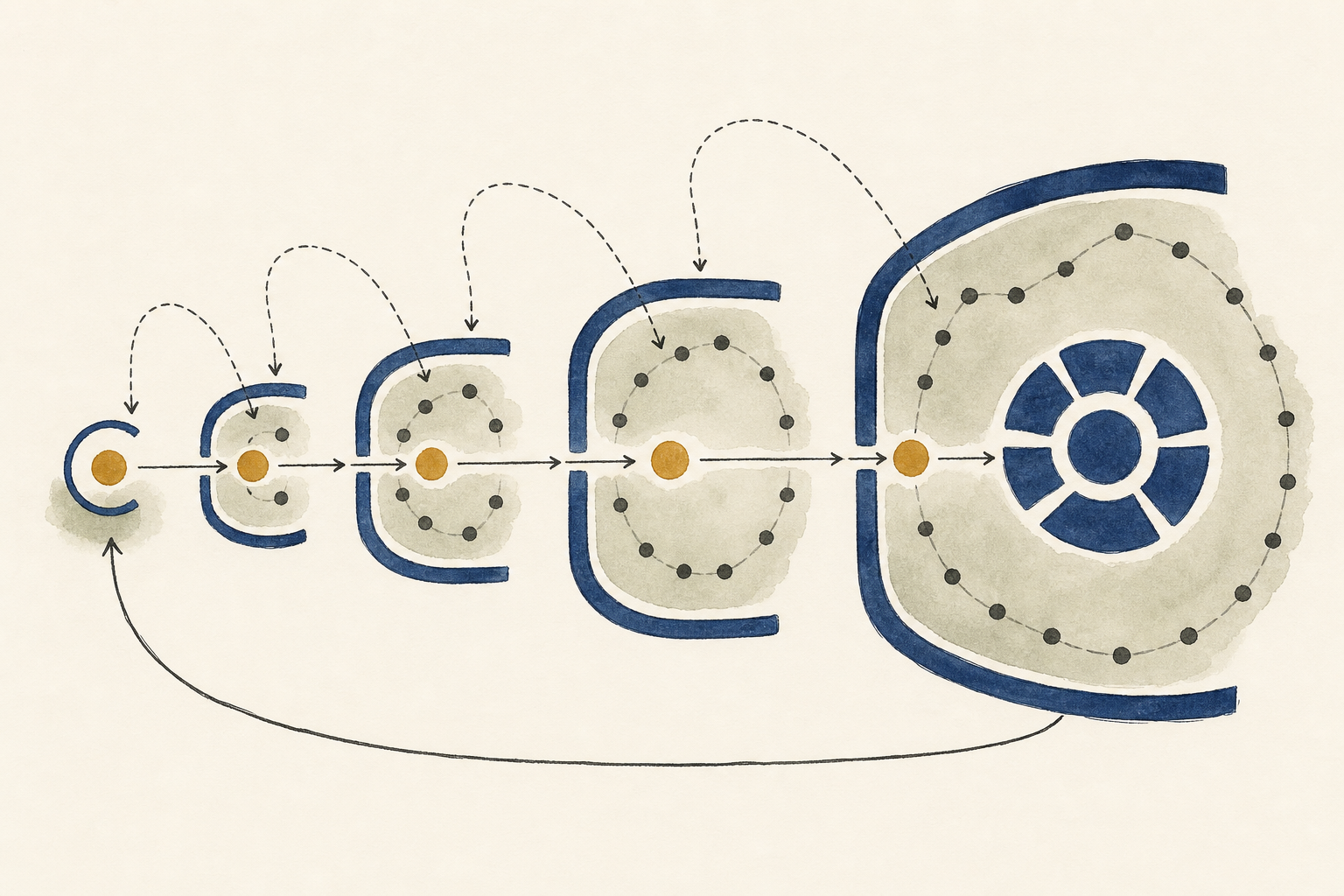
The scaling chain
Within VVViva, I use one sequence to trace how a private response becomes a public world. The chain is the chapter's single transfer. Hold it loosely enough to examine, exactly enough to recognize:
response → story → norm → role → incentive → institution → enforcement → culture → conditioning
Read it slowly. A response may begin as one person’s attempt to stay safe. Repetition makes the response predictable. People explain the pattern through a shared story. The story hardens into a norm. A role forms around maintaining it. Rewards and penalties stabilize the role. An institution formalizes the arrangement. Enforcement makes alternatives costly. Culture absorbs the result as ordinary reality, and new people enter and learn the world as simply how things are — the conditioning that seeds the next response.
The sequence can run in either direction. A law, a platform's design, a market incentive, or a family rule can shape individual expectation before a person has any language for the influence. The child who learned to keep a room intact (in the first chapter) and the person who learned to armor against a specific kind of threat (in the third) were already standing inside a chain someone else had built.
This is why personal work and system change cannot substitute for each other. A breathing exercise may help someone speak in a difficult meeting. It cannot remove a retaliation policy. A policy change may protect speech. It cannot automatically restore a body trained, over years, to expect punishment. Useful intervention begins by identifying the level that maintains the problem — and refuses the fantasy that any one level is enough.
A child in a small system
Families teach this chain in miniature, and the roles they cast are usually inherited rather than chosen.
A child notices that conflict rises whenever they express anger. They become easygoing. The family praises the maturity. Siblings learn to bring their problems to the easygoing child. Adults come to rely on that child to absorb tension. The role becomes “the peacemaker,” and what started as one protective response has now become a norm, a role, an incentive (praise), and a quiet institution of one.
Years later the adult feels guilty when setting a limit, and the guilt feels intensely personal. It also carries a family function. Their compliance once helped the household avoid conflict, and the household has not redistributed that work. The role survives through reward and expectation. Changing it can make the whole system feel unstable, because other people must now carry the labor one member performed quietly. In the language of the third chapter: the protection that once reduced danger has become a personality, and questioning it risks returning the original danger.
A family-level intervention might include explicit redistribution of care, permission for disagreement, and new repair practices. An individual intervention might include tolerating guilt while declining the old assignment. Both levels matter, and neither is enough alone.
The widening
The chain is not a family property. It is how a response becomes a world. Once you can see it in one room, you begin to see it in others — not because every room is identical, but because the same nine steps are available wherever people repeat, reward, and enforce a pattern together.
I notice it most clearly at the seam where a personal habit meets an institutional design. A student who keeps her unusual answers to herself is not, by herself, a system. But place her in a school that grades every meaningful task through one correct answer while celebrating creativity in its posters, and the chain lights up. Creative identity gets filed under decoration. Safety gets filed under compliance. Teachers spend less time managing divergence because divergence has become costly; assessment rewards standardized output; the institution reports comparable results; employers receive people trained to await permission. Years later that same student describes her hesitation as a personal lack of imagination. The system has converted an incentive into an identity, and the identity is now doing the system's work for free.
The same widening runs through the screens in our hands. A platform records how long a piece of content holds attention. Distribution rewards whatever travels — and urgency, fear, outrage, and status anxiety travel further than a quiet explanation. Creators learn which emotions pay. Repetition changes what feels normal. Public attention, now sharpened, reshapes the political and commercial incentives that decide what gets made next. The individual did not design any of this. Individual participation still feeds it: every reaction is a data point, every share a small vote. Responsibility is distributed across users, creators, advertisers, platform owners, regulators, and the architecture itself. To say it is only personal ignores power; to say it is only structural erases the choices people still hold.
Measurement carries the same compression, and it is where the chain hides most respectably. A business that counts only short-term revenue will quietly neglect trust, maintenance, worker capacity, and long-term resilience, because the uncounted costs have no lobby. The metric improves while the system weakens. A price summarizes an exchange without containing every human or ecological consequence of it. This does not make measurement corrupt; it makes it partial. A coherent system says plainly what its metric includes, what it omits, who bears the omitted cost, and how correction enters. The same question applies to follower counts, grades, productivity dashboards, polling, credit scores, and the habit tracker on your phone.
And technology, increasingly, turns these assumptions into repeatable behavior. A form declares what the system believes can be entered. A database declares which differences matter enough to store. An algorithm declares which signals affect an outcome. An interface declares which choices are easy, which are hard, and which are simply impossible. Once implemented, those decisions begin to look neutral, because users meet them as the environment rather than as decisions. A model trained on human-created data, generating outputs inside human-designed objectives, can be fluent enough to hide the judgments embedded in its selection, its labeling, its ranking, its deployment. Technology is not a foreign force. It is a surface expression of prior choices — and those choices remain available for examination.
This is the transfer the chain is for. From a tense meeting to a platform incentive. From a family role to a school policy. From a personal fear to a legal structure. The scales differ; the steps do not.
Mara, and the hidden labor
Organizations announce their values in words and reveal their values in workload. Mara — a composite drawn from common patterns, not one person’s history — is in a Monday planning meeting when she notices a deadline that belongs to no one. She could say so. Instead she absorbs it. By Wednesday she has rewritten the unclear document, calmed the teammate who was about to miss it, and repaired the risk before anyone with authority knew it existed. Her body registers the effort as ordinary. Her job description does not mention any of it.
Mara did not invent this response. She grew up in a household where the adults were stretched thin, and she learned early to notice what needed doing before anyone asked. The capacity is real: she is observant, fast, and skilled at coordination. The chain is also real. Her conditioned response (anticipate, absorb, repair before the need is visible) met an organization that rewarded exactly this labor by not naming it. The shared story is that she is “the one who prevents trouble.” The role forms. The incentive stabilizes — leaders avoid disruption, colleagues avoid ownership, and Mara avoids the guilt of refusing. An institution formalizes it through job descriptions that omit the work and through estimates that leave no room for it. Enforcement is quiet: the cost of stopping falls on Mara, and on the project if she does.
An identity-only intervention would tell Mara to stop people-pleasing. That could expose the team to preventable failure and expose Mara to blame. A systems-only intervention would create a coordination role while leaving Mara unable to refuse it. The revision needs several levels at once.
Mara records the invisible tasks for two weeks. She distinguishes genuine emergencies from work created by unclear ownership. In the next planning meeting she names three recurring functions and asks who owns each. She declines one rescue task with enough notice for the responsible person to act. She proposes that coordination time appear in project estimates. Her body produces guilt before the meeting, and the guilt is autobiographical experience — not evidence that the action is wrong. The manager’s response supplies the new evidence. If the organization welcomes the visibility and redistributes the labor, the present differs from the family system. If the manager punishes her and keeps the work invisible, the workplace is maintaining the role, and the chain is still running.
Where power hides, and how it is corrected
A system can be maintained by decent people whose roles reward harmful outcomes. That is why moral language alone often misses the mechanism, and why a chain that stops at “bad actors” stops too early.
Power is the capacity to shape conditions, allocate resources, define categories, impose costs, or control correction. It becomes harder to see when it is treated only as personal dominance. Institutional power often appears as procedure, as delay, as expertise, as access, or as the quiet ability to make one interpretation official and let the others dissolve. A rule on paper can differ sharply from a lived rule: access to counsel, time, money, documentation, language, social status, and institutional trust all change how two people meet the same formal system.
A healthy system does more than choose good leaders. It builds correction paths that remain usable when leaders fail.
This principle applies to families, companies, religious communities, governments, platforms, and AI systems alike. The relevant questions are structural rather than theological or partisan: Who may interpret? What happens after disagreement? Can a leader be corrected? Which information is allowed to enter? What material or relational cost follows exit? Does the system know how to tell harm from disloyalty? A community can provide deep meaning, ethical formation, ritual, belonging, and care, and still organize its authority so that questioning becomes too costly to attempt. When public disagreement disappears, its absence is then read as consensus — and the chain closes again.
The chain produces its own evidence
A clinic notices that one group of patients misses more appointments. A narrow explanation says those patients are less responsible, and the label turns an outcome into an identity. A systems map begins somewhere else: with the route.
Appointments are offered only during work hours. Reminders are sent in one language. The booking line has long waits. Rescheduling restarts a referral. Public transport to the clinic is infrequent. Missing one appointment produces a fee. Staff are measured by completed visits rather than by successful access. Individual behavior remains part of the outcome — a patient may forget, fall ill, lose childcare, or face transport failure — but the system decides which disruptions can be repaired and which become evidence against the person.
Read it through the chain. The repeated response is a missed appointment. The shared story is “this group does not value care.” The norm is that less staff effort goes to follow-up. The incentive is that quick closure improves workload metrics. The institution is the scheduling and fee rules that stabilize the pattern. The enforcement is the fee itself. The culture absorbs the category. The conditioning lands in the patient who learns to expect dismissal and delays future contact. The system then points to that delay and says: you see?
A measure, once it becomes a target, teaches people how to improve the number without improving the outcome. A school wants learning and targets test scores, so teaching narrows toward tested content. A support team wants trust and targets closure time, so workers close simple tickets quickly and reopen difficult ones under new names. A platform wants meaningful engagement and targets comments, so conflict becomes the most efficient product. The correction is not to abandon measurement. It is to use a family of indicators, to inspect the behavior the metric creates, to include qualitative evidence, and to keep the underlying purpose visible during review. Every metric needs a counter-metric and a story from lived experience that can contradict the aggregate.
This is how a system produces the evidence used to justify its original story. Naming it is the first correction.
The map can overreach
Systems thinking has its own capture risks, and a honest narrator names them. Total explanation turns every event into a product of the system and leaves no room for individual variation or chance. Distance from responsibility lets a person describe harmful conduct as an emergent property and step away from their own decision. Diagram authority lets an arrow create the appearance of causality where only association or intuition exists. Scale confusion takes a mechanism that is useful in a family and drops it onto a nation without accounting for law, population, history, and power. Intervention optimism assumes one leverage point will transform a complex system without resistance or unintended effect.
The correction is not to abandon the map. It is to label it. Each edge in a diagram should say what it is — observed, sourced, inferred, hypothesized, or unknown — and a small leverage point should be named as a hypothesis, not a promise.
Large systems rarely change through one person’s internal coherence. They change through organized authority, resources, expertise, law, incentives, public legitimacy, technical design, and collective action. The people most affected should hold meaningful power in defining the problem and evaluating the solution; consultation without decision rights can become the extraction of testimony. Coalitions need their own conflict structure too, because members may share a goal and disagree about tactics, pace, language, acceptable risk, or allocation — and a group that cannot hold its own disagreement will quietly reproduce the authority pattern it set out to oppose.
Every intervention changes incentives, and that is not an argument against action. A rule limiting work hours may protect staff and reduce access during a crisis. An anonymous reporting channel may increase safety and make investigation harder. A moderation policy may reduce harassment and suppress legitimate testimony. These tradeoffs require monitoring, not paralysis.
Back in the room
Return to the team that closed its meeting with apparent agreement, and read the room again with the chain visible.
The person who softened her concern was not weak. The person who stayed quiet was not careless. The person who offered reassurance he could not support was not dishonest. Each of them was performing a response the room had trained, and the room had trained it by repetition, by the story that bad news angers the leader, by the norm of staying agreeable, by the role of the loyal team, by the incentive of avoiding scrutiny, by an institution that gave the leader control over retaliation and advancement, by an enforcement that made honesty expensive, by a culture that called harmony a virtue, and by a conditioning that arrived in their bodies before they spoke. The project failed where the chain was strongest.
None of this tells them what to do tomorrow. It tells them where the work is. The quiet one might, with allies, propose a way to surface risk that does not pass through the leader's mood. The leader, if they can hear it, might redesign their own role so that correction survives their failure. The organization might build the path that was missing. Authorship, at this scale, includes personal choice — and it also includes recognizing when a private struggle is being produced or amplified by a shared structure, and joining with others to change the structure that produces it.
The meeting after the meeting is where the chain is forged. It is also where it can be broken, link by link, by people who have learned to see it.