Making a Life from Coherence
The morning after
The insight arrived on a Sunday night, the kind that feels complete. I had seen something about how I had been working — how I had priced the labor, how I had answered every message as though a slow reply were a betrayal. The whole pattern made sense. I wrote it down. I slept believing the writing was the change.
By Tuesday the insight was already going soft. A deadline had moved. A client wrote in distress. My body had slept poorly and the coffee was doing more than the rest had. The work required a decision the insight had not actually made. I noticed myself reaching for the same answers I had just named and discarded, and I understood, with a quieter clarity than the one on Sunday, that naming a pattern is not the same as moving it. Insight has to become an arrangement or it does not survive the week.
That is the question this chapter carries: what does a realization become by Tuesday? Everything here — work, money, rest, creation, the structures I build around the work I value — is an attempt to answer it. The answer I have learned to trust is not a feeling. It is whether the life behind me, looked at plainly, can carry the thing I said I believed.
I use coherence for a workable relationship among observation, values, action, and consequence. A coherent life is not a clean life. It contains conflict, changing needs, and unfinished questions. Its parts can communicate. When reality contradicts the plan, the plan can update. Coherence is visible in ordinary arrangements — a calendar that reflects declared priorities, a price that supports the labor, a boundary that can be enacted, a rest practice that protects capacity, a project small enough to finish, an account of success that includes cost.
This is where the map touches the ground. An earlier draft of the Sunday-night insight might have ended with the feeling of clarity and called it a life. The version I trust waits for Tuesday.
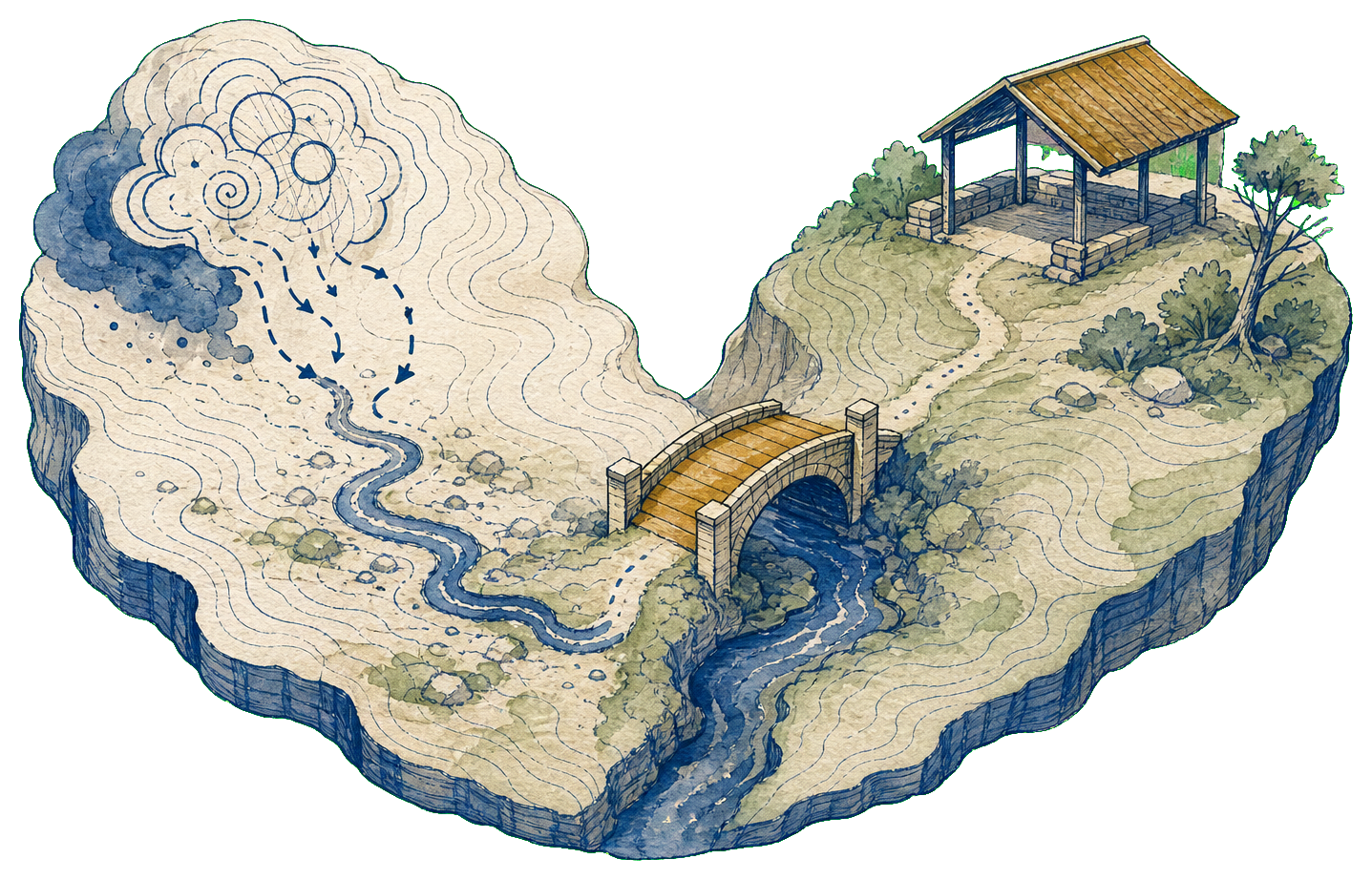
From value to calendar
A value has little operational force until it changes a decision.
If I say health matters while scheduling every hour, the calendar reveals a conflict. If I say family matters and remain unavailable during every shared meal, the arrangement needs attention. If I say creative freedom matters while accepting work that consumes all creative capacity, the tradeoff should be named. None of this demands that every day display every value. Survival periods compress choice; caregiving, illness, debt, deadlines, and emergencies can dominate a season. Coherence begins with honest accounting, not ideal balance.
A value travels from a sentence to a life through several translations. It becomes a condition — two protected sessions each week, say, for the value of creative authorship. The condition becomes a behavior — the phone outside the room, one defined manuscript problem on the page. The behavior produces evidence — sessions that occurred and produced a page, a decision, a sketch, or a useful failure. The same path runs under rest, friendship, money, learning, parenting, activism, or spiritual practice, and walking it once is usually enough to learn whether the current life supports the value it announces.
The audit is the kind of Tuesday work that an insight rarely feels like doing. It is unglamorous. It will not produce a revelation. It produces a block that moved, or did not, and that is exactly the shape a coherent life is made of.
Work has several functions
Work can provide income, structure, identity, contribution, status, community, learning, care, and creative expression. One job rarely fulfills every function, and expecting it to can make ordinary limits feel like personal failure.
The more useful question is what the work is for in this season. A stabilizing job may primarily provide income and predictable hours. A craft practice may develop skill before it earns money. Care work may sustain a family while remaining unpaid or underpaid. A business may seek both service and surplus. An activist role may protect a community while creating personal risk. Purpose becomes more usable once it is separated from employment: a person can live a meaningful life while doing necessary work that is not a calling, and a calling can become exploitative when institutions use devotion to justify poor pay, weak boundaries, or endless availability.
The question “Does this work align?” is a mood unless it travels with company. It needs to ask whether the work covers material needs; what it requires from the body and the relationships; who benefits from the labor; what power the worker has to negotiate; what skill or option the work builds; and what cost accumulates over time. Asked together, those questions turn alignment from a feeling into an arrangement — and the arrangement, not the feeling, is what Tuesday tests.
Money is information and power
Earlier versions of this framework called wealth a nervous-system game and claimed that internal regulation determined abundance. I wrote some of that language myself, and I want to correct it plainly. It overstated one factor and obscured many others.
Money outcomes are shaped by wages, ownership, inheritance, geography, disability, discrimination, education, policy, markets, debt, caregiving, health, risk, luck, relationships, timing, and behavior. Emotional patterns can influence negotiation, spending, avoidance, pricing, investment, and tolerance for uncertainty. They do not explain the whole terrain, and a framework that pretends they do quietly tells a struggling person that their hardship is their own misregulation.
Money performs several functions at once. It is exchange, paying for goods, labor, and access. It is a buffer, increasing the room a household has to absorb interruption. It is power, shaping which options and voices carry force. And it is a record, revealing flows, obligations, priorities, and constraints that would otherwise stay invisible. Treating money as morally pure or corrupt hides these functions. Treating it as “energy” can hide contracts, labor, ownership, and unequal access — which is why this chapter treats it as information and power instead.
That boundary does not retire the emotional question. Someone may avoid opening bills because shame makes uncertainty feel safer than a number. A founder may underprice because rejection feels more threatening than unsustainable work. A worker may stay in a harmful role because the real cost of leaving includes housing and care. Each of these is a real experience inside a real arrangement, and the correction begins with facts rather than feeling.
A page of numbers will not make a hard situation fair. What it can do is end the conversation between fear and a guessed-at figure, and begin a conversation between a person and the actual terrain. That is the move coherence makes everywhere: it brings the felt and the factual onto the same page.
Enough, surplus, and circulation
The language of abundance becomes useful only when it is translated into conditions.
Enough means a defined threshold for needs and commitments. Surplus means the resources remaining after those thresholds and reserves are met. Circulation means the deliberate movement of resources through pay, care, investment, tax, gift, mutual aid, maintenance, and creation. These definitions make questions that “abundance mindset” cannot answer alone — enough for which household, over what period, which risks need a reserve, who performed the labor, what obligations accompany ownership, what form of circulation preserves the source. Generosity without capacity can become self-erasure; accumulation without responsibility can convert other people’s labor into private insulation. Coherence asks how resources were produced, what they sustain, and which costs remain invisible.
There is no universal moral ratio in this chapter. The goal is legibility — a person or a business should be able to explain the flows it depends on, and a reader should be able to see whether the explanation matches the arrangement.
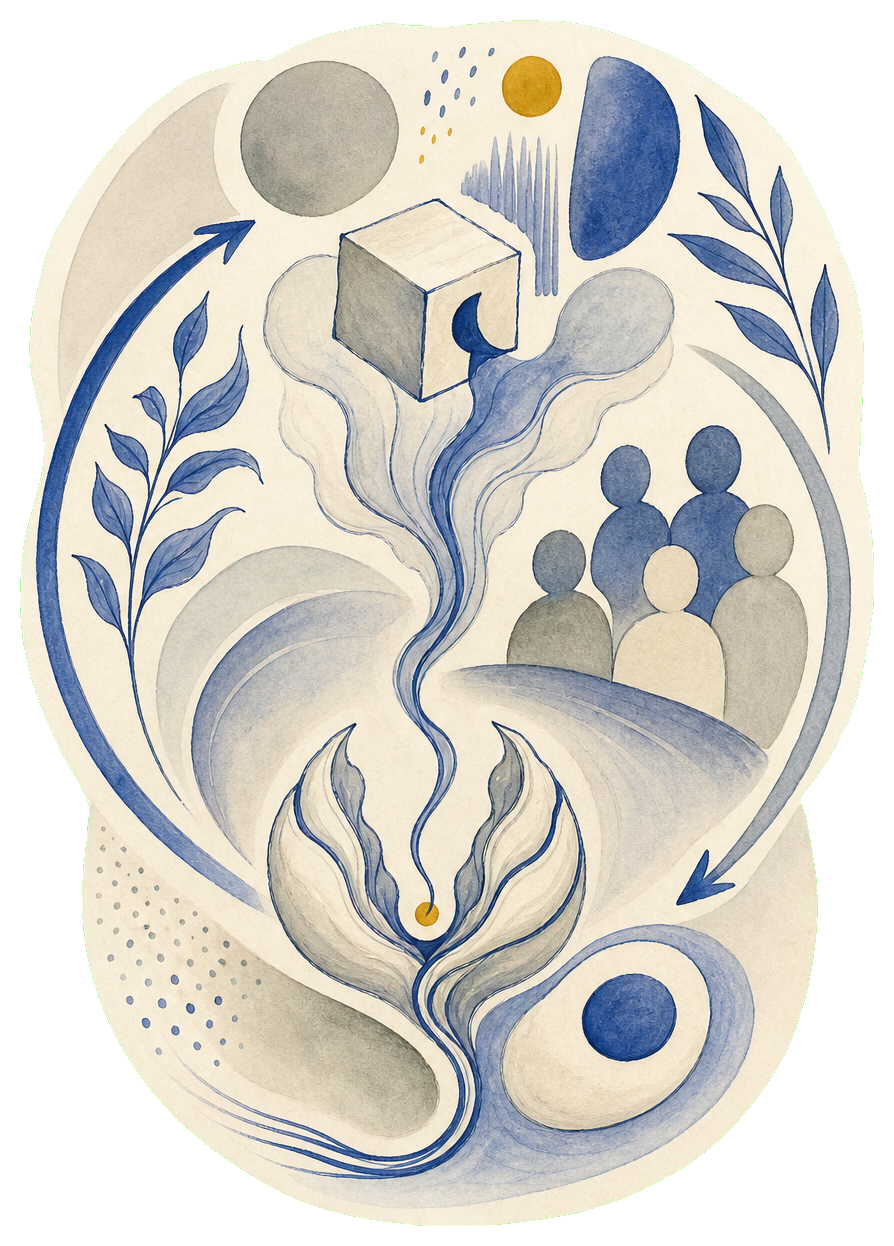
Rest is maintenance and experience
Rest is frequently justified as fuel for more work, and that argument can persuade a productivity-driven system to pause. It still leaves work as the measure of rest’s value. Rest also belongs to life directly. Sleep, stillness, play, idleness, social ease, and time without output can carry pleasure and dignity without becoming an investment in future performance.
Capacity varies, and rest is not always a private choice. It may require money, safe housing, childcare, healthcare, reduced sensory demand, or another person taking a shift. Telling an overloaded caregiver to regulate better ignores the arrangement producing the depletion. I find it useful to separate three needs that rest serves: recovery after exertion or stress; maintenance that prevents avoidable depletion; and unclaimed time whose value is not decided in advance. A coherent week gives each of these some material form, and the amount changes by season and circumstance.
Creative work needs a release path
Creative identity can become another place to hide. A person may research, refine, brand, and imagine indefinitely while protecting the work from contact with readers, users, listeners, or collaborators. The Sunday-night insight that never reaches a release is, in a sense, still Sunday night.
The creation loop needs a release path. It begins with the question or need, moves into the smallest form that can carry it, asks that the stage be labeled honestly, shares the work with an appropriate audience, gathers response without converting response into worth, and then revises, stops, or expands. Completion depends on the form: a private poem can be complete when it says what the writer needed, while a public health tool requires evidence, accessibility, security, and ongoing maintenance, and a business offer requires delivery capacity and a clear exchange. The body can contribute to the release decision — tension may reveal fear, fatigue, unresolved risk, or ordinary exposure — but calmness cannot certify quality on its own. Requirements, review, and feedback travel alongside sensation, and none of them is enough alone.
Tools accelerate every stage of this loop, and the same question of authorship applies to them. I used machine assistance in developing and editing this manuscript; I remain responsible for its claims, architecture, omissions, and final language. The test of accountable tool-use — whether I can explain a claim without the generated sentence, identify its source, verify its facts, stand behind its language, and take responsibility for its effect — is the subject of a later chapter, where the methods of clarity and action get their full treatment. The principle belongs here only as a reminder: a tool can assist the loop, but it cannot take the release decision for you.
Building a business without making it a cosmology
A business is a coordinated system that creates and exchanges value under constraints. It needs a customer or beneficiary, a real problem, a delivery method, resources, a price or funding model, responsibilities, evidence of effect, and a way to handle failure. Calling a business “purpose-aligned” settles none of those questions.
The coherence test I use turns each of them into a sentence that can be examined. What outcome is the promise, and what lies outside it? What demonstrates demand and delivery? What does each party give, receive, and risk? Can the work be delivered without hidden unpaid labor or chronic depletion? Who can change terms, appeal a decision, or leave? Who bears the costs outside the transaction? How are error, refund, complaint, and harm handled? The same structure applies to a solo practice, a technology company, a school, a retreat, a media project, and a nonprofit. Spiritual language does not reduce the need for contracts, safety, accessibility, taxes, privacy, or honest marketing — and in my experience it tends to make the need sharper, not softer.
The meaningful business that could not breathe
Mai builds a small education practice around work she values. Clients describe the sessions as transformative. Revenue grows slowly. Mai interprets every request as evidence that the work is needed and customizes the service for each person.
The business looks aligned and feels increasingly impossible.
The money reality page reveals that preparation and follow-up double the hours clients see. The listed price covers delivery time and little else. Payment is inconsistent. The offer promises “ongoing support,” a phrase clients interpret differently, and Mai answers messages late because responsiveness feels like care. The coherence problem is structural: a sincere purpose is being delivered through an arrangement that consumes its source.
The business test produces changes, each one a sentence that can be checked against a calendar and a ledger. A defined session outcome replaces “transformation.” Feedback is tied to specific changes rather than emotional praise alone. Price includes preparation, administration, tax, and recovery. Support has channels, hours, and response expectations. Clients can complain, request records, and stop. Accessibility and the cost of unpaid care labor become visible. Refund and referral rules are written down. Some clients dislike the new limits; others trust the clarity. Mai serves fewer people for a period while she tests a group format and a reduced-fee allocation supported by full-price work.
The point is not that every meaningful business should grow or charge more. The point is that purpose cannot compensate indefinitely for an incoherent exchange — and Mai’s Tuesday was the place that finally became visible.
Presence and the wider field
I came to this work with a picture of presence that I have had to revise. The old image of the “field operator” suggested a person who silently changed a room through energetic presence, and for a time that felt like the highest form of clarity. The method I trust now is more accountable, and it can be described in behavior rather than aura: a person who can tolerate uncertainty improves a meeting by listening, slowing an escalating exchange, naming the decision, protecting dissent, and keeping the group connected to evidence. Presence still matters. It just matters as something you can watch happen, not something you have to take on faith.
The same accountability applies when presence turns toward conflict. An earlier story of mine treated public anger as charge harvested by a system and calm presence as the superior response, and that binary was ethically and politically incomplete. Anger can reveal violation, mobilize protection, communicate urgency, and support collective action; protest, testimony, journalism, organizing, litigation, mutual aid, and refusal have changed material conditions, and they can also create risk, error, exhaustion, polarization, or spectacle. No emotional tone carries automatic moral authority. The honest question is strategic — what action fits the goal, the evidence, the power, the risk, and the people affected — and coherence at the collective level means alignment between a declared aim, the chosen means, and the lived effect. The full treatment of these collective mechanisms — how clarity becomes action across many people — belongs in the chapters on systems and collective attention; this chapter only insists that the move from private insight to shared condition runs on the same rails of arrangement, evidence, and review.
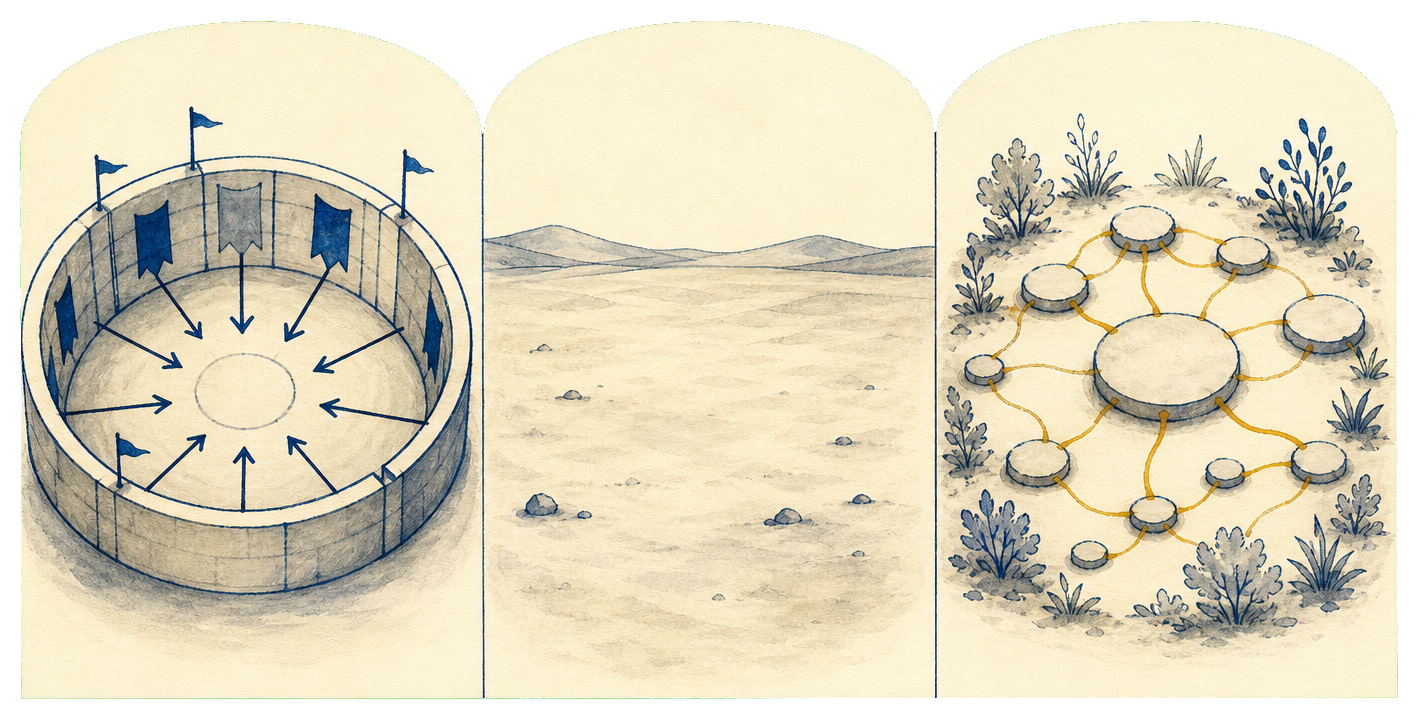
The week as a small building
The Sunday-night insight cannot be lived once; it has to be lived weekly, or it does not stay. A coherent week connects the values to the work, the money, the rest, the relationships, and the creation, and it does so in a form small enough to learn from.
The practice is to name, for the week ahead, one required outcome; one maintenance need; one relationship commitment; one money action; and one creative release — and to protect recovery and unclaimed time beside them. At the week’s end the plan is compared with reality and revised without moral judgment. A weekly page cannot resolve structural scarcity, unsafe employment, illness, or unequal care loads; when basic needs, safety, or health are unstable, the page simplifies around stabilization and appropriate help. Its purpose is not to optimize a life. It is to keep Tuesday in view, so that a value declared in the morning has somewhere to land by Friday.
This weekly habit is closely related to how a life is held together across roles. When one role supplies income, status, community, purpose, creativity, and self-worth, any threat to the role becomes existential, and diversification is emotional as well as financial. A person can cultivate several centers of identity — worker, parent, friend, maker, learner, neighbor, citizen, lover, body, and private self — and these centers do not need equal time. Their existence reduces the demand that one institution confirm the whole person. Economic diversification may include several clients, savings, benefits, transferable skills, shared household planning, or a gradual second income, unequally available as those options are; the principle is risk visibility rather than a command to hustle more. Rest and unclaimed time are themselves identity centers, because they let a person exist without performing a role at all.
Maintenance is part of creation
Creation stories often end at launch. Real things continue through maintenance.
A book needs corrections and future editions. Software needs security updates and support. A garden needs water. A community needs role rotation and repair. A relationship agreement needs review. A business needs bookkeeping, records, taxes, equipment, and succession. Maintenance can feel less alive than invention because the novelty has faded, yet it still expresses values: the person who builds without maintaining transfers cost to users, workers, family, or the future self. Before creating, it helps to write a maintenance horizon — what recurring work keeps this useful and safe, who owns that work, what it costs, what happens when the owner is unavailable, and how the thing can end responsibly. An ending plan is part of durable design, because a product can be archived, a community can distribute its assets, data can be deleted or exported, clients can receive notice, a ritual can be retired. The ability to stop is what protects creation from becoming permanent obligation.
The life becomes the evidence
A coherent life does not advertise an internal purity. It leaves a trail of decisions that can be examined.
The work has terms. The price has reasons. The body has maintenance. Rest is visible. Other people can say no. A project can receive criticism without becoming an identity emergency. Money can be discussed without turning inequality into mindset. Anger can become strategy. Care can have limits. Tools can assist without taking responsibility. This is how a map becomes a building — and it is also how I came back to the Tuesday morning that opened this chapter.
I had gone to the desk with a soft insight and the same answers I thought I had outgrown. The choice in front of me was ordinary: which answer to actually give. The insight did not hand me a new one. What it had done, by then, was give me a way to look at the one I was reaching for — to see whether the calendar, the price, and the rest behind me could carry the value I claimed, or whether I was about to perform a Sunday-night clarity that the week would quietly erase. Coherence is the name for that second look. It is not the feeling of having arrived. It is the willingness to let the arrangement, not the insight, be the thing that answers.