Portal, Ceremony, and Permission
The doorway ordinary life forgets
The year ended on a Thursday at midnight, and I closed the laptop without any sense of ending. The inbox still held unfinished urgency. The body still braced for the next request. Nothing in the room had agreed that anything was over.
So I made the room agree. I lit one candle on the desk where the difficult work had happened. I wrote a single sentence naming what had ended, and what I was leaving on that side of it. Then I went to the sink and washed my hands, slowly, with the candle still burning behind me. When I stepped outside for cold air, the year felt finished in a way the calendar alone had never made it.
The acts did not alter the date. They built a threshold the body could feel.
That is the question this chapter carries: what does a ritual actually do, and where does it stop? The candle and the hand-wash gave a transition form. They organized my attention, gave my body a sequence to follow, and lent a private grief a small permission to close. None of that required a cosmic mechanism to open. The whole chapter turns on that distinction. A ceremony can be meaningful without supernatural guarantees, and it can be meaningful without surrendering the room to an authority who cannot be corrected.
Ritual gives form to the transitions that ordinary schedules flatten — the endings the body has not been told about, the beginnings that have no entrance. Within spiritual language, the same experience may be called a portal. We can keep the doorway. We do not have to keep the promise that something invisible has opened on command.
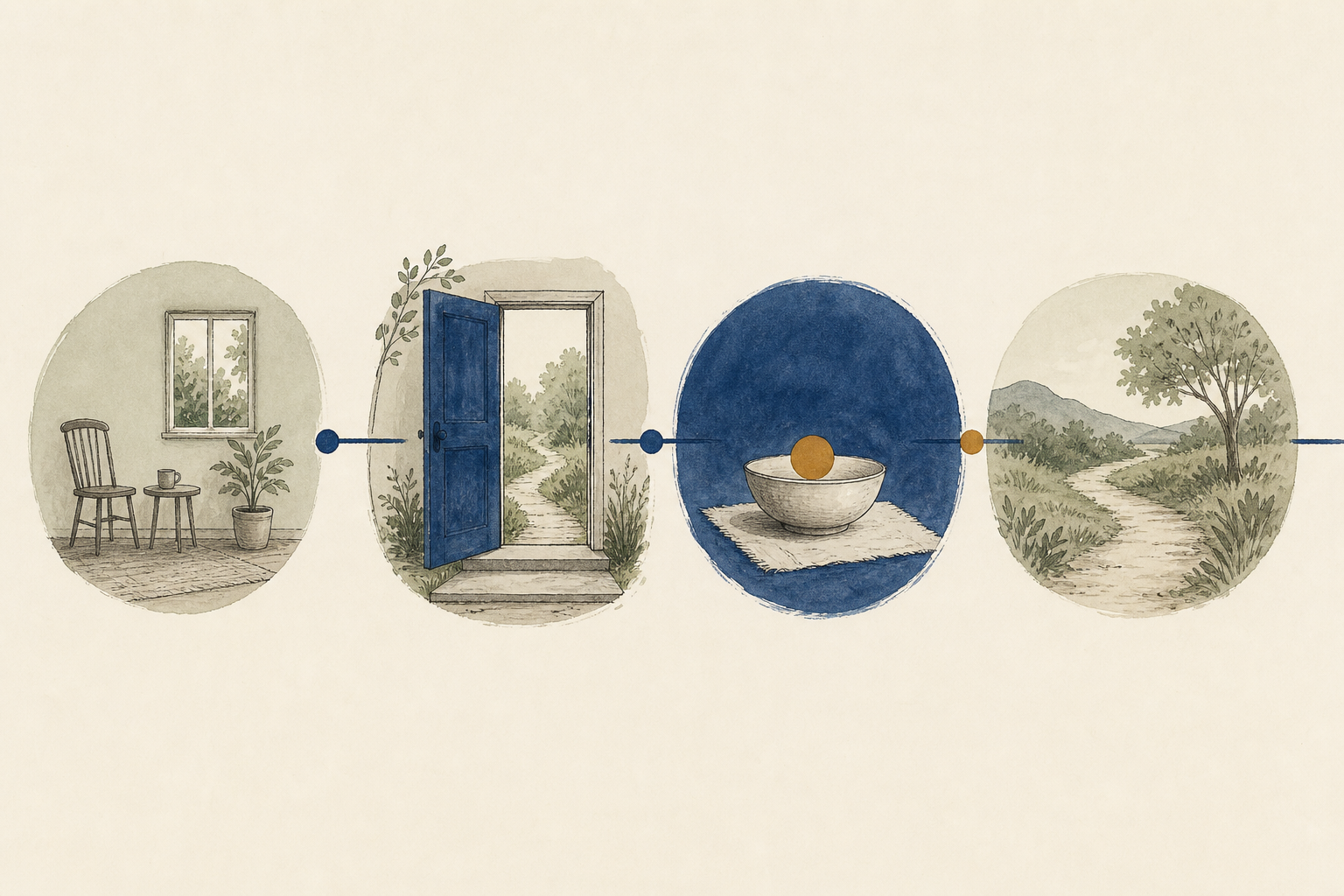
What a ritual does
Pull that single night apart, and one ceremony was doing several things at once. Lighting the candle narrowed a crowded field of attention: for the minutes it burned, one activity mattered, and the devices stopped competing for the room. Writing the sentence gave an embodied transition — the body had been told, by a hand and a pen, that something had crossed from before to after. The act was also a memory structure, pinning an otherwise shapeless ending to a phrase I could later return to. It carried community meaning even alone, because the form — a named ending, a witness, a step into new air — is one that groups have used to coordinate grief and gratitude for as long as groups have existed. And it was a symbolic permission structure, an external act that let me release a capacity I had been clenching for a year.
Several of these functions can coexist in one ritual. They should still be kept distinct. A repeated act can cue attention, mark a transition, support memory, coordinate a group, and give symbolic form to intention — and none of those observable functions proves that a supernatural portal opened. The distinction lets ceremony stay meaningful without demanding certainty, and it lets us ask, function by function, where the ritual is doing real work and where it is asking us to believe more than the evidence gives.
There is one further thing such a practice may claim to do. Some traditions and personal frameworks describe dates, places, rituals, or states as energetic portals with unusual access to guidance, transformation, or nonphysical realities. That is a metaphysical hypothesis. A person may experience profound meaning during such a practice, and the experience can be honored without claiming a guaranteed cosmic mechanism behind it. This book rejects fixed promises such as “integration completes in three days” or “this portal permanently activates a higher state.” Duration and permanence require evidence, and meaning is not the same as mechanism.
Attention and the bridge it builds
Most of the work a ritual does is the smallest part. Turning off devices before writing, placing an object beside a journal, taking three deliberate breaths, or beginning a meeting with one clear question can signal which activity now matters. The mechanism depends on association and repetition. The object carries no automatic power; its meaning comes from use, from context, and from the person’s participation. An attention-setting ritual succeeds when it makes the chosen action easier to begin or sustain, and that result can be observed.
The body often lags behind a conceptual decision. You can know that the work ended and still brace for requests. You can understand that a relationship ended and still reach for the old pattern. You can decide to speak and lose access to the words the moment the room changes. A transition practice gives the body a sequence — before, crossing, after — and lets movement, breath, clothing, sound, location, touch, or washing mark the change. The ritual becomes a bridge, and repetition may reduce the support it needs to provide. The practice stays flexible, because a fixed duration cannot guarantee integration; people differ in history, physiology, environment, and the support available to them.
Whose memory, whose meaning
Ceremonies also help communities remember. Birthdays, funerals, graduations, memorials, vows, seasonal observances, and public acknowledgements place an event inside shared time, providing language and sequence when emotion exceeds improvisation. But memory structures can include and exclude. The person who controls the ceremony may define which story becomes official. A truthful practice leaves room for complexity, dissent, and grief, and the structural question is plain: whose memory is preserved, and who is allowed to revise the account?
A group ritual coordinates attention and belonging at the same time. Shared singing, silence, meals, testimony, procession, prayer, or collective work can create a felt sense of participation, and that experience is real as phenomenology. Its interpretation varies. Communal intensity should never be used as proof that every participant agrees, that the leader possesses special authority, or that the group’s doctrine is objectively true. Consent stays active. Participants need clarity about what will happen, what is expected of them, and how to leave.
A ceremony is, in this sense, a temporary institution. Someone convenes it, someone interprets it, and someone controls the space, the sequence, the objects, the money, the privacy, and the official story of what happened. The emotional power of the event increases the responsibility attached to these roles, because a participant may become suggestible, eager to belong, or reluctant to interrupt a charged moment. Leaders should design for dissent before intensity begins — a plain-language briefing, real alternatives, agreed signals for stopping, an accessible exit, and follow-up contact appropriate to the practice. Whose design is it, who leads and who only witnesses, who can change the sequence mid-stream, what training or authority is being claimed, who holds the confidential information, what support exists after intense emotion, who owns the recordings and the testimony, and how complaints are handled: these are not bureaucratic details. They are the difference between a ceremony and a capture.
Grief ceremony
Funerals and memorials show why the question matters. Death creates practical tasks and an experience language can barely organize. Ceremony gives people a time, a place, a sequence, a witness, and a shared action. No single form fits every grief. Religious rites may carry covenant and hope. Secular memorials may center biography and community. Private rituals may protect a person excluded from official mourning. Cultural traditions may define responsibilities extending long after burial.
A grief ceremony can also fail. It fails when it forces reconciliation, erases conflict, turns the dead into a simplified symbol, excludes a relationship, or treats visible emotion as the measure of love. A more truthful design holds several voices at once and permits silence. It distinguishes celebration from factual history, and it preserves the questions that did not resolve. The ritual does not complete grief. It gives grief a shared coordinate.
Closing the studio
After ten years, Jo closed a studio that had shaped her work, her friendships, and a large part of who she understood herself to be. The lease ended on a Friday. The practical exit was concrete enough — keys, invoices, equipment, client records, the last staff payments — and the emotional exit had no obvious container. So she designed a small ceremony with the team, and she let the room do what the calendar could not.
Phones were set aside for half an hour. Then Jo asked each person to carry one object out of the room, choosing something the studio had made possible or something the work had cost them. She went first. She lifted a chipped ceramic cup that had held ten years of morning coffee and a thousand small decisions, and she carried it through the doorway and set it on the shelf in the corridor, where it would wait to be taken home. The act took four seconds. The room went quiet in a way the spreadsheet of final tasks had not.
One by one the others followed. A paint-stained apron. A hard drive of archived work. A folded chair. Each crossing named what was ending without pretending the ending was only symbolic: the lease really was over, the keys really would be returned, the Friday really was the last one. As each object left the room, the team spoke one thing the studio had made possible and one thing it had cost, and credit was given to the labor that was visible and the labor that had never been named. One person offered a blessing at the end; participation was optional, and several people stayed quiet without shame.
The ceremony did not claim that the studio’s energy had permanently shifted. It marked a real ending and supported several next actions. Records were archived, payments were completed, contact boundaries were clarified, and the group said aloud what could continue under new forms. The practical exit and the symbolic exit strengthened one another. That is what a permission structure does: it lets a group act on a value it already holds, and it leaves the ordinary tasks standing on firmer ground.
Permission and the honesty it requires
A permission slip is an external object, practice, teacher, ritual, or story that helps someone access a capacity they already possess or can develop. A playlist may permit movement. A retreat may permit rest. A uniform may permit a role transition. A trusted teacher may permit experimentation. A ceremony may permit grief.
The phrase can curdle into dismissal if it implies that external support is unnecessary. Environments, relationships, medication, accessibility tools, money, community, and professional care can materially change what is possible. They are not merely ideas; they are conditions. A permission structure becomes mature when it supports increasing authorship and remains honest about dependency — when it can name what capacity it supports, which condition makes access easier, which part of its work is symbolic and which part is materially necessary, whether it can grow smaller over time, what happens when it is unavailable, and whether it increases or reduces dependence on an authority. Asked plainly, those questions keep the doorway open without turning the person standing in it into someone’s client.
The line a ritual must not cross
Some ceremonies intentionally alter ordinary consciousness through prolonged meditation, sleep disruption, sensory intensity, breathwork, fasting, dance, heat, cold, or psychoactive substances. Effects and risks vary by method, person, health, medication, dose, setting, and law. This book provides no protocol for inducing such states. A responsible setting would require expertise beyond symbolic enthusiasm — screening, informed consent, legal compliance, emergency planning, medication and health awareness, protection from sexual and financial exploitation, trained support, privacy, integration, and the right to decline without status loss.
An unusual experience during an altered state remains phenomenological evidence. It does not automatically reveal historical facts, another person’s mind, medical truth, or cosmic instruction. Risk depends on the specific practice and the participant’s health context. The U.S. National Center for Complementary and Integrative Health notes that meditation safety evidence remains limited, that negative experiences have been reported, and that complementary practices should be discussed with health-care providers when health conditions are involved.1
Suggestion and recovered meaning
Ceremony creates an environment where words can feel unusually authoritative. A facilitator may name a sensation as ancestral memory, entity contact, past-life trauma, blocked energy, or proof of healing. Suggestive interpretations can shape later memory and confidence.2 They should be offered, if at all, as optional hypotheses rather than discoveries.
A participant can protect Reality Clarity through three columns: what I directly experienced; what someone else interpreted; and what I currently believe, and with what confidence. The columns matter most when an interpretation concerns alleged abuse, another person’s guilt, a medical diagnosis, a supernatural threat, or an irreversible life decision. A powerful setting does not make a suggestion factual. (Reality Clarity is owned by Chapter 9; the source questions for any practice drawn from another community are developed in Chapter 12.)
Ritual ownership and adaptation
Ceremonies often draw from specific peoples, religions, initiatory lineages, or communities. Removing a form from its context can erase meaning and repeat histories of extraction. Before adapting, use the source questions from Chapter 12: determine whether the practice is public or restricted, who has authority to teach it, how credit and compensation work, and which changes misrepresent the source. A generic transition ritual can be designed without copying sacred names, clothing, songs, medicines, symbols, or offices. Originality is preferable to a false claim of lineage. Personal meaning does not provide ownership over another community’s sacred form.
Designing ceremony as a system
A bounded ceremony has four phases, and they exist so that intensity always has a route back.
State the purpose, sequence, duration, roles, cost, risks, accessibility, privacy, and exit before anything begins. Gather consent. Clarify whether the form is religious, spiritual, therapeutic, artistic, communal, or personal. Then orient participants to the place and to their choice, beginning with the least intense action needed for the purpose and preserving alternatives throughout. The central act follows — speaking, silence, movement, exchange, remembrance, witness, or commitment — with leaders kept inside their stated scope, and withdrawal never reinterpreted as failure. Finally, end clearly. Restore ordinary orientation. Provide food, water, transport, records, contact, or follow-up appropriate to the form, and state what the ceremony did and did not decide. The return is part of the ritual. An experience that opens intensity without a route back transfers the cost to participants and their relationships.
A bounded transition practice
Not every ending earns a designed ceremony. Most transitions ask for something smaller and more ordinary: a single act that tells the body a chosen ending or beginning has occurred. The sheet above plans a shared event; the practice below is for the private threshold — the workday that will not release you, the conversation whose weight your shoulders are still carrying.
Ceremony without capture
Ritual becomes a capture system when access to safety, belonging, truth, or worth depends on perfect performance or obedience to an uncorrectable authority. The warning signs are recognizable: escalating cost; secrecy used to prevent informed consent; punishment for questions; claims that failure proves impurity; pressure to abandon ordinary support; special access controlled by one person; and the reinterpretation of harm as necessary initiation. A healthy ceremony has scope. Participants know what is happening. Consent can be withdrawn. Leaders can be challenged. Symbolism stays distinguishable from material fact.
The ceremony that changes nothing
A ceremony can be beautiful and ineffective for its stated purpose. A company holds a listening ritual while keeping the policy that punishes dissent. A couple renews vows while avoiding the behavior that broke trust. A community performs reconciliation without restitution. A person burns a letter and continues the same contact pattern. The symbolic act may still carry emotion. The actuator remains missing.
So ask what condition should be different after the ceremony. If the purpose is commitment, which agreement changes? If the purpose is repair, what restitution or behavior follows? If the purpose is grief, what support continues? If the purpose is transition, which access, role, or schedule ends? A ritual can mark a change, support a change, or substitute for a change. Reality distinguishes them. What actually opens is a changed condition. A conversation gains a correction path. A room becomes safer for disagreement. A person defines the first reversible step. A community marks grief without forcing closure. A ritual helps someone act on a value. The symbolic language may deepen the experience. The mechanism remains available in ordinary terms.
The doorway, marked
A ceremony earns its place when it returns the participant to life with more clarity, agency, and capacity for relationship. That is the only test the candle and the hand-wash had to pass. I no longer remember the exact sentence I wrote that night, but I remember the cold air on wet hands, and I remember that the next morning the year did not follow me into the room.
The doorway had not opened anything supernatural. It had done the smaller, harder thing: it had let me step through a transition my body could finally feel, and it had returned me to ordinary life without taking anything from me that I was not ready to release. A ritual does that, and stops there. The next chapter releases the architecture itself.