The Open Map
The sentence I struck
I sat at my desk and deleted a sentence from the manuscript.
It was a sentence I had once believed, and for years it had held the whole structure together: inner state renders outer reality. Frequency explained why a person fit or did not fit. The body knew. Fear selected a timeline. I had built an architecture in which no fragment had to remain unrelated, and the relief of that totality was real. The sentence was its keystone.
I removed it because a body had disagreed with me. So had another person, a measurable outcome, and a source whose account did not match mine. Each time I had explained the disagreement away as resistance, distortion, or low frequency. Then I could not. The map had to bend, or the world had to be wrong, and I was no longer willing to make the world wrong to keep the sentence.
That morning I understood what the book had actually been asking. Not how does the hidden pattern explain my life? The question underneath had always been colder and kinder: How much of this life did I author, and how much did I learn to perform before I could choose? I had carried that question since the first room. I had spent the book refusing to answer it with a final number, because the honest answer is not a percentage. It is a practice — revising the architecture whenever a person, body, source, or fact does not fit.
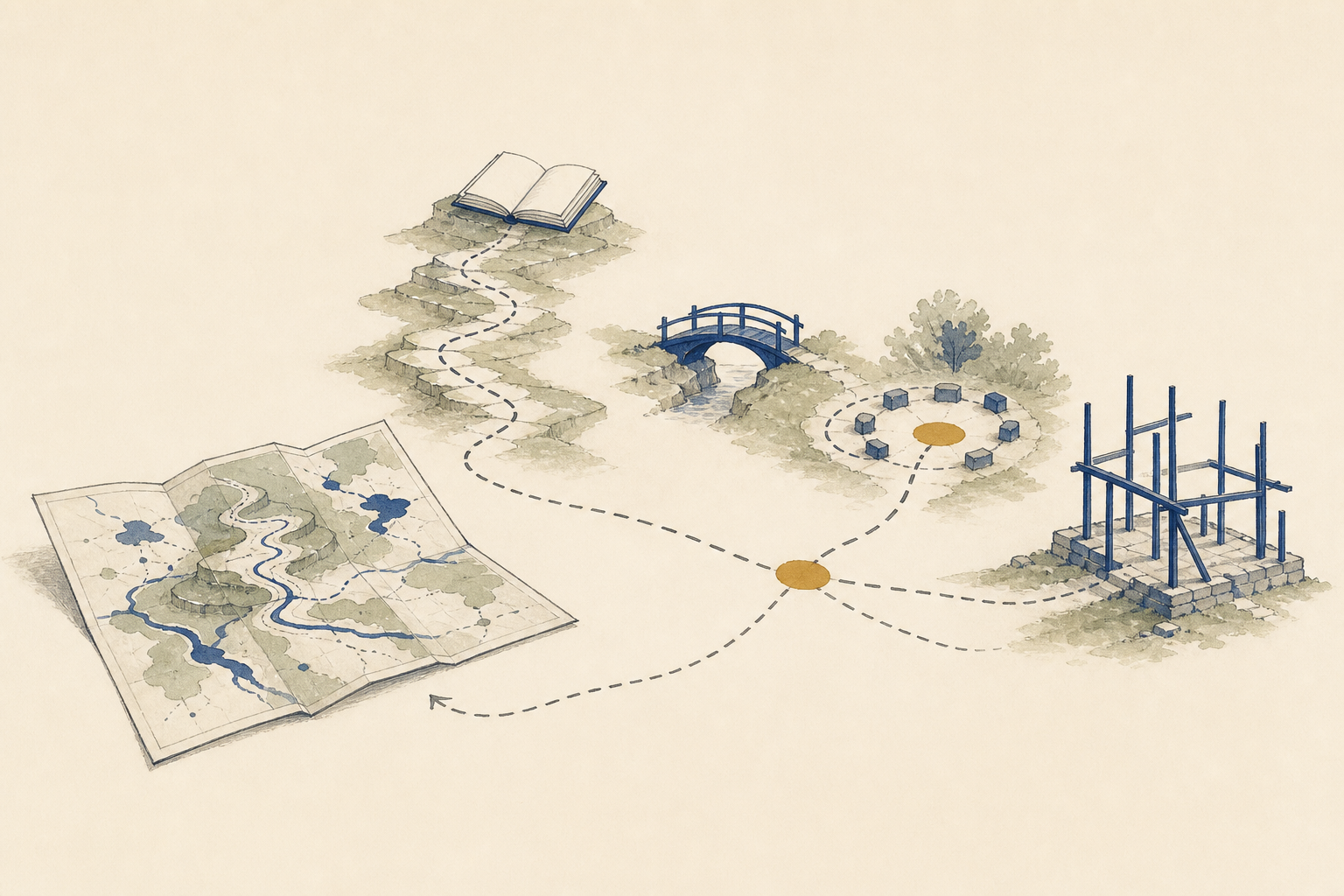
What survived the revision
When the keystone came out, not everything fell. Some principles had held at every scale I had tested — family, relationship, workplace, institution, ritual, cosmology — and they survived precisely because they did not claim to finish the world.
Experience and instruction shape expectation; protection organizes itself around the safety a situation seemed to promise. Preference keeps needing discernment, because a freely chosen trait and a disguised wound can wear the same face. Insight only becomes usable once it reaches the body and an action. Relationship preserves the reality of two separate people, and feedback can either reinforce an old pattern or correct it. Repetition is the lever that turns a private habit into a norm, an incentive, an institution, and finally a culture. A claim earns trust through classification and correction rather than conviction. Symbolic language opens inquiry when it does not pretend to be measurement, and metaphysical language keeps its poetry only where it shows its limits. Authorship, through all of it, is the capacity to revise.
These are coordinates, not conclusions. They help a reader locate a relationship. They are never the relationship itself.
The right the world retains
I still do not know the minimum irreducible primitives beneath every human system. I do not know which metaphysical models describe reality outside human interpretation, whether consciousness persists after death, whether synchronicity reflects a larger order, or whether spiritual symbols reveal something beyond the mind. I expect parts of this architecture to change.
New evidence may narrow a claim. A reader may expose a missing variable. A community may show that a practice assumes resources or safety many people do not possess. A framework may prove less transferable than it first appeared. Those corrections belong to the work.
What the authorship actually was
The editorial journey required me to give up relief, not mystery.
Other people regained independent reality. Chance returned. Material power returned. Illness stopped carrying moral meaning. Addiction required medical and social complexity rather than a single spiritual verdict. Bodies became sources of evidence rather than truth machines. Metaphors kept their poetry and lost unearned scientific authority. Scripture became a layered encounter rather than a secret code. Expanded awareness became a proposal rather than a law.
Source, soul, synchronicity, ritual, and portal stayed alive in the second half of this book. They now share the page with provenance, competing explanations, consent, stop conditions, and the word unknown. The map became less complete and more trustworthy.
That change is the deepest example of self-authored coherence in these pages. Authorship was not defending the architecture I first recognized. It was accepting responsibility for revising the architecture when another person, body, source, or fact did not fit.
Two paths in one body
The two halves of this book now perform different functions, and both travel a path a reader can walk.
The first half gives a grounded causal path. A family instruction becomes a private identity; the identity shapes relationship; repeated relationship becomes a role; the role can harden into incentive and institution. Correction can begin at any level where enough leverage exists.
The second half gives an interpretive path. A reader can enter a worldview, preserve what belongs to its source, translate a usable mechanism, retain a sacred remainder, and leave without capture.
The threshold between them is part of the architecture. Grounded discernment precedes cosmic imagination. Imagination returns to grounded life.
What is mine in the lineage
The ingredients in this book belong to long conversations across psychology, philosophy, systems thinking, religion, mysticism, pattern language, and self-development. VVViva does not claim to have invented conditioning, embodiment, projection, attachment, ritual, or feedback.
My contribution is the configuration: the sequence, the distinctions, the mechanisms, the safety boundaries, the authored vocabulary, and the movement from private fragment to transferable architecture. The work developed through experience, writing, dialogue, testing, correction, and AI-assisted organization. It remains mine through judgment and responsibility. It remains open through provenance and correction.
The map on a territory it never named
Imagine a neighborhood considering an AI system that predicts which families need public support.
The grounded path asks about the visible system. What data enters? Which past decisions shaped the labels? What protection is the agency seeking? Who can consent, who is misclassified, which incentive rewards prediction over care, and who can appeal? A model score is an output, not a fact about a family; research may support some predictive relationship under defined conditions, while the ethical question is whether prediction should govern access at all.
An actuator appears: the community might require a transparent eligibility path independent of the score, human review, data minimization, an appeal, and an audit of outcomes.
The interpretive path asks about meaning. What image of human need is encoded in prediction? Does the system function as an oracle? Which stories of deservingness shape the categories, and what metaphysical claims about destiny or human nature are being imported unconsciously?
A territory absent from most chapter examples still yields better questions and a correction path. The coordinates did not solve the case. They made the case answerable.
Disagreement that can name its level
Disagreement is easiest to use when it can name its level. A factual issue says the evidence does not support the sentence. An interpretive one says the same source or event suggests another meaning. An ethical one says the proposed value or tradeoff is unacceptable. An experiential one says the description does not resemble your life. A metaphysical one says you hold another view of ultimate reality. An aesthetic one says the metaphor or voice does not serve you. Each deserves a different response: a factual issue requires evidence, an ethical issue requires reasons and affected perspectives, an experience cannot be corrected by the author from outside, and a metaphysical disagreement may remain open.
An open map needs a durable way to receive correction after publication. A ledger that records the exact passage, its claim class, the concern and evidence, who may be affected, the author’s response, the change made or the reason for retaining it, and the edition in which the decision appears makes public claims and revision decisions inspectable. Corrections differ in urgency: a dangerous medical implication requires immediate action, a factual citation error requires a visible correction, a disputed interpretation may require a note or deeper study, and a reader’s personal dislike may reveal a style issue without proving the concept wrong. The ledger should not become a vote on the author’s experience. Future editions may change terms, diagrams, chapter order, or the metaphysical architecture; the current volume remains a dated record of the map at this stage.
Creation after correction
Seeing hidden structure can produce paralysis. Every design omits something. Every institution creates power. Every metaphor excludes. Every action can carry unintended effects.
An open map does not demand innocence before creation. It requires bounded claims, legitimate authority, consent, safeguards, feedback, and repair. Build the smallest form that can teach you something real: a teacher changes one assignment and listens to students; a couple writes one agreement and reviews it; a founder tests one transparent price; a community rotates one role; an artist makes one image that preserves ambiguity; a practitioner translates one ritual and checks whether daily capacity improves. Widen only when the evidence and responsibility can widen.
Creation gives uncertainty a form through which relationship can begin.
What a reader carries outward
You can use the map on a territory the book never described. Begin with a fragment — what happened — and separate fact, experience, inference, model, symbolism, hypothesis, value, and unknown. Find the condition that maintains it, choose the level where change is possible, act, observe, and revise the map. Then widen the view: ask how the mechanism appears in a relationship, a workplace, a technology, a law, a ritual, or a story, and preserve the differences across scale.
Before presenting a new framework to others, pass it through ten gates.
- Purpose: What problem does the map help someone see?
- Provenance: Which ideas and sources shaped it?
- Claim status: What is observed, inferred, symbolic, ethical, or metaphysical?
- Mechanism: Can the central relationship be stated in ordinary language?
- Countercase: Where does the map fail?
- Power: Who gains authority if people accept it?
- Safety: Which misuse could cause harm?
- Practice: Does each intervention have scope, limits, and stop conditions?
- Transfer: Can another person use it without adopting your identity?
- Correction: How will disagreement and new evidence change it?
These gates make responsibility visible before fluency and conviction create reach.
The right to leave
A framework serves the reader only while it increases visibility and agency. You may keep one distinction and release the vocabulary around it. You may use the first half of this book and leave the second. You may value a symbolic reading and reject its metaphysics. You may find that another tradition, discipline, or lived experience maps the terrain better.
Leaving is part of authorship.
The book asks for no loyalty. It asks for careful seeing.
The sentence I kept
I went back to the manuscript and read the place where the keystone had been. The structure held. Other people still had their own reality, chance still moved, illness still carried no moral verdict, and a body that disagreed with me was still allowed to be right. The mystery I had to stop abusing was still in the book — source, soul, synchronicity, ritual, portal — only now it stood beside provenance, consent, and unknown.
The Child remains. Her silence is part of the archive. The Performer remains. Her radiance is part of my capacity. The Void remains as the memory of a season when old roles could not continue. What changed is their authority. Silence can become observation and chosen privacy. Performance can become art and communication. The void can become a marked threshold rather than proof that no self exists. None of these translations erases the cost of how they formed.
Self-authorship did not take me outside history. It gave me a way to speak with history while living in the present. The relationship is still unfinished: a new room can activate an old rule, a beautiful theory can still tempt me toward certainty, work can become identity again. The map does not prevent recurrence. It helps me recognize it sooner, and choose with more company, evidence, and care.
So I answered the question. How much of this life did I author? Enough to delete the sentence that kept the world small, and to keep the sentence that lets the world disagree.
Close the book when you are ready. Carry the coordinate you earned. Let reality revise it as you walk.