Decoder and Actuator
The archive and the missing move
I once looked at an archive filled with elaborate cosmology and felt pressure to absorb every term. The material seemed important because it was dense. Preserving it felt like a test of whether I could perceive the hidden pattern. I copied vocabulary, traced lineages, and tried to hold the whole structure in my head before I had asked a single practical question about it.
Then the real question became visible, and it was not the one I had been studying. Which mechanism survives translation? What keeps this situation functioning? And the question that has mattered most to me since: where can a practical change enter?
That shift clarified three roles. A Decoder identifies the mechanism. An Actuator changes a condition that maintains it. Integration tests whether the change remains available across time, pressure, and context. The sequence converts interpretation into accountable action — and it is the move the archive, for all its density, never made on its own.
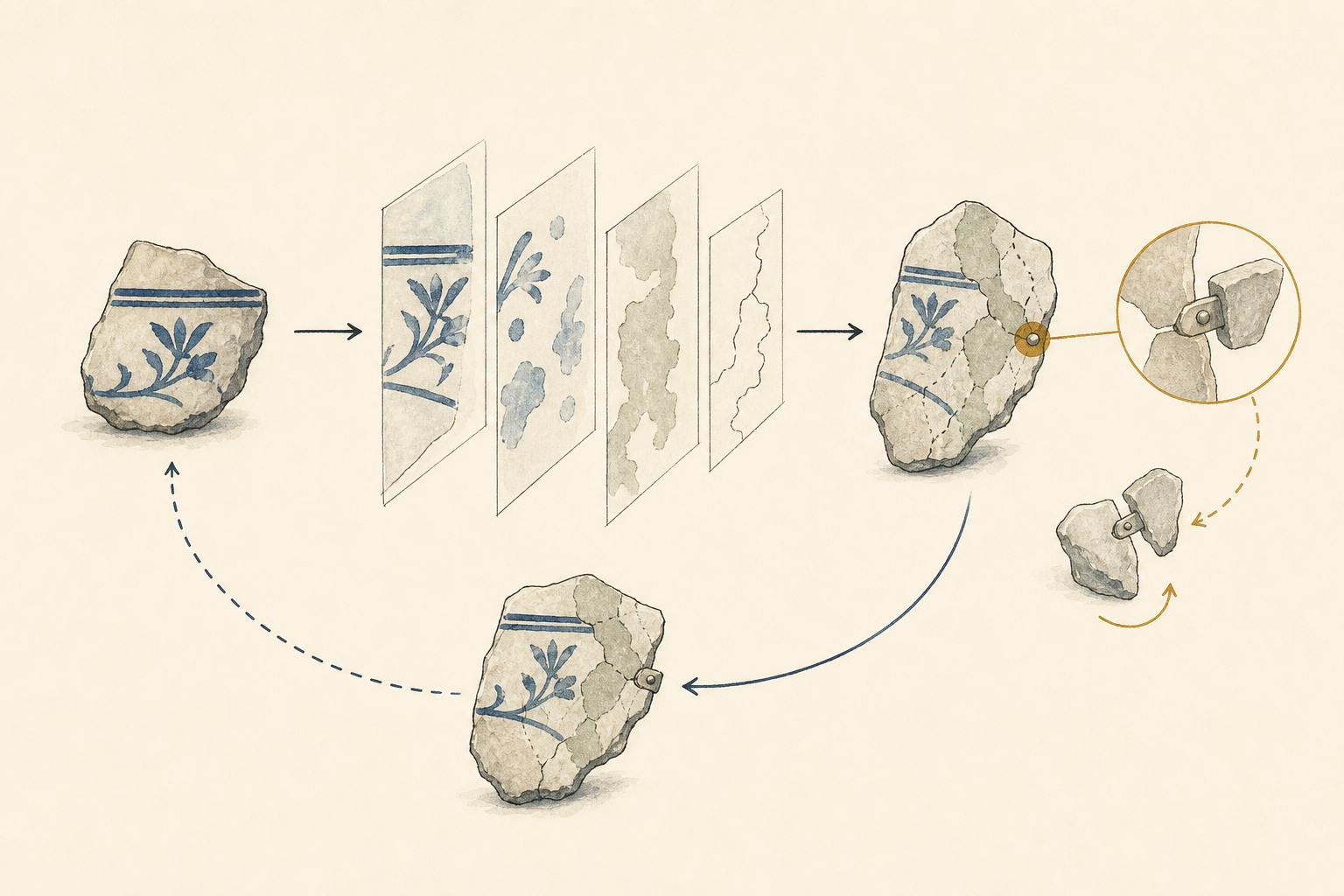
From explanation to operation
An explanation can feel complete while the situation remains unchanged.
You may understand why you avoid visibility. You can connect it to family history, to shame, to perfectionism, or to a spiritual story about being seen, and the understanding may be entirely accurate. The maintaining condition may still be active. Perhaps every public task has an undefined scope. Perhaps feedback arrives only through an unsafe person. Perhaps your body has learned to expect exposure to become endless, or the project simply has no reversible first step. The actuator question cuts across all of these the same way: what condition can change now?
This is the difference between knowing the story and operating the system.
The True Blue sequence
The evidence-corrected operating sequence runs in one breath: See, Separate, Structure, Select, Actuate, Verify, Revise. You begin with what actually happened. You separate fact from experience, inference, model, symbolism, hypothesis, value, and unknown. You identify the relationships that hold the pattern in place, choose the level where intervention is possible, change one condition, compare prediction with outcome, and let the result update the map. A True Blue operator keeps every one of those stages answerable to reality. Confidence, however earned it feels, can never replace outcome.
See: preserve the fragment
A fragment is a small piece of experience that carries unresolved information — a sentence, a sensation, a repeated error, an image, an argument, a failed launch, a dream, or a moment of resistance. The first discipline is preservation. Write the exact words. Record the sequence. Note what changed before and after. Resist the pull to upgrade the fragment into a theory before it has earned one.
Suppose a collaborator says, “I thought you had already decided.” The fragment contains those words and the context around them. It does not yet prove avoidance, control, confusion, poor communication, or a power struggle — any of those would be an interpretation laid on top. Preserving the fragment protects the inquiry from the explanation you already prefer.
Separate: layered reality
Apply the Reality Clarity classes from Chapter 9 to separate each layer of the fragment — the observable words and actions, your autobiographical feeling and memory, your inference about what the person meant, the psychological model you suspect, the symbolic image that helps you think, any metaphysical hypothesis about souls or mirrors or fields, and the information you do not possess. Holding those classes apart is what prevents Fielded Perception from collapsing into mind-reading.
Fielded Perception
Fielded Perception is my term for reading a situation across several layers while preserving uncertainty. You track the content of what was said or done; the delivery — timing, pace, volume, and visible affect; the behaviour, by which I mean repeated actions and their consequences; the context of history, role, environment, incentives, and power; the provisional pattern connecting events; your own desire, fear, projection, and stake; what can be asked directly; and the best current interpretation you can hold with an honest confidence level attached.
No layer grants access to another person’s private mind. Delivery can suggest an inquiry; behaviour and direct communication carry the weight when a decision must be made. Confidence scales with evidence: a low reading rests on one clue among several alternatives, a medium reading on a repeated pattern with partial confirmation, and a high reading on repeated observable behaviour plus direct confirmation or strong independent evidence. Even a high reading remains revisable. That is the point of holding a confidence level at all.
Structure: build the mechanism
A mechanism connects trigger, response, protective function, maintaining condition, consequence, and feedback. Consider what I call the Locked Gate. A visible opportunity appears — the trigger. The response is delay, over-planning, or withdrawal, and its protective function is to reduce exposure to judgment. The maintaining condition is structural: the opportunity has no defined boundary, and visibility is imagined as permanent. The consequence is that the person misses the opportunity, and the feedback confirms the identity “I never follow through.”
Once the mechanism is visible, it suggests its own actuator moves. Define a reversible scope. Choose a safe reviewer. Limit the duration. Separate draft from publication. Record the actual consequence. “Become confident” is too vague to operate; “define a ninety-minute draft and send it to one trusted reader” is a condition you can change and then test.
Competing explanations
One explanation creates capture. Three create room.
For any pattern that matters, generate at least three models drawn from different levels. Suppose a team member stops contributing. An individual model says they are exhausted or disengaged. A relational model says disagreement has become unsafe. A structural model says the decisions are already made before the meeting. An incentive model says contribution creates work without authority. An ordinary model says they simply have another priority right now. The goal is not maximal complexity — it is preventing the first emotionally satisfying story from hardening into the only map. Once the models are on the table, choose the next piece of evidence that would best distinguish among them, and go gather it.
Select the intervention level
Intervention can occur at several levels, and which one you choose changes everything. You can work internally, on attention, belief, emotion, skill, bodily state, or choice; relationally, on communication, boundary, agreement, repair, or access; environmentally, on space, schedule, friction, cues, or available resources; institutionally, on role, policy, incentive, authority, budget, or correction path; symbolically, on ritual, narrative, image, meaning, or identity; or metaphysically, on prayer, cosmological interpretation, or a spiritual practice offered as hypothesis rather than certainty.
The discipline is to start with the lowest level that carries enough power to matter. Using an internal practice to solve an institutional threat leaves the threat intact. Using metaphysics to bypass a direct conversation turns spirituality into avoidance. Match the level to the condition the mechanism actually runs on.
Actuator: change one condition
An actuator move is specific enough to test. Change the meeting agenda so risks appear before commitments. Put the phone outside the bedroom. Ask one direct question. Define a two-hour draft. Stop completing a relational circuit alone. Move approval authority, add an appeal process, replace an unlimited practice with a bounded ritual, or seek qualified help. Whatever the move is, it should carry a predicted effect with it: if undefined scope maintains the avoidance, then defining a ninety-minute draft should make starting easier. The prediction is what creates a verification point. Without it, you have an action but no way to learn from it.
Pressure Lock
A Pressure Lock is my name for a state that stays fixed because pressure is part of what maintains it. A person wants joy and monitors every sensation for proof of it. Monitoring becomes pressure. Pressure narrows spontaneity. The absence of spontaneity then confirms the belief that joy is inaccessible — and the loop tightens around the very thing it was searching for.
The actuator does not try to produce joy directly. It removes pressure from the loop. The person chooses an activity with modest intrinsic interest and suspends measurement while doing it, recording afterward only what occurred. The intervention cannot guarantee recovery. It changes the condition that made access harder, and lets the system respond to the change.
Cross-Temporal Actuator
Cross-Temporal Actuator is a metaphor for changing a present condition that keeps a past-anchored pattern active. The past event remains exactly as it was. What changes is the access path in the present. A person who learned that disagreement ends connection may still avoid conflict years later. A current relationship can build a different sequence — disagreement, pause, return, repair — and repetition of that sequence supplies new evidence about what disagreement can mean now.
Recovered Code and Bridge to Plumage
Recovered Code frames change as renewed access to a capacity that protection once made difficult to use. The metaphor can reduce shame, because it suggests a person is working with blocked access rather than proving they lack the capacity altogether. The limit is honest: some capacities require learning, resources, treatment, support, or practice, and recovery language cannot manufacture a skill that was never developed.
Bridge to Plumage describes the transition from external scaffold to embodied capacity. A checklist may begin as a bridge — an artificial support held in place until the sequence becomes familiar. Repeated use can make the sequence familiar enough that the person no longer needs the full scaffold. A good bridge, eventually, reduces dependence on itself.
The five-stage cycle
The full actuator cycle moves through five stages. You diagnose the maintaining mechanism and the competing explanations, design an intervention at the correct level, deliver the smallest meaningful change, stabilize it across relevant contexts, and verify the outcome against the prediction before revising. Stabilization is the stage most often skipped, and skipping it is what lets a dramatic first success get mistaken for durable change. A person may speak clearly once in a safe room and lose access entirely under pressure. That is not failure; it is information. The next design can address context, pacing, support, or authority. Claims of permanent or irreversible change require evidence across time and conditions, and this book makes no such guarantee.
A business case
Suppose customers begin a checkout and leave before payment. The weak interpretation is that the audience lacks commitment. The Decoder refuses to stop there and generates competing explanations — price, trust, technical error, payment method, unclear delivery, hidden fees, distraction, poor audience fit — then looks for mechanism data. The data might show that most exits occur at the moment the shipping cost appears. The actuator move is to show the total cost earlier. The prediction: if surprise cost maintains abandonment, earlier disclosure should reduce exits among similar visitors. Verification compares behaviour before and after the change. The method has replaced a judgment about people with a testable intervention in the system.
A relationship case
Suppose a partner agrees to a boundary and crosses it again. The Decoder records the words, the behaviour, the context, and the consequence, while the self-audit notes the hope, fear, and investment already in play. Competing explanations include misunderstanding, limited skill, incompatible needs, low commitment, or disregard. The Actuator clarifies the boundary and changes access; verification then observes behaviour over time. The method cannot guarantee respect from another person. It can prevent explanation from replacing evidence — and that alone changes what the operator is able to do next.
An institutional case
Suppose employees report inclusion during surveys while promotion remains concentrated within one network. The system map examines criteria, sponsorship, visibility, informal access, decision authority, appeal, and outcome data. An actuator might publish the criteria, rotate high-visibility assignments, separate advocacy from final approval, and audit outcomes. A workshop may support the change. It cannot replace changed allocation and accountability — and the moment the workshop is treated as the intervention, the structure is safe again.
The locked manuscript
A writer has accumulated years of notes and cannot complete a manuscript. The archive includes strong material, repeated frameworks, personal testimony, and contradictory plans. The first explanation is perfectionism. A second is grief attached to finishing. A third is that the manuscript has no stable architecture. A fourth is that publication risk is genuinely high, because private stories involve other people. A fifth is simple overload. Each is plausible; none, alone, is the lock.
The Decoder preserves fragments and separates claims. It finds that the same concept owns several names, that chapters repeat the same function, and that metaphysical claims appear before the reader has any way to evaluate them. The maintaining conditions turn out to be structural rather than temperamental: there is no semantic owner for each concept, no boundary between the source archive and the reader-facing manuscript, no evidence system, no privacy review, and no word allocation by chapter.
The Actuator does not command confidence. It creates an approved table of contents, assigns one owner per concept, moves source material outside the manuscript, marks claim classes, and defines a review sequence. The prediction is precise: if architectural ambiguity is the primary lock, drafting speed and editorial decisions should improve once the structure is fixed. Verification compares a month of work. Chapters now reach completion, but one autobiographical section remains blocked. The model updates honestly: architecture was one maintaining condition; privacy and relational ethics require a separate review. Integration means the writer can use the structure when new material arrives rather than recreating the book each week.
This volume itself passed through that actuator pattern.
Intervention ethics
Changing a condition creates responsibility, because an intervention can be effective for the operator and harmful to someone else. Before actuating, the discipline is to ask a sequence of questions rather than reach for a single one. Do I have the authority to change this condition? Whose consent is needed? Who receives the benefit and who bears the risk? Can the change be undone? Can the people affected understand what changed? What will stop the test if harm appears? And what obligation follows an error?
The answers vary by role. A manager can change a meeting agenda and should tell the team why. A product designer can test an interface and must protect user data and consent. A friend cannot secretly manipulate another person to test a relationship theory. A spiritual facilitator cannot induce an altered state without informed permission and safety planning. The smallest meaningful change is not always the smallest ethical risk; both need their own review.
Verification is a design problem
“It worked” can mean several things, and they are not the same thing. The person felt relief. The behaviour changed once. A metric moved. The relationship improved. The operator simply noticed the expected pattern. These outcomes differ, and a claim that conflates them has not been verified.
Define verification before the intervention, not after. For a meeting change, a process measure asks whether risks are submitted before commitment; a behaviour measure asks whether more distinct risks get voiced; an outcome measure asks whether preventable late surprises decline; a safety measure asks whether people who raise risks face retaliation; and a counter-effect measure asks whether meetings have become so slow that urgent decisions now fail. One measure can improve while another worsens — more reports may initially make the system look less safe precisely because hidden issues have become visible. Interpretation needs time and context. A good verification plan names its baseline, its time window, its data source, the affected people who will be heard, and the decision rule that will close the test.
Stabilization without permanence claims
A change that occurs once may depend on unusual support. Stabilization asks under which conditions the new behaviour remains available, and it tests that question gradually — at a different time of day, with familiar and unfamiliar people, under low and then moderate pressure, with and without the original scaffold, after adequate and after poor sleep, in private and in public. The test seeks the change’s operating range, not proof that it can survive every condition imaginable. A boundary spoken clearly in rehearsal may disappear entirely before an authority figure. The next intervention may call for accompaniment, written communication, policy, or a different route — not simply more internal courage.
“Permanent rewiring” is not required. Durable capacity can be described honestly through repeated behaviour across defined contexts and a repair path for when access is lost.
AI as Decoder and the risk of false structure
AI can group fragments, compare versions, propose mechanisms, and produce diagrams faster than any human reader. That fluency makes it especially useful as a Decoder — and especially risky. A model may invent relationships because the prompt asked for a coherent answer. It may repeat cultural bias, collapse distinct sources, fabricate citations, or hand an operator exactly the explanation they were hoping to find.
Use AI output as a candidate structure, never as a verdict. Preserve the links back to raw evidence. Require direct quotations or source locations for any extraction. Verify every citation. Ask explicitly for countermodels. Distinguish generated interpretation from source claim at every step. Test the mechanism independently of the model that proposed it. Keep private and regulated data outside unauthorized systems. And assign final responsibility to a person with actual authority. An elegant diagram generated from incomplete evidence is still incomplete, no matter how confidently it is drawn.
Operator handoff
An intervention becomes generative only when another person can understand it, run it, and correct it without adopting the operator’s identity. A real handoff carries the problem and its scope, the evidence and its uncertainty, the mechanism and its alternatives, the intervention and the authority behind it, the safeguards, the verification method, the current outcome, the open risks, and the condition under which the next review happens. This is what prevents hidden expertise from hardening into dependence. The person who receives the handoff should be able to question the map and to find where the raw evidence lives. True Blue work is complete only when the system can keep learning after the original decoder has left the room.
Failure modes
The Operator identity carries its own risks, and naming them is part of the practice. Pattern intoxication turns every event into evidence of a hidden structure. Terminology inflation lets naming stand in for explanation. Field omniscience promotes sensitivity into a claim about another person’s private reality. Stabilizer suppression uses calm to silence conflict that was necessary. Archive capture makes preservation more important than use — the very trap of the cosmology I first tried to memorize whole. AI capture lets fluent synthesis feel authoritative simply because it is coherent. Identity capture turns “Operator” into a superior self-image. Endless decoding uses interpretation to delay action. Premature lock-in promotes a provisional model into doctrine.
Each of these has the same correction: return to observable facts, hold competing explanations open, honor consent, act proportionately, read the outcome, and revise.
The Operator card
)Setting the archive down
Most people collect explanations. A Field Operator studies what keeps a situation functioning, chooses the level where change is possible, and turns understanding into a practical move — and the True Blue standard adds one condition to all of it: the map stays answerable to reality.
I think back to that dense archive of cosmology and the pressure I felt to absorb it whole. The pressure eased the moment the question changed. I did not have to memorize the pattern to be permitted to perceive it; I had to find the one condition I could change and change it. A private fragment becomes a mechanism. The mechanism transfers across domains. The intervention produces an outcome. The outcome corrects the architecture, and another person can then use the map without reproducing the author’s identity or worldview. The archive was never asking to be carried. It was asking to be set down, and acted on.
The next part widens that work into collective and cosmological territory. The same standard follows us there.