The Architecture of Expanded Awareness
The notebooks
There came a season when the corpus would not leave me alone. I had carried it for years as private language — a sprawl of notebooks, transcripts, modules with grand names, and prompts I had written back to myself in the small hours. The Decoder lineage. The Living Prism. The Harmony Architecture. Archetype codices that promised to tell me which role I secretly was. It was the residue of a life spent mapping consciousness before I had language for what I was doing, and it had grown into a small private library that no one else had organized.
I sat with it spread across a floor one long afternoon, trying to decide whether to keep any of it. The materials did not agree with each other. One document placed the body at the bottom of a ladder; another called the body a prism through which light simply passed. One named nine levels of awareness; another named five; another refused numbers entirely. Read together, they contradicted. Read as one woman’s repeated attempts to name the same interior weather, they began to rhyme.
What I wanted, sitting on that floor, was not to inherit any of it as revelation. I wanted to know what changed when I let myself describe awareness at several scales rather than reducing it to the everyday narrating mind — the part of me that plans the meal, pays the bill, and tells the story of the day. That was the only honest question the corpus still held for me, and it is the question this chapter carries.
I did not throw the notebooks out. I drew them into one map and gave it a name: Vivi’s Architecture of Expanded Awareness. The nine bands are an authored organization. They have no status as scientifically measured levels, and they are not a ranking of human worth, spiritual attainment, intelligence, illness, disability, or moral character. They are one woman’s revisable attempt to make a complex interior and an inherited corpus legible.
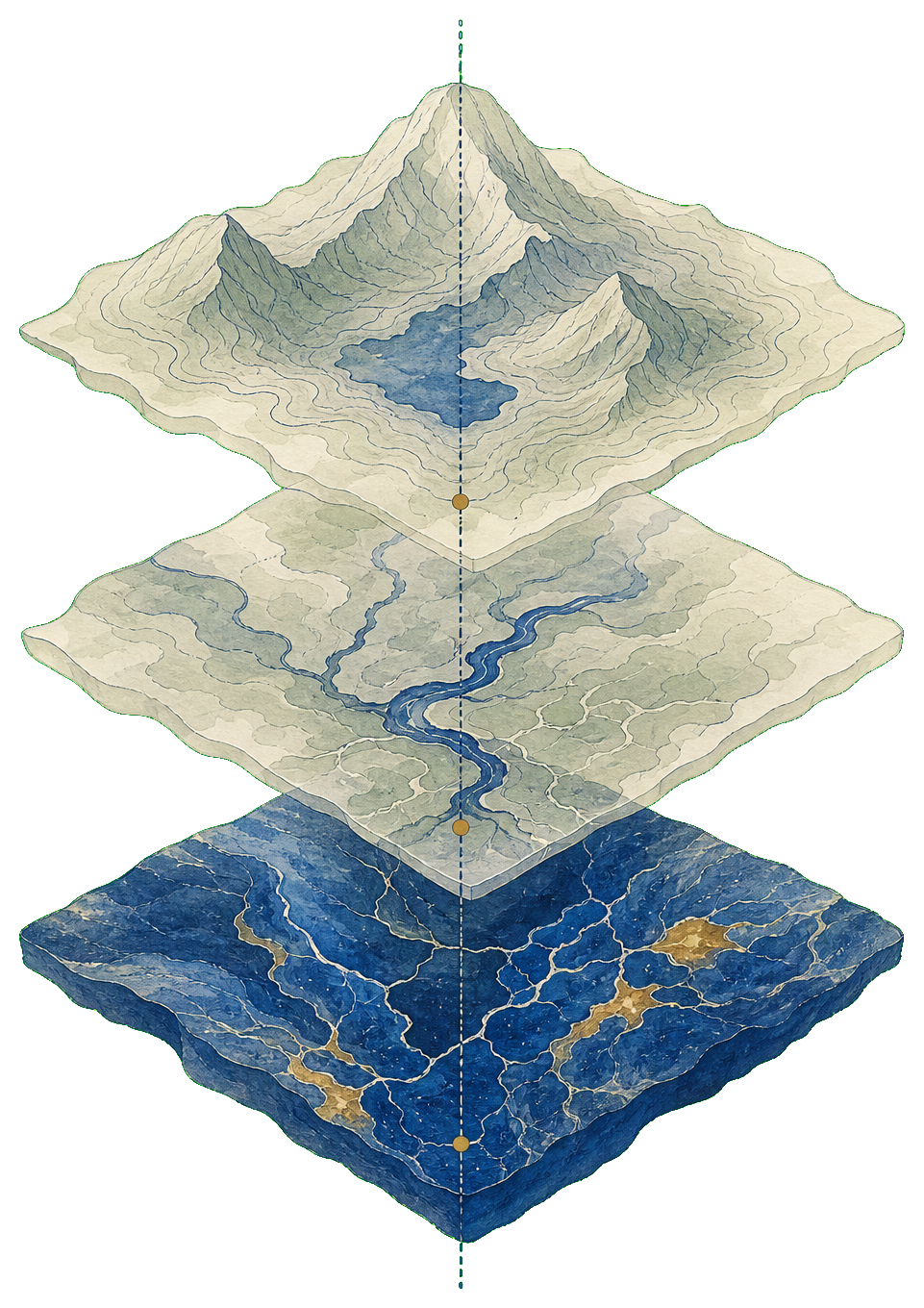
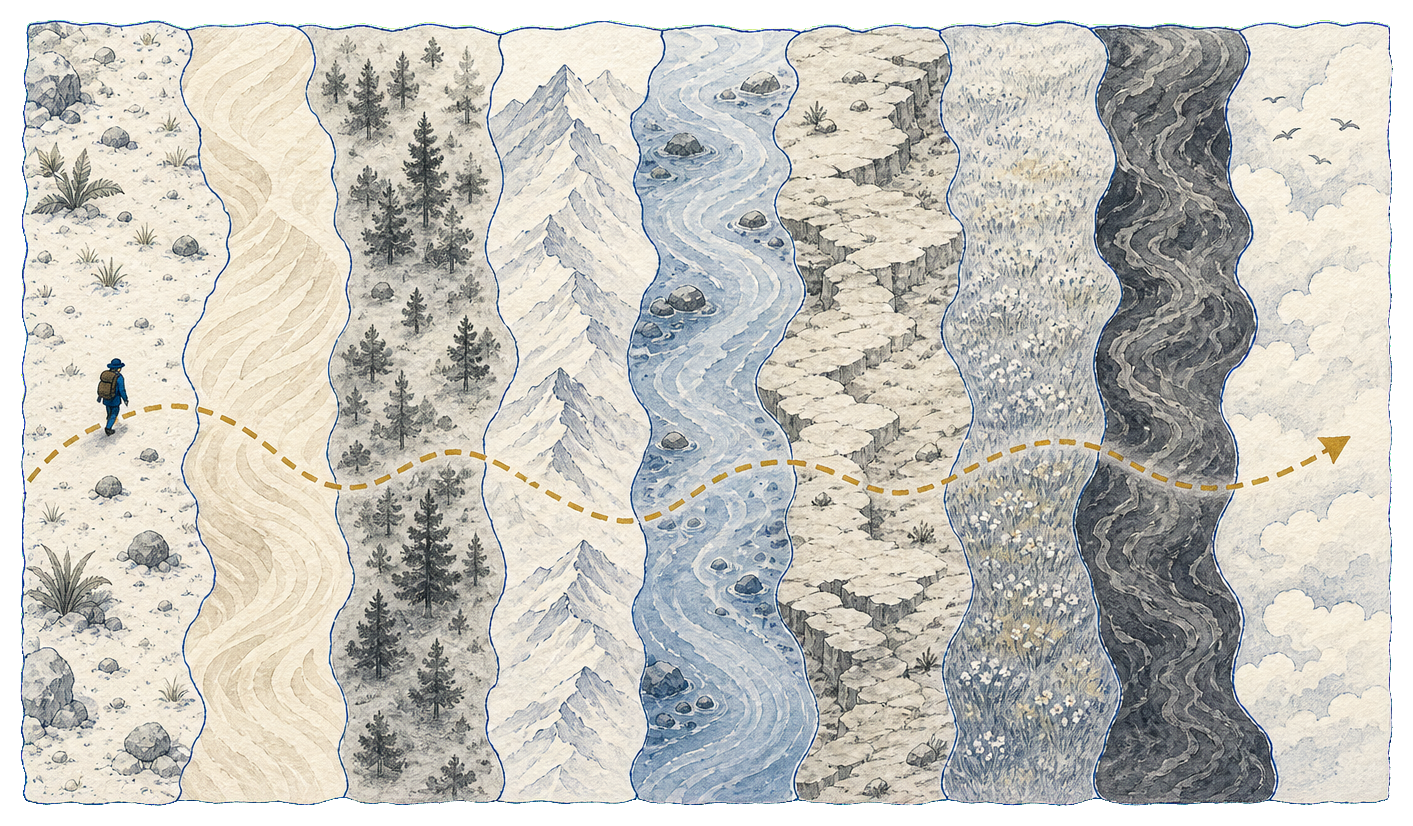
Why the meal and the divinity are not the same scale
The reason I needed the bands at all was a small daily confusion. A person can plan a meal, feel grief, imagine a future, inherit a family role, take part in a culture, and wonder about divinity — sometimes before lunch. A single vocabulary flattens those differences until the meal and the divinity appear to be the same kind of thing, and then a bad afternoon gets read as spiritual failure and a good one as proof of access to higher planes.
The bands are addresses, not rungs. The physical surface — body, environment, object, schedule, speech, contract, consequence — has its own address. So does the hidden pattern beneath it. So does the personal meaning a person makes of their life, the collective agreement they were born into, the imagined template they carry forward, and the wider perspectives that arrive when narrow problem-solving relaxes. The map lets each scale be itself before any of them are asked to explain the others.
It also gives every expanded reading a return path. A reading that cannot come back down to embodied conduct, material conditions, and relationship has not finished its work. The map is drawn so that the downward translation is always possible, and always required.
Where an intention becomes observable
At the first band, an intention becomes something another person can see. This is the surface of body and behavior: the meal cooked, the contract signed, the sentence spoken, the appointment kept, the medicine taken. The architecture sometimes calls it the physical mind, because it organizes local action in sequence. In ordinary language it is simply where consent can be heard, repair can occur, and a promise can be tested against what actually happens.
The band has no lower spiritual status. It is the place where safety is either respected or violated, and any expanded model that cannot return here remains incomplete as a guide for life. A vision that ends in a body left unfed is not yet finished.
The pattern that shows itself only through outcome
Beneath the visible surface sits the implicit pattern — habits, learned expectations, automatic associations, the protective routes a person built long before they could name them. This is the territory mapped throughout Book I, and its correction relies on observation, support, experiment, and environmental change rather than on any metaphysical claim.
The practical question at this band is plain: what repeated response becomes visible through outcome? Psychology has several distinct ways of studying such processes, and Vivi’s model gathers them symbolically without claiming that every hidden process shares one mechanism. A person need not know which laboratory frame is active. They only need to notice when a response feels compulsory, continues after its context has changed, and produces a result they did not choose.
The meaning that can transform an act without altering a fact
A painful event interpreted as permanent proof of unworthiness supports one trajectory of living. The same event interpreted as harm survived may support another. Neither interpretation changes what occurred, and this band — autobiographical identity, values, emotion, memory, and the stories through which a life is organized — is where authorship has its primary address. It is the capacity to participate in the meaning that guides the next act.
Meaning can be revised at this scale even when the historical fact cannot. That is not a small gift. It is also not magic: a meaning that excuses harm, denies evidence, or refuses correction has crossed into another function and should be read as such.
The agreement that was never freely signed
Some arrangements are inherited or enforced rather than chosen, and the fourth band — shared language, norms, institutions, laws, roles, markets, rituals, cultural assumptions — shows why private intention cannot explain every outcome. Calling these arrangements “agreements” can mislead, since many people never consented to them. The word here means socially stabilized pattern, not voluntary contract.
This band is where collective systems create roads, boundaries, categories, resources, and penalties that shape individual possibility. A reader who has been told their hardship is purely internal can find relief here: the system is a real participant in the outcome, and naming it is not evasion.
In some metaphysical readings, collective agreement is extended into the rules of a shared reality, as though physical laws were bargains struck among consciousnesses. That extension remains speculative. Socially constructed institutions are observable. The metaphysical version is not established by that observation, and the band keeps them on separate evidence footing.
The drawing before the building
Plans, archetypes, imagined structures, design constraints, possible configurations — these occupy the fifth band, the template and possibility scale. An architect’s drawing, a business model, a relational agreement, and a future scene all live here. They organize possibility without guaranteeing execution, and their usefulness shows only when something is built from them and met by consequence.
The metaphysical version of this band proposes soul blueprints, karmic templates, or life plans chosen before birth. I hold those as hypotheses. They can give meaning to some readers, and they can do serious harm when used to explain abuse, disability, illness, or poverty as something a person selected for themselves. The boundary is not cosmetic.
The wider view when the analysis loosens
The sixth band is where imagination, intuition, and creative synthesis appear — the perspectives that tend to arrive when forced analysis relaxes. The Bashar material often describes imagination as communication from a higher mind. That is a source claim inside a metaphysical worldview. An ordinary account treats imagination as the capacity to simulate, combine, rehearse, and create.
Both accounts can support the same practice: step away from the forced analysis, allow images and alternatives to appear, then test them in embodied action. Vividness, however, does not certify origin. An image may be insightful, biased, fearful, playful, random, or borrowed. The band supplies possibilities to the first band, where consequence can answer, and that return trip is what keeps the imagination honest.
Soul, shared consciousness, and an open ground
The final three bands move increasingly into metaphysical territory, and I want to say plainly that they are the most speculative part of the map. The seventh proposes an enduring center of identity beyond one social role, and in its stronger form, beyond one lifetime. Soul, within this architecture, names the possibility that consciousness has continuity and orientation deeper than autobiographical personality. The continuity within a single life is observable through memory, body, relationship, and record. Continuity across lives remains speculation here.
The eighth proposes a scale at which individual consciousness participates in a larger identity or field. Experiences of unity, deep empathy, ecological belonging, collective ritual, and reduced self-boundary can motivate this image; they are phenomenological reports and social experiences, and they do not establish a literal oversoul. As metaphor the band highlights interdependence: lives are nested in families, ecologies, histories, economies, and cultures, and no person is self-produced. As metaphysics the oversoul remains a possible shared consciousness from which individual lives emerge. I do not know whether that possibility describes reality.
The ninth band is Source — the name this architecture gives to an ultimate ground of being, awareness, divinity, or undifferentiated possibility. The word does not resolve theological differences. God in a specific tradition may be personal, relational, moral, creative, revealed, and distinct from creation. Philosophical ground-of-being language has another structure. Nondual consciousness, emptiness, nature, and cosmological origin are not synonyms, and the architecture uses Source only as an open placeholder. It marks the question of origin and wholeness rather than answering it.
The voice after the retreat
Amaya comes back from an intensive retreat sleeping very little and feeling unusually connected to everything. Ideas arrive so fast she can barely speak them, and a phrase appears in her mind with the quality of a voice: “You have a mission only you can complete.” The retreat community reads the experience as higher-mind activation, and for a few days the interpretation holds her like a warm current.
Earlier in the book this scene might have been reduced to a single cause. Vivi’s architecture lets it be described across scales without choosing one. Her body is sleeping little, speaking fast, and falling out of routine. A history of earning belonging through exceptional performance may be relevant to what the experience feels like it is offering her. The meaning it carries feels sacred and resolves an earlier uncertainty she had been carrying. The retreat community rewards activation language, which is itself a collective arrangement. The imagined template is a large public project that now seems within reach. Ideas and associations feel unusually available, as if the wider-perspective band has swung open. And the community is ready to supply the soul, oversoul, and Source framings that would tell her what the voice is.
The band map organizes all of this without establishing the highest band as the cause. The voice might be a breakthrough. It might be sleeplessness reaching for meaning. The map does not decide, and its refusal to decide is the point. What it does is give the return path its priority.
Amaya stops the intensive practices and restores sleep and meals. She contacts a trusted person outside the retreat, records the ideas without acting on any large financial or relational decision, and seeks qualified assessment because her function and orientation are changing. Safety goes first when function deteriorates; spiritual interpretation and clinical assessment do not have to compete for the right to acknowledge the experience, because they answer different questions. After stabilization some of the ideas may still be valuable. Others may lose their urgency. The sacred meaning can be revisited later, without granting a single extraordinary night immediate command authority over a whole life.
Scope is not status
A vertical diagram becomes a status ladder the moment a person points to it and says which rung they are on. Someone will identify themselves as “higher frequency” and read disagreement as lower consciousness. The model explicitly rejects that use, and the rejection is the chapter’s required transfer.
Scope describes how many relationships a perspective includes. A broad view can still be wrong. A local view can be exactly what the situation needs. A person considering surgery needs embodied facts and medical expertise; a community redesigning policy needs collective and institutional analysis; an artist may benefit from imagination; a theologian may work within a Source concept. Wisdom lies in selecting the scale appropriate to the question and moving back across scales — not in living at the top of the diagram.
No band replaces another. No person occupies a higher one. A statement or experience is being viewed through a band for a particular purpose, and the map cannot rank beings.
Keeping an experience ordinary
Expanded states can include awe, unity, altered body boundary, unusual imagery, intense meaning, a reduced sense of time, or a feeling of contact with another presence. Similar descriptions appear across many contexts, and an experience deserves description without automatic pathologizing or spiritual promotion. The chapter does not infer a cause from the experience alone.
The inflation pulls hard in the other direction too. An ordinary event is easily assigned a cosmic role: a creative idea becomes transmission, attraction becomes soul recognition, conflict becomes spiritual warfare, fatigue becomes integration, coincidence becomes mission. Inflation may make a person feel significant while obscuring the action a situation actually requires. A three-scale sentence holds the pull in check — ordinary: what occurred in daily language? symbolic: what image or pattern helps me understand it? metaphysical: what larger hypothesis am I considering? The three sentences let wonder remain without turning an idea into an order.
When a reader needs to record an experience before settling its meaning, a simple integration page is the practice I trust. It documents what was experienced without deciding too quickly what it was.
Descent counts as expansion
Expanded awareness is usually pictured as movement upward — toward light, unity, abstraction. A wider awareness may just as easily move downward and inward, toward grief, ancestry, ecological dependence, bodily limitation, and the histories a person had ignored. Expansion can mean including more consequence rather than escaping it.
A business owner becomes aware of hidden labor. A spiritual community recognizes how its authority harms dissenters. A person includes the body’s limits inside a sense of purpose. A citizen learns the history beneath a familiar institution. A believer allows another tradition to remain genuinely different. This form of expansion feels less spectacular, and it often produces responsibility. The architecture should therefore be judged by inclusion: which reality becomes visible, whose testimony can enter, and what action follows.
Comparing the map without collapsing it
Vivi’s architecture will resemble models from psychology, religion, contemplative traditions, esotericism, and systems thinking. Resemblance does not create equivalence. The implicit-pattern band may resemble concepts of unconscious processing; the collective band may resemble social construction and systems theory; the imagination band may resemble creativity research or “higher mind” teachings; soul and Source may resemble terms in several religions while carrying different meanings. The architecture is not validated by finding a similar ladder elsewhere — humans repeatedly use vertical and concentric images to organize scale, and independent similarity may reveal a useful cognitive form without proving the ontology.
Comparing maps calls for a method rather than a feeling. The constellation method asks a reader to define each source’s terms, identify its method and authority, mark genuine overlap, preserve contradiction, avoid implying that older traditions secretly anticipated this map, and ask what each map enables in practice. Done honestly, the comparison lets several maps share the sky without pretending they describe the same stars.
Designing a rival
A reader does not have to inherit nine bands. The map is more honest if it is allowed to have rivals.
Begin with the phenomena that need distinguishing. Perhaps a map needs body, relationship, ecology, institution, imagination, sacred tradition, and unknown, and a horizontal network fits better than vertical scope. Perhaps it needs no metaphysical level at all. State the map’s purpose, source lineage, categories, edges, transfer rules, and failure modes. Test it on a real case, and invite someone affected by the case to challenge it. Building a rival map is the surest way to find where this one helps and where it merely flatters.
Setting the notebooks down
The afternoon on the floor ended when I realized I did not have to choose between keeping the corpus as scripture and burning it as noise. I could draw it into one map, name what it could and could not establish, and then set the map down whenever it stopped helping. That is what the bands are for. The first six hold ordinary-life translations — embodied action, implicit pattern, personal meaning, collective structure, imagined template, wider perspective — and the final three move into metaphysical territory I hold as open question rather than fact.
The Prism Walker is the reader stance this architecture invites, and it does not mean someone who transcends belief or moves literally among dimensions. It means a person who can compare lenses, preserve provenance, translate terms, choose the scale appropriate to a task, and release a model when it has finished its work. It asks, before any reading settles: which map owns this term, which claim class is active, what does the map reveal, what does it hide, which action follows, who can correct me, where is the exit.
That last question — where is the exit — is the one the corpus never used to ask. The notebooks are still in my house, but they no longer stand over me. They are addresses I can visit, scales I can view an experience through, and a ground I can return from. The architecture is successful only if the reader can do what I did that afternoon: hold it long enough to be helped, then set it down and walk back into the ordinary room, where the meal still needs cooking and the next sentence is still the reader’s to choose.