Scripture as Architecture
The line that refuses to close
I was sitting on the floor with a borrowed Bible open to Psalm 88. The room was quiet. I had come looking for something I could not name — a word for the particular weather I was in. The Psalm gave me one. It moved through abandonment, darkness, terror, and the feeling that God had hidden his face, and it did not resolve. The last line is the darkest one in the book: “darkness is my closest friend.”
I had been taught, somewhere, that the right move was to finish that sentence. The pain is real, but. The night is long, yet. The Psalmist is honest, and then. Every sermon I had absorbed wanted to attach the resolution the text itself refused to give. The institutions surrounding the text had made the resolution feel like the price of staying inside it.
That night I did not want the resolution. I wanted to stay inside a passage that let the dark be dark. And I wanted, for once, to read scripture as what it actually felt like: a set of relationships among desire, authority, identity, rupture, and repair — without pretending that one symbolic reading could also settle its history, its theology, or its divine status.
That is the carrying question of this chapter, and Psalm 88 is its ground.
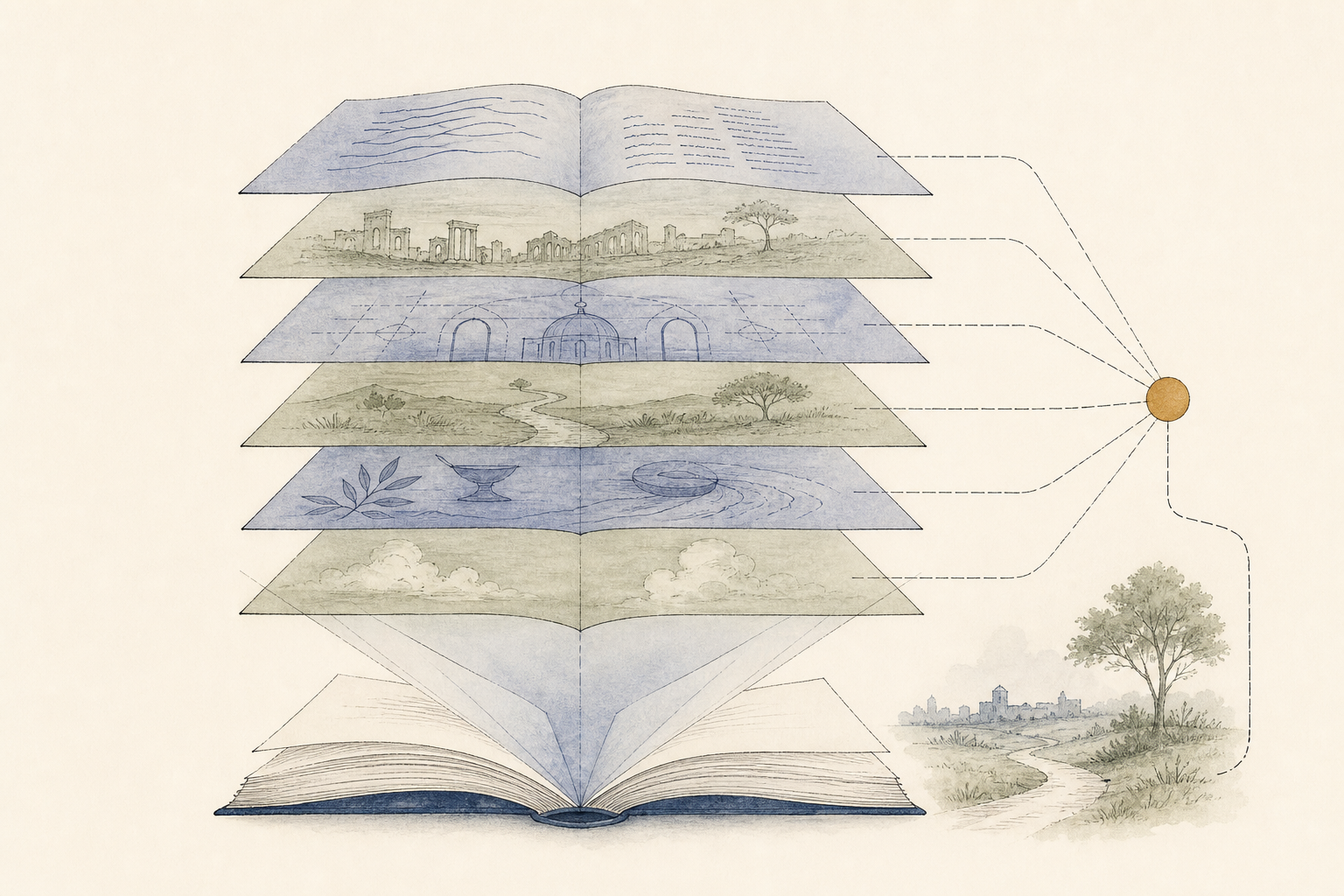
Six layers of reading
The thing I wanted — to stay inside the Psalm without collapsing it — required a discipline I had to name. A sentence can move from describing what a text says, to what scholarship establishes about it, to what a tradition believes, to what I see in it from my own life, to the human mechanism the image carries, to a claim about ultimate reality. Each of those is a different layer, and each carries different evidence. Confusing them is how a passage gets used as a weapon.
A disciplined reading keeps all six visible. Text asks what words, scenes, repetitions, characters, and structures appear in the passage. History asks what responsible textual and historical scholarship can establish about context, development, and transmission. Theology asks how a named tradition understands God, humanity, obligation, salvation, and community. Personal interpretation asks what pattern I see from my own experience and framework. Symbolic reading asks what human mechanism the image can help us examine. Metaphysical speculation asks what claim about ultimate reality is being proposed, and what remains unknown. A sentence may move across layers. The movement must be named.
With Psalm 88, the layers separate cleanly. The text is a lament that ends in darkness and offers no turnaround. The history and theology are the province of scholars and traditions I am not inside. My personal interpretation is that someone, once, found language for a weather I have also been in. The symbolic mechanism is that a community preserved anguish without rushing it into improvement. The metaphysical claim — whether God was present in that darkness — is one I can neither assert nor deny, and Psalm 88 does not require me to. The passage does its work in the symbolic layer and then stops.
That is what I mean by reading scripture as architecture. Not a decoder. Not a final doctrine. A practice of holding the layers apart so that none of them is forced to do the work of all the others.
Rupture, law, and what holds
Once the layers are separate, the same image can be turned in the hand. Genesis 1 presents creation through a sequence of speech, distinction, naming, evaluation, and rest.1 Read symbolically, it is initialization: a world becomes operable when differences become visible — light from darkness, waters divided, times and living forms given places. The same is true of ordinary work. A project stays vague until someone distinguishes purpose from scope, task from owner, draft from decision, and work from rest. The symbolic parallel does not turn project management into cosmology. It lets a creation story illuminate why distinction, sequence, and limit matter, and it stops there. What refuses to be differentiated cannot be organized.
Genesis 2–3 then introduces the garden, the boundary, desire, persuasion, choice, shame, concealment, blame, and exile.2 Many traditions read the passage through sin, disobedience, mortality, freedom, or the human condition. My symbolic reading focuses on what happens after a boundary is crossed. Perception changes; the humans become ashamed and hide; when questioned, responsibility moves outward; and the relationship with self, other, environment, and authority reorganizes around the new self-perception. That is a prototype of protective identity. A limit exists, desire and interpretation alter its meaning, action creates consequence, shame changes self-perception, concealment reduces truthful contact, blame protects the threatened identity, and the new pattern becomes the environment for whatever life comes next. This reading does not decide whether the story records a historical event. It offers a mechanism for examining how rupture hardens into identity — and it meets the protective-loop vocabulary of Book I exactly where that book left it.
From there the architecture thickens. Biblical law contains ritual, ethical, social, economic, and communal instructions, and the collections differ in context and purpose. A symbolic systems reading asks what protocols do for a community. A protocol turns a value into repeatable behaviour: “care about rest” stays abstract until a shared Sabbath practice allocates the time; “care for the vulnerable” stays abstract until a rule about gleaning, debt, testimony, or the treatment of strangers structures the responsibility. The existence of a rule proves nothing about its application — interpretation, authority, enforcement, and power determine how a rule is actually lived. This is exactly the ground Book I covered when it traced how a response becomes shared architecture through repetition, until a value hardens into a story, a norm, a role, a rule, an enforcement, and a lived condition. A community can preserve the words of a law while violating its purpose through selective enforcement, and it can revise a protocol when experience reveals harm. Scripture becomes architecturally interesting the moment readers examine the distance between stated value and operating structure.
The same attention applies to the large movements. Exodus carries oppression, confrontation, departure, wilderness, covenant, and the difficult formation of a people.3 Its theological meanings include divine action, liberation, election, law, worship, and communal identity. The systems reading notices the quieter thing: leaving domination is not the same as building a just alternative. The people cross a boundary and remain shaped by scarcity, fear, authority, and the habits of the prior system. Wilderness becomes a transition where old dependence has ended and new governance is unfinished. The mechanism travels carefully to organizations and relationships. Exit can be necessary. After exit, people still need resources, roles, conflict methods, memory, and a legitimate distribution of authority; without those, freedom can collapse into nostalgia for the familiar system or dependence on a new uncorrectable leader. A workplace resignation is not the Exodus, and the identities should not be appropriated casually — the biblical narrative belongs to Jewish and Christian traditions and to specific histories of interpretation, including liberationist readings — but the ordinary mechanism of unfinished transition travels on its own.
Rest, mediation, and the question of who serves
Sabbath appears in biblical texts through creation, command, covenant, rest, and communal practice.4 Traditions differ in theology and observance. Architecturally, Sabbath gives nonproduction a recurring place and interrupts the claim that labor and accumulation should continue without boundary. The Deuteronomy command connects rest with liberation and extends it across household members, workers, foreigners, and animals — and that social scope is the part that matters. Rest for a privileged person can depend on hidden labor by others. A serious rest architecture asks who continues serving while the community pauses, which is a question about time, dignity, production, and shared limit rather than a wellness day arranged so that a person can work harder.
Mediation runs the same test from the other side. Priestly structures organize access, ritual responsibility, teaching, purity, sacrifice, and communal identity within biblical texts, and different traditions understand those functions differently. The systems question concerns mediation itself: who may approach, interpret, authorize, forgive, teach, or declare restoration? Mediation can preserve knowledge and communal care, and it can concentrate authority, and the structural test is correction. Can a mediator be prepared, challenged, and held? What happens when access is denied? Can the community distinguish sacred responsibility from personal power, and does the role serve relationship or does relationship serve the role? The same questions apply to therapists, coaches, teachers, experts, spiritual leaders, platform moderators, and AI systems. Specialized roles can help people cross complexity, and trust increases when the role has scope, accountability, and an exit.
Coherence under pressure
The canonical Gospels portray Jesus teaching through stories, healing encounters, disputes, shared meals, public acts, and a movement toward crucifixion. Christian theology interprets his identity, death, and resurrection through many doctrines. My symbolic reading attends to four recurring structures, each of which can be examined whether or not the theology is accepted. Coherence appears when stated value and enacted relationship align, and the teaching is tested in contact with excluded, ill, condemned, powerful, and grieving people. Surrender appears as the willingness to remain accountable to a chosen orientation under pressure — which differs from passive submission to abuse, and which ethical surrender cannot be used to demand another person’s silence or continued exposure to harm. Restoration appears when a person regains relationship, dignity, participation, or truthful contact. Love appears as enacted regard for another’s reality; in the Synoptic tradition, love of God and neighbor functions as a central organizing command.5
Then the architecture turns toward the structure readers find hardest to hold without harm. Crucifixion carries historical, theological, liturgical, political, and emotional meanings, and resurrection is central to Christian proclamation and interpreted differently across communities. A symbolic architecture can explore death and return without pretending to resolve those debates. The sequence carries exposure, loss, grief, apparent ending, absence, encounter, reinterpretation, and changed community. Human lives contain smaller versions of it. An identity may end. A relationship may become impossible in its old form. A vocation may collapse. Grief creates an interval in which the prior world no longer functions and the next one has not stabilized, and resurrection language can symbolize renewed participation after an ending. The metaphor becomes harmful when it rushes grief, promises a guaranteed outcome, or treats suffering as spiritually necessary.
The text that refuses to blame the sufferer
This is where the architecture becomes load-bearing for VVViva. The Book of Job stages suffering, argument, counsel, divine speech, and the failure of simple moral explanation. Job’s friends repeatedly try to restore order by linking suffering with wrongdoing. The text refuses their confidence even while leaving readers with difficult theological questions.6 A closed system protects itself by making every outcome confirm the rule: if the righteous suffer, hidden fault is assumed; if a prophecy fails, insufficient faith is assumed; if a practice harms, resistance is assumed. Job preserves protest and unknown. The sufferer’s testimony is not erased to protect the friends’ worldview.
The symbolic mechanism is epistemic humility before another person’s suffering. Care should not begin by assigning cause, lesson, karma, contract, or frequency. It can begin with presence, material help, and the admission that the explanation is unavailable. This reading does not settle the text’s theology or the historical problem of suffering. It provides a strong counterweight to spiritual victim-blaming, and it returns me to Psalm 88 — because biblical lament and the book of Job are doing the same thing from opposite ends. Lament gives fear, abandonment, anger, grief, accusation, and hope a public form; the Psalms include voices that do not perform serenity.7 Architecturally, lament protects a community from making positive testimony the only acceptable speech. It permits distress to enter relationship and memory.
A modern community can learn from the function without copying a sacred form: create a channel where bad news can be spoken, preserve testimony, do not require immediate resolution, and separate witness from investigation and from repair. Lament also limits the idea that emotional intensity is spiritual failure. A person can remain inside faith and speak anguish, and a secular reader can recognize the human need for language that does not rush pain into improvement. Psalm 88 is the canonical example. It refuses to close, and the canon kept it anyway.
The danger of total decoding
Some passages invite the opposite failure — not too little resolution, but too much. Apocalyptic texts use visions, symbols, conflict, judgment, endurance, and hope, and their interpretation has produced extensive scholarship and many competing traditions. Revelation, in particular, has repeatedly been attached to contemporary events and fixed timelines.8 The symbolic density invites decoder certainty. A beast becomes a current leader. A number becomes a date. A conflict becomes proof that the final sequence has begun. This is the moment to reach for the prediction register introduced in the chapter on time and the open field: record the interpretation before the date, preserve the failure, and do not convert ambiguity into authority over health, money, politics, or another person’s life. An architectural reading can instead ask what apocalyptic language does for communities under pressure — it exposes imperial power, relocates hope, dramatizes allegiance, and imagines judgment beyond present authority — and those functions can be studied without claiming that a contemporary decoder has unlocked the final calendar.
Parables run the discipline in a third direction. A parable does more than state a principle. It places a listener inside a situation and changes the frame. The Good Samaritan, for example, asks who acts as neighbor through care across a social boundary,9 and the story resists a purely abstract definition because the listener has to evaluate behaviour. That is executable structure: a familiar question is asked, expected categories are disturbed, a concrete scene carries the distinction, behaviour reveals the operating value, and the listener must choose an application. A modern framework can learn from the form. Explanation gains force when a reader can inhabit the problem, feel the conflict, and test an action — and the same form warns against turning every story into code, since a parable can retain ambiguity and several readings may stay alive at once.
When the teaching becomes an institution
A teaching becomes institutional through roles, texts, rituals, buildings, budgets, training, authority, and enforcement. Institution preserves continuity, and it also changes the incentives surrounding interpretation. The structural question is not whether institution is inherently pure or corrupt. The question is whether the operating system remains connected to the value it claims to preserve. A church can preach service while rewarding status, and it can also build durable practices of care that outlast any one leader. A community can honor scripture while discouraging questions, and it can also use study, debate, and accountability to deepen understanding. What separates the two is the relationship among the stated teaching, the observable behaviour, the distribution of authority, the treatment of dissent, the use of money, the response to harm, and the correction process. This is the layer where spiritual commitment and institutional analysis are allowed to coexist.
That coexistence has consequences, because interpretation creates them. A passage used to define gender, sexuality, race, land, authority, punishment, disability, or belonging can shape law, family access, and bodily safety. The six-layer method therefore includes an impact layer: who has received care through this reading, who has been excluded or controlled or harmed, which voices were permitted to interpret, what institutional power enforced the result, which counter-readings exist within the tradition, and what repair is possible now. Ethical preference cannot rewrite a text at will. The narrower point is that interpretation becomes architecture through institutions, and readers should seek scholarship and testimony from communities whose lives have been shaped by the passage. The author’s symbolic insight is never the only relevant evidence.
The Living Prism
Within VVViva, the Living Prism is my model for comparative interpretation. A prism receives one field of light and reveals different colors, and the metaphor suggests that traditions can disclose different aspects of human or spiritual experience. The limit matters as much as the image. Traditions are not merely interchangeable colors. They contain distinct histories, truth claims, communities, practices, conflicts, and power structures, and combining them carelessly can erase difference. The Living Prism therefore asks three questions. What does this tradition claim on its own terms? What human mechanism can travel beyond the tradition? What difference must remain intact? The model supports dialogue without forcing every system into one hidden doctrine, and it keeps Psalm 88 honest: some traditions preserve an unresolved lament because the alternative — a text that has to be cheerful before it can be true — would erase exactly the witness the text was kept for.
A reader’s architecture practice
The line that can stay open
I went back to Psalm 88 the next morning. The same line was still the last line, and the dark was still the dark. What had changed was that I no longer needed the text to close in order to stay inside it. The six layers let the symbolic work happen — a community had preserved a voice that did not perform serenity, and that preservation was itself the architecture — while the theological and metaphysical questions stayed where they belonged, with the traditions and the silence that hold them.
I read scripture as architecture because stories reveal relationships among desire, authority, identity, rupture, repair, community, and meaning. That is my interpretive contribution. It remains one reading among many, and it can survive disagreement, name where its authority comes from, and accept correction from history, ethics, community, and consequence. A living reading does not have to finish the sentence the text refused to finish. It can leave the night open, and still be true.