Love Without Self-Erasure
The door after midnight
A message arrives after midnight. The person who sent it has been distant for days, then suddenly wants closeness. Your body reacts before you choose a response. Relief rises with anger in the same breath. Hope arrives beside the memory of every unanswered question, and a hand you know well hovers between answering and leaving the phone face-down on the table.
The room narrows to one decision. The old pattern offers two choices, and both feel inevitable. You can open the door and call the intensity love — let the relief, the hope, the sudden warmth organize themselves around the other person's return. Or you can close it hard enough to feel invulnerable, convert the anger into a verdict, and tell yourself the silence meant what you feared. Both choices answer the message before they answer anything else. Neither one begins with the conditions you actually need to be in that room.
Notice what the two choices share. They are both organized around the other person. The door opens or closes in response to them — to their availability, their distance, the hunger that travels through the screen. The question hiding underneath both is harder to reach: not whether to let them in or keep them out, but what kind of contact would let you remain a person in the exchange. What kind would let them remain one too.
I learned to call this question by a name, slowly, the way you learn a word that finally fits a feeling you have carried for years. The name was untethered love — care that stays real while access changes, longing that can be honored without becoming a command, tenderness that survives a boundary. The naming mattered less than the turn it produced. Instead of asking whether I loved someone, I began asking what form of contact allowed both people to remain real.
That is the question this chapter carries. The door is still open. The phone still glows. We will not choose for it until the mechanism has had its say.
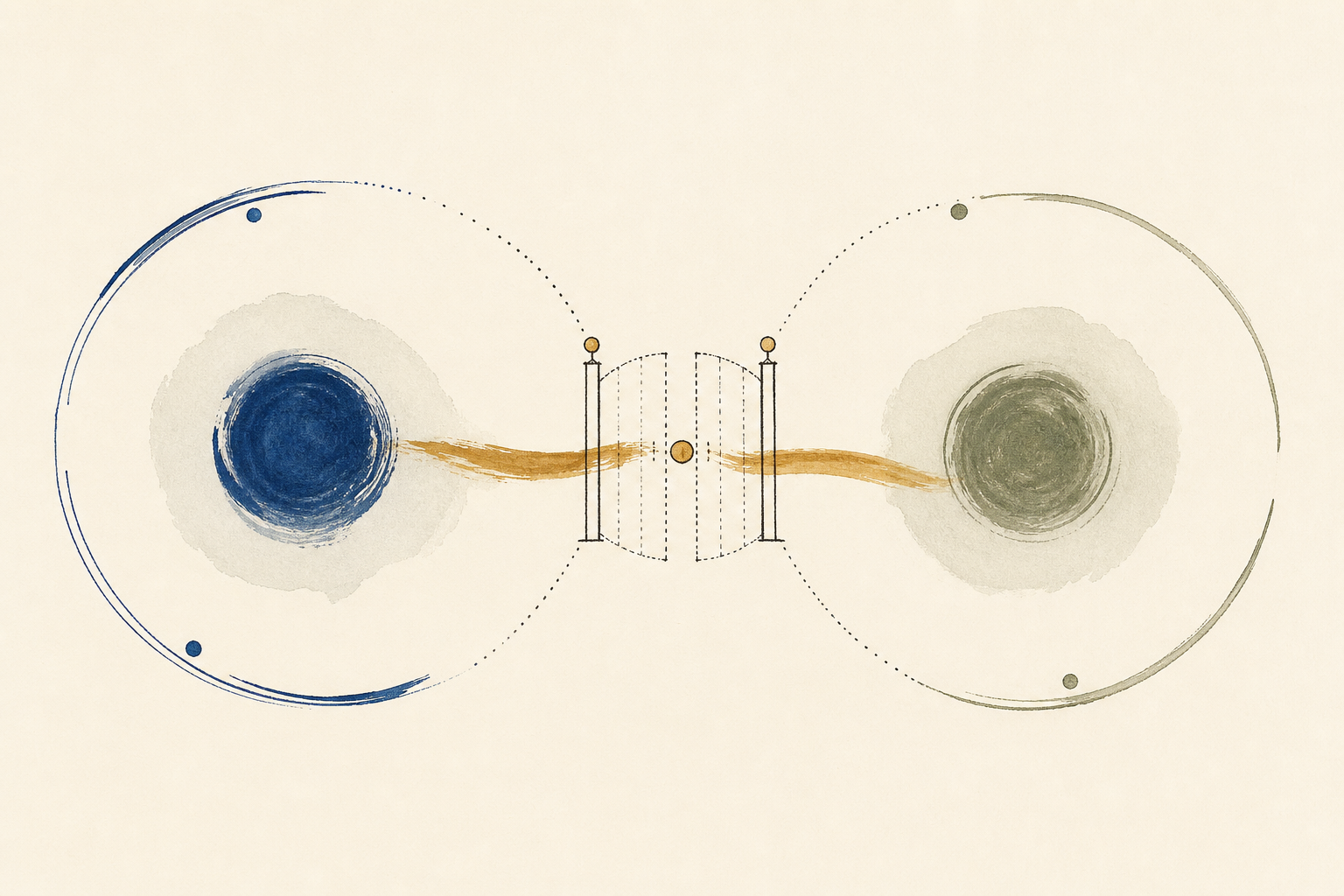
Separating love from access
Love describes care, attachment, affection, devotion, or a chosen ethical orientation. Access describes what another person may receive from your time, attention, body, home, work, money, and emotional availability. The two can move separately, and most of the suffering in the midnight room comes from treating them as a single fused thing.
You may care for a relative and refuse to discuss a subject they use to shame you. You may love a former partner and stop answering messages that reopen the same injury. You may feel tenderness toward a friend and recognize that the friendship no longer supports mutual life. A boundary changes access. It does not require an argument about whether the feeling was ever real.
This principle protects both people. It prevents boundaries from becoming proof that love failed. It also prevents love from becoming a reason to tolerate coercion, contempt, manipulation, or repeated unreliability.
A source inside the room
External love matters. Human beings need connection, care, touch, witness, and practical support, and naming the inner question does not turn those needs into an individual defect. Within VVViva, self-sourced love means keeping an internal relationship with your own worth while seeking connection from others — wanting someone without assigning them the job of proving you deserve to exist, receiving reassurance without making reassurance the only route back to yourself.
The difference becomes visible in behaviour. When all nourishment is assigned to one person, uncertainty can feel like starvation: attention becomes surveillance, a delayed reply acquires the weight of a verdict, and the relationship is asked to regulate identity, loneliness, desire, safety, and meaning at once. Self-sourced love distributes those functions. Friendship, rest, creative work, movement, solitude, community, and professional support can all carry part of the load, and the bond in front of you gains room to become a relationship between two people rather than a single emergency system.
Why the familiar one pulls so hard
Attraction can contain several signals at once. Preference may be present; so may novelty, chemistry, shared values, status, scarcity, fear, fantasy, or a familiar emotional pattern. Wound matching is my working term for one form of that familiarity — the moment when one person's protective strategy fits the unfinished expectation of another. The pursuer meets the withdrawer. The rescuer meets the person who avoids responsibility. The performer meets the person whose approval feels scarce. Each person's response confirms the other's expectation, and the match creates intensity because the system already knows the choreography. Recognition is immediate. Safety is less certain.
A wound-matching model becomes harmful when it reduces every relationship to pathology. Some people simply enjoy each other. Some relationships end because goals differ. Some conflicts arise from fatigue, poor timing, limited skill, or an ordinary mistake. The model earns its place only when it reveals a maintaining loop and suggests a different action.
The different action has a name too. Clean attraction is attraction that can survive contact with reality — desire and evidence occupying the same room, the person you actually meet allowed to be more than the role you hoped they would perform. Clean attraction lets you ask, without panic, whether closeness increases your capacity to speak plainly or shrinks it, whether either of you can refuse without punishment, whether words and behaviour grow more consistent over time or less, whether repair is possible after a disappointment, and whether the relationship leaves room for two lives. Urgency resists every one of those questions. It treats delay as danger and ambiguity as a problem to be solved through more contact. Clean desire can tolerate enough space to learn what is true, and its strength is not certainty but corrigibility — new information can update the picture without requiring you to deny your own perception.
Behaviour as the primary evidence layer
A person may have a tender explanation for harmful behaviour. The explanation can matter. Behaviour still determines the conditions of contact. This rule protects against mind-reading: you do not need access to someone's secret feelings, unconscious motives, spiritual purpose, or childhood architecture to decide what a repeated action means for your participation. A person who cancels repeatedly may be afraid, disorganized, overwhelmed, ambivalent, or uninterested. You may never know. The observable pattern remains — plans are unreliable — and your decision can respond to that pattern.
Who is completing the circuit
A half-circuit forms when one person supplies most of the energy required to keep a connection alive — initiating, interpreting, soothing, planning, repairing, and imagining the future, while the other participates intermittently. A full-circuit holds reciprocal contribution, which does not mean identical tasks or a perfect balance at every moment; it means both people can affect the relationship through care, initiative, honesty, repair, and responsibility. A half-circuit can feel powerful precisely because the person supplying the energy also supplies the meaning: every small response appears significant, the scarce moment of contact rewards the whole interpretive system. The corrective move is practical and a little frightening — stop completing the circuit alone, long enough to observe what remains. The pause is an experiment, not a punishment. If the connection collapses without one person's constant labour, the collapse reveals the structure that was already there.
Helping can complete a half-circuit or break one, and the difference appears in ownership. A helper trap forms when care becomes control through usefulness — when you anticipate every need, prevent every consequence, translate every feeling, and become indispensable, often to protect yourself from the uncertainty of being loved without performing. The alternative, within VVViva, is what I call a True Guide: clarity offered while ownership stays with the other person, guidance that includes consent, limits, and room for consequences and does not require the guide to become the engine of another person's life. The questions that mark the difference are simple and rarely comfortable: whether help was actually requested, what capacity the intervention might replace, what is genuinely yours to carry, and what boundary would keep the relationship mutual. Care often becomes more honest when it grows smaller and more specific — small enough to include a handoff.
When love is real and partnership is not
A relationship can contain love and still lack the conditions for partnership. Values may conflict. Desired forms of commitment may differ. Geography, health, money, family obligations, sexuality, religion, or timing may shape what is possible, and incompatibility does not require a villain.
This matters because spiritual and psychological frameworks can turn every ending into a hidden lesson, a wound, a karmic bond, or a failure of courage. Those interpretations may occasionally help someone make meaning. They cannot override the ordinary fact that two people want different lives. The same humility protects against over-therapizing the present: a person may lack a skill without carrying a deep wound, may be uncertain, may choose themselves, may make a mistake, may simply decline access. Relational sovereignty makes room for those facts.
Designing the door you actually control
A boundary is a decision about your participation, and its clearest form describes what you will do under specific conditions. “I need you to respect me” names a value. “If insults begin, I will end the conversation and return when we can speak without them” names a boundary — a trigger, an action, and a route back, none of which require control over the other person.
Stating a boundary is the visible beginning. The difficult work often starts afterward, when the other person welcomes the clarity or tests whether the limit is real, and your own system produces the guilt, the grief, the desire to overexplain, or the impulse to remove the boundary before any response arrives. Those reactions do not determine whether the boundary is appropriate. They become new information. A boundary needs an enactment you control: “You must stop calling after midnight” depends on the caller, but “I silence my phone after ten and answer the next day” names your participation. Consequences should protect participation rather than manufacture pain — ending a call protects contact from contempt, while public humiliation seeks leverage through injury. A person may dislike a consequence and still respect it; another may repeatedly treat the boundary as an invitation to bargain. The pattern after the boundary often reveals more than the promise made during the conversation.
Repair belongs to the same architecture, and it can be spoken of plainly. Love needs a route back after ordinary harm: people misread, forget, become defensive, speak carelessly, and fail to anticipate impact, and a relationship that cannot tolerate error becomes brittle while one that never requires repair makes harm cheap. I look for six pieces of repair — the behaviour named specifically, impact heard without immediate self-defence, responsibility matching the person's actual part, an apology that does not demand instant absolution, material or relational repair offered where possible, and the conditions supporting repetition actually changed. Repair is behavioural evidence, and a beautiful explanation can accompany it, though explanation alone cannot complete it. The receiving person also retains choice: they may accept the apology and preserve distance, may need time, may decline renewed access. Forgiveness, reconciliation, trust, and contact are separate decisions.
The information underneath jealousy
Jealousy can contain fear of loss, desire for exclusivity, comparison, uncertainty, anger about a broken agreement, or recognition that attention has changed. Treating jealousy as shameful drives the information underground; treating it as proof of betrayal gives it too much authority. The steadier move is to separate the layers in plain language: name the agreement that exists, the observable event that occurred, the loss you predict, the reassurance or change you are requesting, whether the other person can freely agree, and the decision you will make if your desired structures differ. The same sequence applies across monogamous, non-monogamous, friendship, family, and working relationships — no structure guarantees coherence; each needs explicit agreements, consent, and repair.
Comparison deserves ordinary language too. Another person's beauty, success, partnership, or visibility may activate a conclusion about your own scarcity, but their life provides evidence of what happened for them, not a verdict on your value or future. The information inside comparison is sometimes a desire you have not admitted. Envy can be translated into a coordinate — “I want more creative recognition,” “I want tenderness,” “I want financial room,” “I want to feel at home in my body” — and the coordinate can become a plan without requiring the other person to become smaller.
Beyond romance
Love without self-erasure extends past the romantic room. Family roles can make access feel permanent; community ideals can make departure look like betrayal; care work can become invisible because the person giving it is expected to continue. In a family the question may be how labour, money, decision-making, privacy, and elder care are shared. In a community it may concern who is permitted to dissent, who receives protection, and whose unpaid work maintains belonging. In friendship it may be whether crisis contact has become the only form of intimacy. Love gains structure when these arrangements can be named.
Mutuality does not require equal resources. A sick friend and a healthy friend may contribute differently; a parent and child have different responsibilities. Equity asks whether the arrangement respects capacity, consent, dependency, and the right of each person to remain a subject rather than a function.
The body's own door
Sexual desire can bring preference, attachment, physiology, imagination, culture, memory, status, tenderness, power, and risk into one event, and no single feeling should be asked to govern all of them. Sexual sovereignty means a person can notice desire, communicate, receive an answer, and remain a full person across yes, no, uncertainty, and change — the freedom to want and the freedom to stop. Consent needs particular care when alcohol or other substances, age, professional authority, financial dependency, disability support, spiritual leadership, fame, or group pressure affect choice; legal standards vary and matter, and ethical care can require a higher standard than minimum legality. Desire from both people does not settle every question: agreements with other partners, contraception, infection risk, privacy, recording, pregnancy, aftercare, and the meaning of contact may all need discussion. The practical discipline is to make desire, information, and permission explicit before and during contact — to ask what action is being considered, check that each person can freely answer, share what is relevant, receive a specific answer, keep checking as the action changes, and stop the moment consent changes or capacity becomes unclear. “Energy” language makes these conversations less precise, not more. Feeling a strong bond does not establish consent. A claim that bodies agreed at a soul level cannot override a spoken no. A teacher who frames sexual access as activation or healing carries a severe conflict of interest.
Privacy is the other half of the body's door. Love can create a wish to know everything, and full access is often presented as proof of trust, yet people need private thought, confidential friendships, protected creative work, and control over their histories. Privacy is not deception: privacy preserves a legitimate boundary around information, while deception provides false information or hides facts relevant to an agreement. The distinction depends on the agreement. A partner may reasonably expect disclosure of sexual-health risks or shared debt; they do not automatically own every journal entry or past memory. A friend may keep another friend's confidence and should still disclose information when a person faces immediate serious harm, according to the responsibilities and laws that apply. Digital life complicates the boundary further — shared devices, cloud accounts, location services, photographs, and message archives can create access that outlives consent, and relationship design now includes data design. The work is to name which information is jointly owned, which remains private, which facts are material to an agreement, who may share images or stories, what changes after separation, and how access can be revoked. Trust grows through reliable agreements, not the elimination of private space.
Support without rescue
When someone you love is struggling, stepping back can feel cruel, and the difference between support and rescue appears in ownership. Support may offer food, transport, listening, money with clear terms, childcare, information, treatment options, or company during a difficult task. Rescue takes over the decisions and consequences that another capable person needs to own. The line is contextual: a person in crisis, a child, or someone temporarily unable to act may need direct intervention; an adult repeatedly avoiding responsibility may need a boundary that lets consequences become visible. The useful questions are practical — what the help is intended to do, what capacity it may replace, and when it ends. A helpful plan includes a handoff.
The pain of watching someone choose differently remains. Love cannot guarantee that another person selects recovery, honesty, stability, or the future you prefer. Respecting agency includes grieving choices you would not make.
Grief is part of untethering
Releasing access can create grief even when the decision is clear. You may grieve the person, the hoped-for future, the role you played, the community attached to the bond, and the version of yourself that existed inside it. Grief does not invalidate the boundary, and relief does not prove the relationship was meaningless; contradictory feelings can share one ending.
The temptation is to convert grief into a sign — reunion is destined, separation is a spiritual test, longing proves a telepathic bond. Those stories may soothe uncertainty, and they also keep the other person inside a role they have not chosen. A grounded grief practice returns to what is known: contact changed; something mattered; something is no longer available; the body and daily life need time to reorganize. Meaning can emerge without predicting another person's return.
Returning to the door
The phone is still glowing. The person on the other end is still half-known, still arriving after days of distance. Nothing about the mechanism has made that moment easy. What it has made is a third door — one that was not visible when only open and close seemed possible.
You can answer without assigning the reply the job of proving you deserve to exist, because the worth is sourced somewhere it cannot be withdrawn. You can want them and still wait for behaviour to tell you who they actually are right now, because desire and evidence are allowed to share the room. You can feel the pull of the old choreography and ask, plainly, whether this contact lets both of you remain real — and if it does not, you can let the longing stay while the access changes. You can set a condition you control: that the phone goes silent at ten, that insults end the conversation, that repair be more than a beautiful sentence. You can grieve the version of the future that dies with the boundary, and notice that the grief does not undo it.
The door no longer moves only in response to them. It moves with the conditions you have learned to name. Sometimes it opens, and the person who walks through is met by someone who stayed intact while they were gone. Sometimes it closes — gently, without the old need to feel invulnerable — and the care goes on living on the other side of it, untethered, faithful to two people instead of one.
Untethered love has no need to reduce desire. It removes the demand that desire decide everything. When connection supports honesty, consent, reciprocity, and independent life, love gains structure; when those conditions disappear, self-erasure cannot restore them.