Reality Between People
The mirror that became a wall
I once found the mirror metaphor irresistible. If every relationship reflected an inner pattern, pain could become a message and confusion could become a map, and the metaphor returned a sense of agency after experiences that had felt chaotic. Then I saw its danger. A total mirror leaves no room for another person to be separate: their deception becomes my vibration, their boundary becomes my fear, their violence becomes my lesson, and chance and power disappear. The metaphor meant to restore agency becomes a wall around reality.
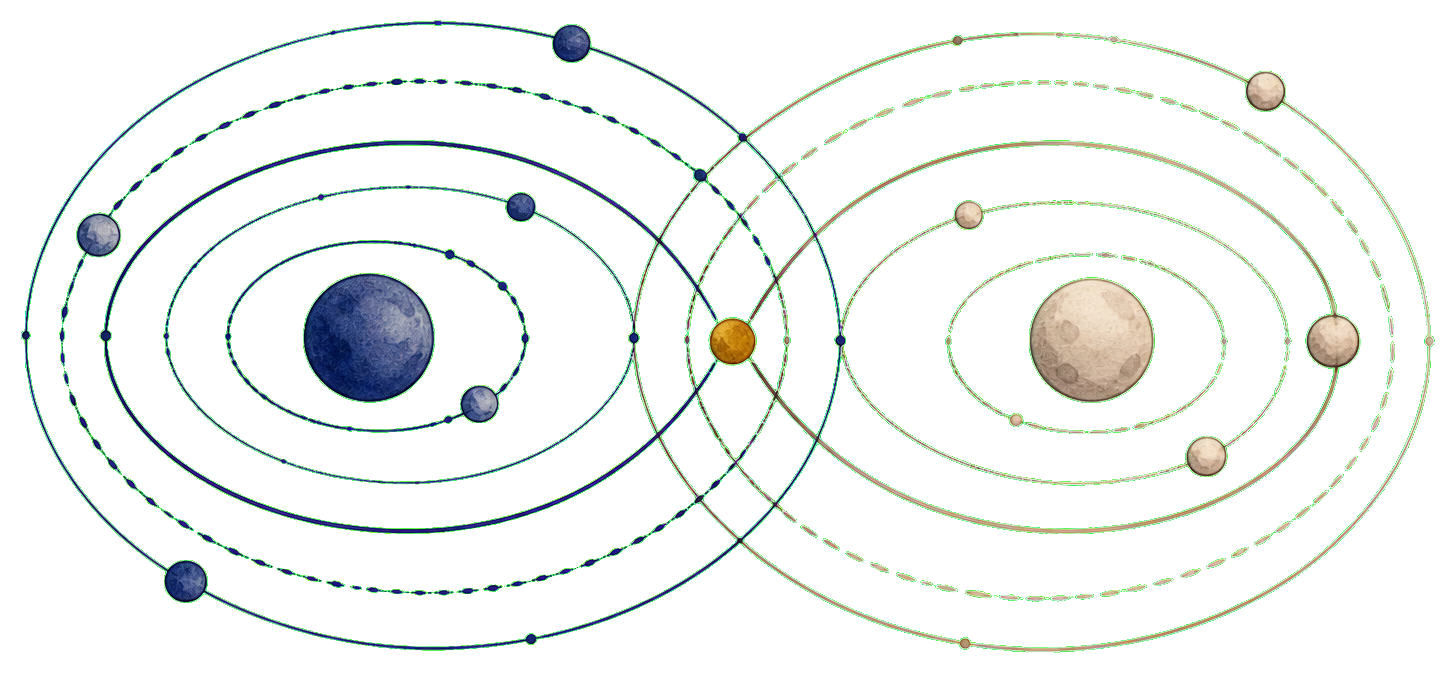
Relationship is more demanding and more alive than that. Two or more centers of experience meet under material conditions, each bringing perception, history, capacity, desire, and choice. Their interpretations overlap imperfectly, and institutions, resources, social roles, and chance shape what happens. A relationship emerges from the interaction without becoming fully owned by either person.
Six layers of a relational event
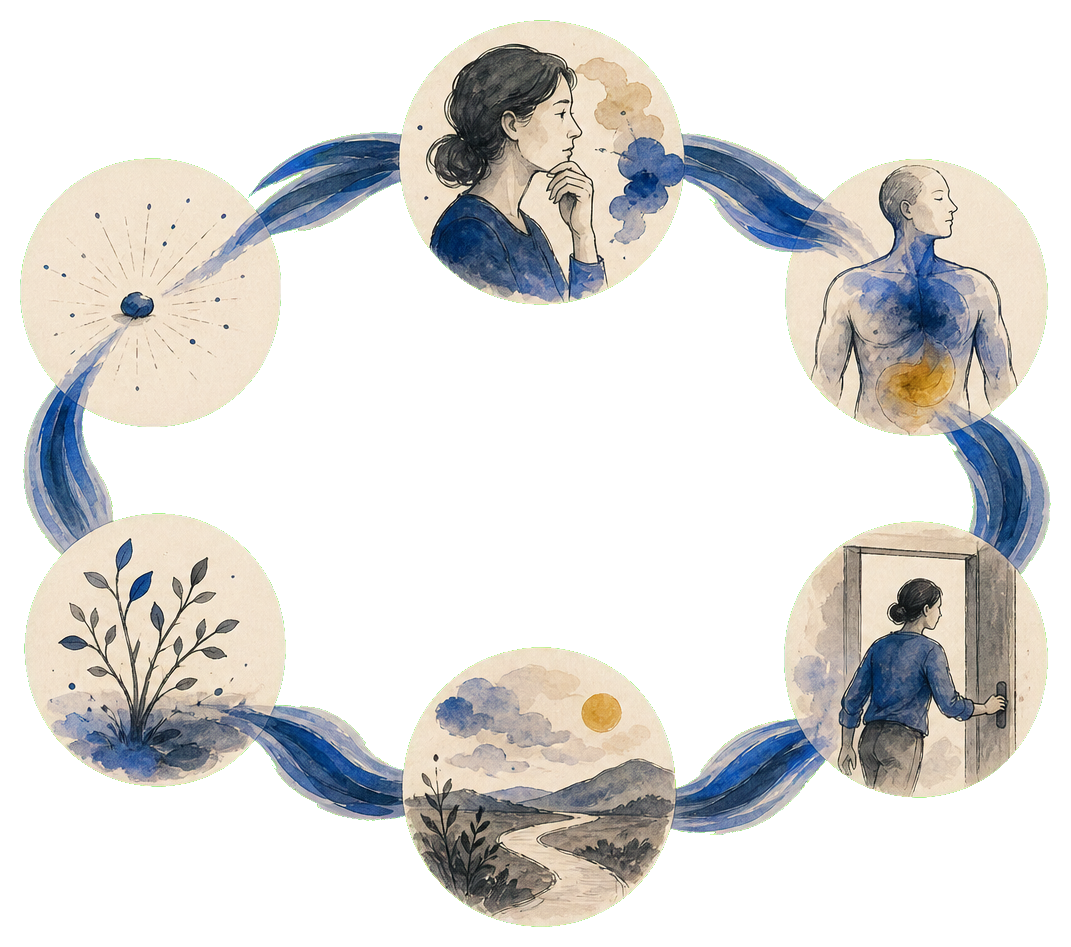
When a relationship activates a strong pattern, six layers are worth separating before assigning meaning. The observable event is what a camera, message record, contract, or neutral witness could confirm — “they cancelled dinner two hours before we were due to meet” — and naming it reduces mind-reading. The private experience is what you sensed, felt, remembered, imagined, and wanted; it is real as experience even when its explanation remains uncertain. The interpretation is the meaning you assigned (“I am unimportant to them”), and it can be accurate, partly accurate, or wrong, with confidence following evidence. The other person’s account adds evidence from another center of experience; it does not automatically settle the facts, and credibility depends on consistency, history, incentives, corroboration, and behavior. The pattern and agreement layer asks whether the event is isolated or repeated and what both people agreed to, because a single cancellation due to illness belongs to a different pattern from repeated disregard after explicit conversations. The context and power layer asks who controls money, housing, employment, immigration status, community access, caregiving, reputation, or physical safety, because power changes the meaning and risk of communication. Held together, these layers let inner work and external accountability coexist.
Projection is a hypothesis
Projection is often used loosely to mean “your reaction is about you.” A reaction always occurs within a person, yet it can still respond accurately to another person’s conduct. If I expect rejection and interpret a neutral pause as contempt, my expectation may shape perception; if someone repeatedly insults me and I feel hurt, the reaction contains information about their behavior. Both can be true at once: an old wound intensifies the response, and a present action violates a value.
A careful projection inquiry asks what exactly the other person did, what I added through prediction or memory, what evidence supports each interpretation, what pattern appears across time, what I would conclude if a friend described the same facts, and what information could change my mind. The inquiry cannot be used to excuse harm; “you are projecting” is often a refusal to address impact.
Consent is a continuous condition
Consent gives relationship a correction mechanism, allowing each person to state whether contact, touch, disclosure, collaboration, or access remains welcome. It needs several conditions at once: it must be voluntary (threats, dependency, intoxication, deception, and severe pressure undermine freedom), specific (agreement to one action does not imply agreement to another), informed enough (relevant facts and foreseeable consequences are available), current (past access does not guarantee present access), revisable (a person can change their mind), and communicable (the setting makes yes, no, uncertainty, and pause possible).
The framework does not treat silence as mystical consent, and it does not treat arousal, attraction, history, marriage, spiritual claims, or another person’s intuition as permission. Consent also has a relational dimension beyond minimum permission: a person may technically agree while feeling unable to disappoint, leave, or negotiate, and care asks what conditions make the agreement meaningful.
Conflict is information about the system
Conflict reveals differences in need, perception, value, resource, expectation, or power, and useful conflict makes those differences informative while refusing to normalize contempt, coercion, or violence. A conflict can be mapped through five questions: What outcome is each person seeking? What fact or interpretation is disputed? What value or need is threatened? What agreement exists? What decision follows if no agreement is possible? Some conflicts can be repaired through information and apology, some require renegotiation, some reveal incompatibility, and some require distance, legal protection, or exit. Repair has observable components — naming the behavior, acknowledging impact, taking responsibility without demanding immediate forgiveness, offering proportionate repair, and changing conditions that make repetition likely — and remorse without changed behavior is incomplete evidence.
Power changes what “choice” means
Two people can speak the same words under unequal conditions. “You can leave if you want” means little when one person controls housing, money, transport, documents, employment, or community belonging. Power can be formal or informal — legal authority, employment and financial control, physical strength or access to weapons, social status and audience reach, expertise and control of information, racial, gendered, caste, class, or citizenship advantage, caregiving dependence, or spiritual and therapeutic authority. Power is not automatically abuse, but it creates responsibility and risk: a teacher, employer, healer, author, parent, or community leader has greater capacity to frame reality and greater duty to preserve dissent and correction. This is especially important in systems that call disagreement “resistance,” “ego,” “low frequency,” or failure to trust, because such language can make authority unfalsifiable. A healthy framework lets a participant reject the interpretation without losing dignity or safety.
Chance and the unassigned event
Some events have no available personal meaning. A driver runs a red light. A storm destroys a home. A genetic condition becomes symptomatic. A stranger is kind. A flight is delayed and two people meet. Humans can create meaning afterward, but the meaning is authored in response to the event; it is not proof that the event was arranged for the lesson. This distinction protects grief from explanation. When someone is suffering, “everything happens for a reason” may serve the speaker’s need for order, while care begins closer to the person: “This happened. I am here. What do you need?” An unassigned event can remain unknown, and the absence of cosmic explanation does not remove the possibility of courage, repair, beauty, or creation.
Mirror, window, and door
Three relational metaphors do the work that one could not. The mirror asks what my reaction reveals about my expectations, wounds, values, and desires. The window asks what I can learn about the other person through their words, behavior, context, and history. The door asks what access, boundary, or next action is appropriate. Mirror without window becomes self-enclosure; window without mirror can ignore our contribution; either without a door can produce endless analysis without decision.
Intimacy requires separateness
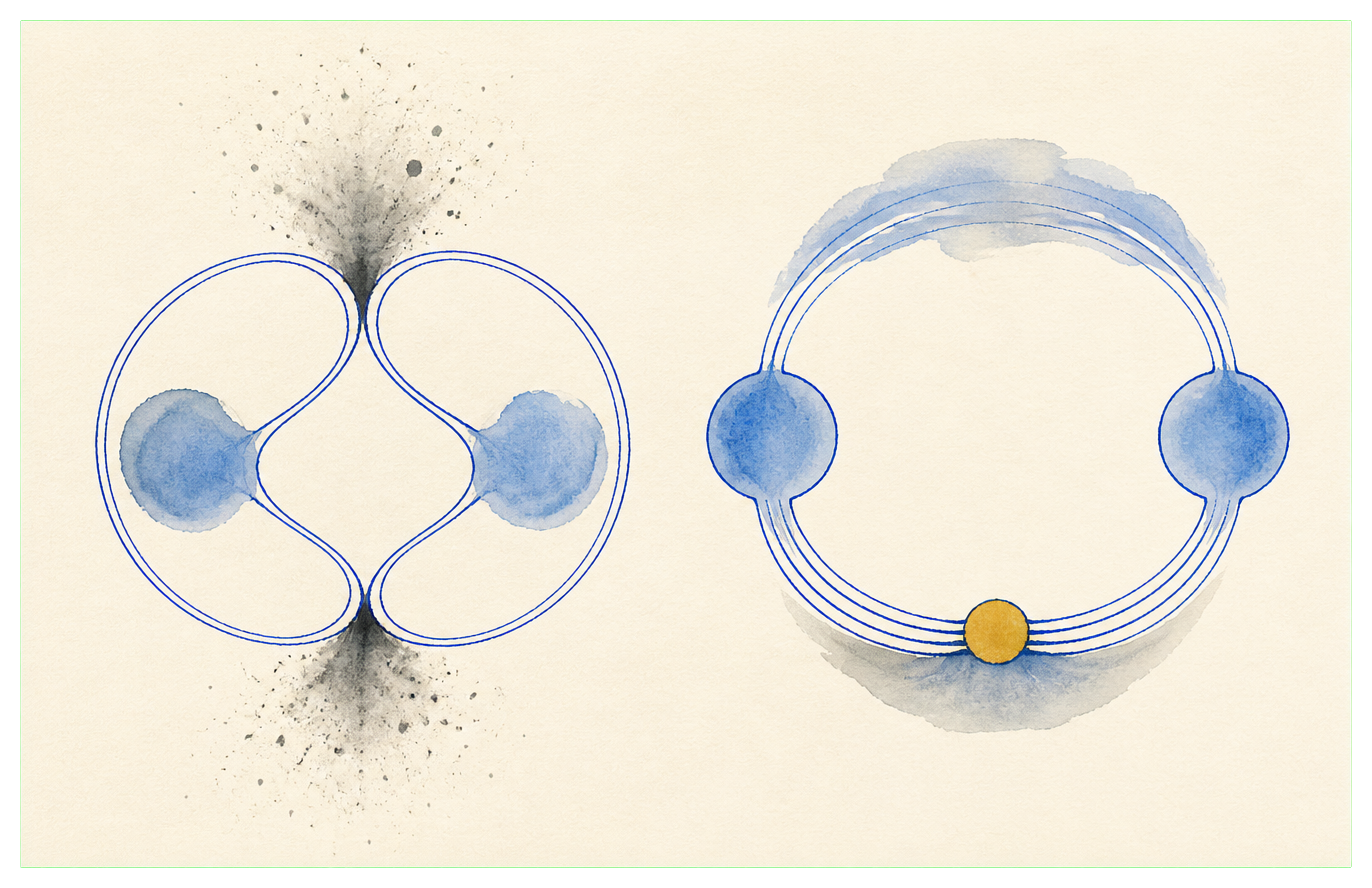
Fusion can feel like intimacy because uncertainty briefly disappears; if we think the same thoughts, want the same things, and never create distance, the relationship seems safe, and the price is that difference becomes danger. Intimacy has a different structure. Two people remain separate enough to reveal something true, hear something unexpected, negotiate access, and survive a difference without erasing either person. This structure includes privacy: love does not create a right to every thought, password, memory, friendship, body, or hour, and transparency should be defined through agreements rather than demanded as proof of devotion. It also includes interdependence. Separateness is not isolation; people rely on one another, coordinate, care, borrow strength, share labor, and build common life, and healthy dependence becomes more trustworthy when it can be named, negotiated, and revised.
When the relationship ends
An ending does not prove that the relationship failed. It may reveal incompatibility, completed purpose, changed conditions, accumulated harm, or a choice one person cannot share. Closure cannot always be jointly produced: another person may refuse explanation, accountability, or contact, and internal closure then means accepting the available facts, grieving the missing answer, and deciding what access remains. It does not require inventing a hidden cosmic agreement. The ending can remain unjust; self-authorship does not convert injustice into gratitude, but it asks what life can be built from the truth that remains.
The unanswered message
Noor sends a vulnerable message to a close friend. Two days pass without a reply, and the silence activates an old conclusion: “When I need something, people disappear.” The six-layer map slows the event. The message was delivered, and no reply has arrived within forty-eight hours. Privately there is fear, embarrassment, anger, and an urge to delete the conversation. The interpretation is that the friend is avoiding the vulnerability and no longer values the relationship. The friend’s account is currently unavailable. The pattern shows that the friend usually replies within a day and has asked that urgent needs be marked clearly, which Noor did not do. The context is that both people can contact and leave freely, and that the friend is caring for an ill parent — Noor knows this but not the current situation.
The map does not make the silence painless; it prevents one interpretation from becoming the whole relationship. Noor sends one follow-up: “This was vulnerable for me, and the silence is difficult. I know you have a lot happening. Please tell me whether you have capacity to respond this week.” Several outcomes remain possible — the friend may respond with care, explain limited capacity, avoid the question, become defensive, or continue the silence — and each supplies relational evidence. The case shows why direct communication and behavior over time carry more weight than imagined motive, and why context cannot become an endless excuse: a real caregiving burden explains limited capacity, but it does not prevent the friend from eventually naming that limit.
Digital contact changes the field
Messages remove many cues and preserve others. Tone, facial expression, immediate repair, and shared context may be absent, while timestamps, exact words, edits, screenshots, and patterns of availability become visible. Digital systems also create new relational ambiguities — read receipts, public activity during private silence, disappearing messages, recommendation algorithms, shared locations, and expectations of constant reachability — so agreements should become explicit: which channels are urgent, what response time is realistic, what information may be shared or screenshotted, whether location sharing is voluntary and revocable, when conflict should move to voice or in person, and what contact remains appropriate after a relationship ends. Technology can support connection and become infrastructure for surveillance or coercion; “if you loved me, you would share your password” turns access into proof, and love does not require eliminating privacy.
Conflict styles are arrangements, not identities
People may approach conflict quickly, need time, seek detail, become quiet, use humor, or want reassurance. Naming a style can improve coordination, while turning the style into identity can excuse harm or make change impossible. “I am avoidant” cannot settle whether someone will return to a conversation; “I am direct” cannot excuse contempt; “I need processing time” becomes useful when paired with a return time. A conflict agreement can specify the signals that a pause is needed, a maximum length before contact resumes, prohibited behavior such as threats or public exposure, how each person can correct the record, which decisions require calm and which require immediate safety action, and what happens when the agreement is repeatedly broken. The agreement cannot guarantee skill, but it makes expectations visible enough to review.
Mutuality and asymmetry
Relationships pass through asymmetric seasons. One person becomes ill, earns more, grieves, has specialized knowledge, or carries pregnancy, immigration risk, disability, or care responsibility. Mutuality cannot mean identical contribution in every interval; the question is whether asymmetry remains legible and accountable. Can the person receiving more name the support? Can the person giving more state limits without moral punishment? Are resources shared according to capacity and need? Is the arrangement reviewed? Does the asymmetry become a permanent entitlement? An equitable relationship may look uneven from outside, and a coercive relationship may look equal on paper. The operating conditions matter.
Abuse is not a mutual pattern exercise
When one person uses violence, threats, surveillance, isolation, sexual coercion, financial control, stalking, or systematic intimidation, language about co-creation and mutual triggers can obscure responsibility. The behavior belongs to the person using it. The affected person may need secrecy, documentation, advocates, legal options, emergency resources, or a carefully timed exit, and direct confrontation and couples exercises may increase danger. The person harmed can still have patterns, feelings, and choices; those facts never distribute responsibility for another person’s abuse.
Relationship as a small institution
A long relationship develops roles, norms, resource flows, stories, and enforcement; it becomes a small institution. Who plans, remembers, earns, decides? Whose career moves? Which family receives holidays? How is sex initiated? Who can spend? What becomes private? How is repair recognized? Many answers emerge through habit rather than explicit decision, and the systems map can reveal them without turning intimacy into bureaucracy. One annual conversation about labor, money, care, privacy, desire, family, and future can expose where an old role became a rule, and its purpose is shared authorship of the arrangement rather than numerical balance.
Reality is co-created and independently constrained
People do co-create parts of reality: agreements, households, teams, cultures, rituals, markets, institutions, and shared meanings. Co-creation requires contribution from more than one center, and no individual controls the whole result. Reality also constrains every participant through bodies, ecology, law, resources, history, other people’s choices, and events nobody selected, and the capacity to author meaning and action lives within that larger terrain.
This is the relational correction to the mirror principle:
My inner patterns influence what I notice and do. Your reality remains your own. Our interaction creates consequences neither of us can define alone.
The mirror that once became a wall does not have to be discarded; it only has to share the room with a window onto the other person and a door that consent can open or close. Inner patterns influence what I notice and do, another person’s reality remains their own, and our interaction creates consequences neither of us can define alone.