Harvest, Attention, and Collective Systems
The hand that reaches for the phone
Your hand reaches for the phone to answer one message. A red badge points to another. A video begins before you choose it. Ten minutes later your attention has crossed several arguments, advertisements, private lives, and unfinished desires, and the message you sat down to answer is still unanswered.
The experience can feel personal — weak discipline, curiosity, boredom, or habit. It is also, quietly, a designed system. Somewhere a team measured how long you stay, which thumbnail holds you, which notification color pulls you back fastest, and tuned the surface until your morning became their metric.
The question this chapter carries is narrower than it first looks: when attention, identity, and meaning get organized for someone else’s benefit, what is actually being taken, and what would make it possible to put the phone down?
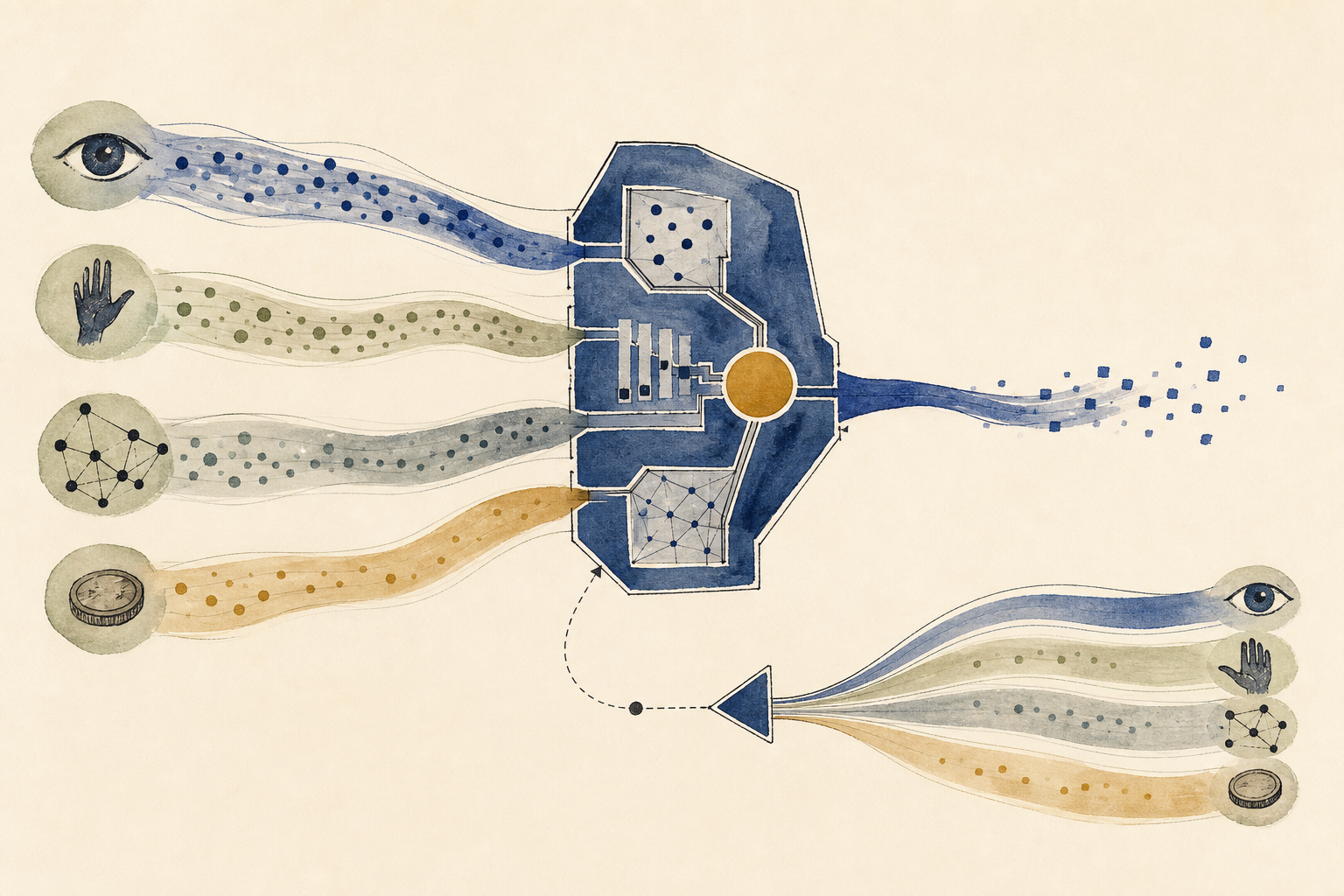
The return route marks exit and restored agency. This is an incentive map, not a metaphysical entity.
The word that did too much work
For a season I described everything that depleted me as a harvest. A meeting that left me hollow had “harvested my energy.” A platform that made me anxious to check it was “feeding on my attention.” A community that asked too much of its members “harvested devotion.” The word came easily because it carried a real felt truth: something was being taken, and the taker was hidden inside a structure rather than standing in front of me.
But the word did too much work. It moved silently across very different things — a measurable business model, a private psychological loop, a metaphor for exhaustion, and a speculative claim about invisible entities consuming human emotion. Each of those asks for a different response. Treating them as one left me either outraged at everything or unable to act on anything.
Separating them is the work of this chapter. Harvest can name six distinct layers, and one word should not be allowed to slide between them unnoticed. At the bottom sits observable attention extraction — a system competing measurably for your time and interaction. Above it runs a psychological dependency loop, the felt experience of being pulled back. Both rest on an economic incentive, since someone profits when engagement rises. The same force concentrates into institutional power when one actor controls the categories, access, and exit. Separately, there is symbolic harvest language — the way a culture turns exhaustion into imagery. And finally there are speculative metaphysical harvest systems, claims that nonphysical entities or grids feed on fear, worship, or attention. Six layers, one borrowed word.
The distinction protects both analysis and imagination. Observable mechanisms become easier to change. Symbolic and metaphysical readings remain clearly labeled.
Attention as a scarce resource
Human attention is limited in the most ordinary way. Every choice to notice one thing leaves other things unattended. The economist Herbert Simon described a wealth of information as producing a poverty of attention.1 When information multiplies, what becomes scarce is the capacity to hold any of it.
Digital systems measure that scarcity with precision. They count clicks, viewing time, replies, purchases, and return visits, and feed those counts back into design. Extraction becomes visible in the small mechanics: a notification that interrupts, content that begins before you consent, a feed with no stopping point built in, a reward for frequent checking, a social response turned into a visible count, a door that is easy to enter and quietly hard to leave. None of these is automatically sinister. A reminder can support a chosen practice; the same reminder can exploit urgency. What matters is consent, transparency, control, and consequence — whether you can see the mechanism and answer it.
The dependency loop
A dependency loop forms when relief, belonging, status, novelty, or certainty becomes linked to repeated engagement. It can be mapped without diagnosing the person inside it:
cue → anticipation → action → variable result → emotional update → renewed cue sensitivity.
A notification produces anticipation. Opening the app may bring affection, or conflict, or novelty, or nothing at all. The variation keeps the outcome uncertain, and uncertainty keeps the hand moving back. Loneliness maintains it, or work expectation, or social obligation, or interface design, or habit, or political fear — sometimes a genuine practical need. An individual intervention may reduce the cues. A structural one may change the defaults, the metrics, or the business model behind them. Treating the loop only as personal weakness hides the design. Treating the person as powerless hides the choice that remains.
When the incentive does the work
A business model shapes which behaviors become valuable. When revenue rises with attention, a platform has reason to increase time, return, and interaction. When a creator’s income depends on reach, they learn which emotions and formats distribution rewards. When advertisers can target identity and insecurity, personal information acquires market value. No secret conspiracy is required. Ordinary incentives, each rational on their own, can produce an environment saturated with urgency.
This is the same chain Chapter 8 traced for inner patterns becoming systems — a response hardening into a story, a norm, a role, an incentive, an institution, an enforcement, a culture, and finally the conditioning of the next person who enters. Here the story may be “visibility equals relevance.” The role becomes continuous performer. The incentive rewards frequent output. The platform formalizes the rule. The culture trains people to experience silence as disappearance. The chain is not mine to rebuild here; what belongs to this chapter is the observation that attention itself has now become a link in it. A coherent intervention must address the incentive as well as the feeling, because the feeling was engineered to protect the incentive.
Where the taking concentrates
Extraction grows more consequential when one actor controls the categories of access, payment, visibility, appeal, and exit. The taking moves from the diffuse economy of a feed into the asymmetric economy of a workplace, a religious community, a family, a campaign, or a data system. A workplace can harvest uncompensated emotional labor. A religious community can depend on unquestioned service. A family can assign one person the role of absorbing conflict. A political campaign can turn fear into mobilization. A data system can convert ordinary activity into an enduring profile.
The common mechanism, in the cases I've traced, is asymmetric benefit: someone supplies a resource, someone else collects the value, and the arrangement is hard to see clearly enough to refuse. Rather than announce the questions a reader should ask, the test is simpler to hold in the body of the inquiry: what resource is being supplied, who receives the benefit, who bears the cost, whether participation can be refused, whether refusal is punished, whether the person can see how the resource is used, and whether any correction or appeal exists. Power becomes visible through the conditions of refusal. A system that punishes the act of naming what it takes is not the same as one that merely asks for much.
Data as extracted memory
The resource supplied is larger than attention. Digital systems turn behavior into records that persist long after the original interaction ends. Search, location, purchase, contact, health, biometric, and communication data can be combined to infer interests, routines, risk, and identity. What is being taken is, in effect, memory about the person: a sediment of their days that they cannot easily inspect, correct, or carry away.
Consent grows weak when a necessary service requires broad collection through unreadable terms, and formal agreement does not settle whether the exchange is fair. Data can create real benefit: a health record coordinates care, location helps navigation, personalization reduces search. The ethical problem is not collection itself but proportionality, security, secondary use, power, and correction — whether the record serves the person it describes or only the system that holds it.
The labor that gets called personality
Extraction is easiest to hide where the resource is emotional. A service worker remains warm while receiving hostility. A manager absorbs team distress without support. An employee from a marginalized group repeatedly explains discrimination. A founder performs certainty to protect investment. Emotional labor can be a legitimate part of a role. Extraction appears when the labor is invisible, unlimited, unequally assigned, or uncompensated while another party receives the benefit.
The system usually converts the labor into personality before anyone notices. “She is naturally caring.” “He handles pressure well.” “They are good at culture.” The description turns hours, recovery, and skill into a character trait, which makes the cost impossible to negotiate because it has stopped being visible as cost. Naming the labor in role scope, distributing high-intensity contact, building in escalation and recovery, protecting workers from abuse, and compensating required availability are not acts of generosity. They are the minimum that lets an organization stop pretending its smoothness is free.
When extraction is made sacred
Communities organized around healing, salvation, awakening, service, or mission can draw extraordinary commitment, and the commitment may sustain genuine care. It can also make extraction sacred — which is the hardest form to refuse, because refusing now looks like a spiritual failure.
The warning signs read less like a checklist than like a single texture that thickens over time. Unpaid labor is framed as proof of devotion, and escalating payments are required for higher access. Leaders exempt themselves from ordinary accountability, while private disclosure is used to maintain loyalty. Exhaustion gets interpreted as resistance, and separation from outside relationships is counseled as protection. Prophecy creates urgency, and exit is framed as spiritual danger. The harvest metaphor fits these settings because identity and meaning are genuinely being converted into labor, money, status, or control. Only the conversion has been dressed in sacred language, so the person being drained reads their depletion as devotion.
Observable language is the antidote. Record the hours, the payments, the promises, the access rules, the disciplinary practices, the confidentiality terms, and the treatment of dissent. Seek appropriate legal, safeguarding, financial, or mental-health support where harm has occurred. Calling the system an energetic trap may express the experience accurately. Documentation creates a route to accountability that intensity alone never will.
Attention organized as fear
Political systems need attention too. Public warnings can mobilize people around real danger. Campaigns and media can also benefit from continuous threat, identity conflict, and short reaction cycles. The mechanism is not that anger itself feeds an invisible system. It is the ordinary machinery of donation, reach, voter mobilization, advertising, agenda control, and the suppression of nuance.
A political message can be evaluated without descending into permanent suspicion: read the specific claim and its source, the action requested, the urgency and its deadline, the identity being offered, the predicted enemy, the person or institution receiving money or power, the correction available after a falsehood spreads, and the material outcome for the people affected. A message can be emotionally intense and accurate. A calm message can be deceptive. Tone is not the evidence. The response — organizing, voting, protest, donation, journalism, legal action, mutual aid, conversation, refusal to share, or deeper study — should lead toward civic capacity rather than permanent spectatorship.
The symbol that returns to mechanism
Symbolic language compresses a complex experience into something a person can hold. “That room harvested my energy” may simply mean the interaction demanded attention, emotional regulation, performance, or vigilance and left the person depleted. Translation is where the symbol earns its keep: once depletion is named in ordinary terms, it points toward action — reduce the duration, change the task, request shared responsibility, decline the role, rest, or investigate a health concern.
The symbol turns harmful when every difficult interaction gets read as intentional energetic theft. That reading increases suspicion, isolates the person, and erases ordinary explanations such as conflict, fatigue, overstimulation, anxiety, incompatible expectations, or illness. The symbol is useful when it returns to mechanism. It is dangerous when it replaces mechanism entirely.
The hypothesis that cannot be enforced
Some spiritual and esoteric systems propose that nonphysical entities, grids, or collective structures feed on fear, worship, conflict, or attention. This is a metaphysical hypothesis. I cannot establish it as observable fact. It may function as a mythic description of how people feel inside coercive systems. It may also intensify fear and make ordinary disagreement appear spiritually dangerous.
The ethical test comes before the metaphysical one. Such a model should never discourage medical care, mental-health support, legal protection, or direct investigation, and it must not identify another person as a hidden entity or assign them secret spiritual motives. Ordinary distress is not proof of attack. If a model produces only vigilance and isolation, its practical effect deserves scrutiny regardless of its ultimate truth. A model that increases fear and isolation should be set aside, whether or not it turns out to be metaphysically true.
Harvest Exit
Harvest Exit is my term for withdrawing participation from an extraction loop. The exit can occur at several levels: attention, where cues are removed or batched; behavior, where an automatic response is no longer supplied; relationship, where access or labor is renegotiated; environment, where a space or schedule is left or altered; economic, where purchase, employment, or platform participation shifts; institutional, where people organize, appeal, regulate, or build an alternative; symbolic, where an identity that made extraction feel obligatory is released; and spiritual, where prayer or ritual becomes a personally meaningful support without being assigned factual authority over others.
Exit is rarely pure. People depend on jobs, family, platforms, communities, and public systems. The goal is to identify the smallest meaningful change available without blaming someone for constraints they did not choose.
Elena and the platform she cannot leave
Elena earns most of her income through a video platform that rewards frequent posts and rapid responses. When she takes a week off, reach declines. Followers expect personal access, because intimate disclosure is what built the audience in the first place.
An individual-only reading says Elena needs better boundaries. A platform-only reading says she has no choice. The layered map shows why both are incomplete. Notifications and metrics cue continuous checking. Variable reach links her output to anxiety and relief. Her income depends on distribution she cannot control. The platform sets the categories, ranking, payment, and appeal. Her followers know a version of private life she can no longer fully retract. And her rent depends on the income.
A pure exit would cost her seriously, so Harvest Exit becomes diversification. Elena batches communication, defines which topics are private, builds an email list she can export, develops a paid product with clearer delivery terms, saves a transition reserve, and reduces one posting cycle while tracking income. She joins other creators advocating for transparent policy. The first month may reduce her revenue. The exit is evaluated across income stability, attention, privacy, health, and audience relationship — not across a single dramatic gesture. Sovereignty, here, means changing dependency architecture over time rather than performing sudden independence.
Exit can become privilege
Advice to leave assumes there is somewhere to go. People remain on a platform because customers are there, stay in a job for health insurance, remain near family for care, or depend on a religious community for housing and identity. The person with more resources can exit sooner — and may then judge those who remain.
A collective exit strategy creates shared alternatives instead of solitary ones: emergency funds, cooperatives, unions, portable audiences, legal clinics, mutual aid, independent media, open standards, public options, community care. The design question changes from “Why don’t they leave?” to “What would make refusal survivable?” Refusal is not a test of will. It is a function of what the surrounding world makes possible.
The same inquiry works in reverse, translating the felt word “harvested” into inspectable layers. When a system feels consuming, manipulative, or impossible to leave, the move is not to argue about whether it is “really” extracting energy. It is to record the observable interaction, name the resource supplied, identify the personal need or cue involved, identify who benefits economically or institutionally, identify the power held over access and exit, write the symbolic meaning separately, mark any metaphysical claim as hypothesis, choose one level-appropriate intervention, and define an outcome that would show improvement. Fear shrinks when the mechanism becomes legible.
Building what is not a trap
A map of extraction is incomplete until it supports creation. An alternative platform might minimize interruption, make recommendation controls visible, and separate payment from surveillance. A workplace might recognize coordination labor, protect refusal, and audit workload. A community might rotate roles and create independent correction paths. A family might distribute care rather than moralize one person’s sacrifice. Each asks the same generative questions without announcing them as a list: what resource the system needs, how it can ask transparently, what constitutes meaningful consent, how participants can inspect the use, which costs need redistribution, what stopping point restores choice, how exit stays possible, and what feedback changes the design. The metaphysical imagination can contribute symbols and values; the human architecture supplies the operating conditions they have to live inside.
Non-extractive does not mean costless. Every system needs resources. It means the request, the exchange, and the governance remain legible enough for participants to choose and correct — a clear resource request, proportionate collection, fair compensation or reciprocal value, limits on secondary use, distributed decision power, repair after harm, and an exit that does not erase the person’s identity or essential access. No system satisfies these perfectly. At personal scale this might mean asking before emotional disclosure and accepting that a friend lacks capacity. At business scale it might mean charging transparently and protecting worker time. At platform scale it might mean paid service without surveillance, interoperable data, and meaningful controls. At community scale it might mean rotating service and publishing finances. Extraction becomes easier to refuse the moment participation has another design.
From fear to discernment
Harvest language once helped me recognize that attention and identity could be organized for someone else’s benefit. The correction was to keep seeing the taking while refusing to let one word blur six different things into a single dread. Observable extraction deserves evidence and intervention. Psychological loops deserve compassion and design. Economic incentives deserve transparency. Institutional power deserves correction paths. Symbolic language deserves translation. Metaphysical hypotheses deserve explicit limits. Discernment reduces the need for a totalizing enemy — and, just as importantly, it makes real extraction harder to hide.
Your hand is on the phone again. The badge is red. The video is queued. Nothing about the moment has changed, and yet you are no longer inside it in quite the same way. You can see the cue for what it is, feel the pull without obeying it as destiny, and ask, quietly, before the screen decides for you, whether this is the room you want to enter, and whether usefulness is still the price of staying. The life written before you could choose does not have to remain the only author of what you attend to next.