Time, Memory, and the Open Field
The room that selected its next move
I was sitting on the floor of an apartment I was about to leave, a half-packed box beside me, when I told a friend that my nervous system was choosing which timeline I would enter next. I meant it as illumination. State and expectation had genuinely changed which options I could see. Fear had been narrowing my range for months; once the fear softened, the apartment, the work, and the relationship I had been holding together all looked like choices rather than fates. The sentence gave vivid form to an ordinary truth.
It also carried an overreach I did not hear at the time. By saying the nervous system selects timelines, I had folded four different questions into one and dressed the result as a single mechanism. A change in my body had changed what I noticed. That is a psychological claim. The afternoon feeling long while I packed is a different claim, about lived duration. The blue feather I kept seeing in three places that week was a symbol I was reading for meaning. And the suggestion that real futures already exist in parallel, with my nervous system routing me between them, was a cosmology the observation could not establish.
The mistake was not in any one of those sentences. It was in the folding. Each account illuminates the others. None of them can answer the others automatically, and calling them one claim lets the strongest-sounding one carry the rest without earning the load.
I learned to keep the accounts apart the way I had learned to separate observation from interpretation in Book I. The psychological account asks how learning, expectation, memory, and state shape present action. The phenomenological account asks why a minute can feel long, a decade near, or an absorbed afternoon gone. The symbolic account asks what a recurring image or coincidence means to the person who meets it. The metaphysical account asks whether time is an ultimate feature of reality, an emergent relationship, a structure within consciousness, or something else entirely.
The practical mechanisms stay available inside their own account. The metaphysical possibilities stay open inside theirs. What I lost by folding them was the ability to test any one claim on its own evidence — and that is the faculty I set back on the floor beside me.
Clock time and lived time
Clock time coordinates shared activity. A train departs, a medication interval passes, interest accumulates, a child grows, a deadline arrives. This public structure matters, and metaphysical language should not be used to evade its consequence or its chronology.
Lived time describes how duration appears from inside experience. Waiting can enlarge a minute. Absorption can compress an afternoon. Grief can make the future feel inaccessible. Memory can bring an old room into immediate emotional proximity.
The clock and the experience can differ without either becoming false, because they answer different questions. Precision lets a common confusion come apart at the seam. “It feels as if no time has passed” is a phenomenological report. “No time has passed” is a public factual claim. “All moments exist simultaneously” is a metaphysical proposition. Each sentence can be examined on its own terms once it stops borrowing the authority of the others.
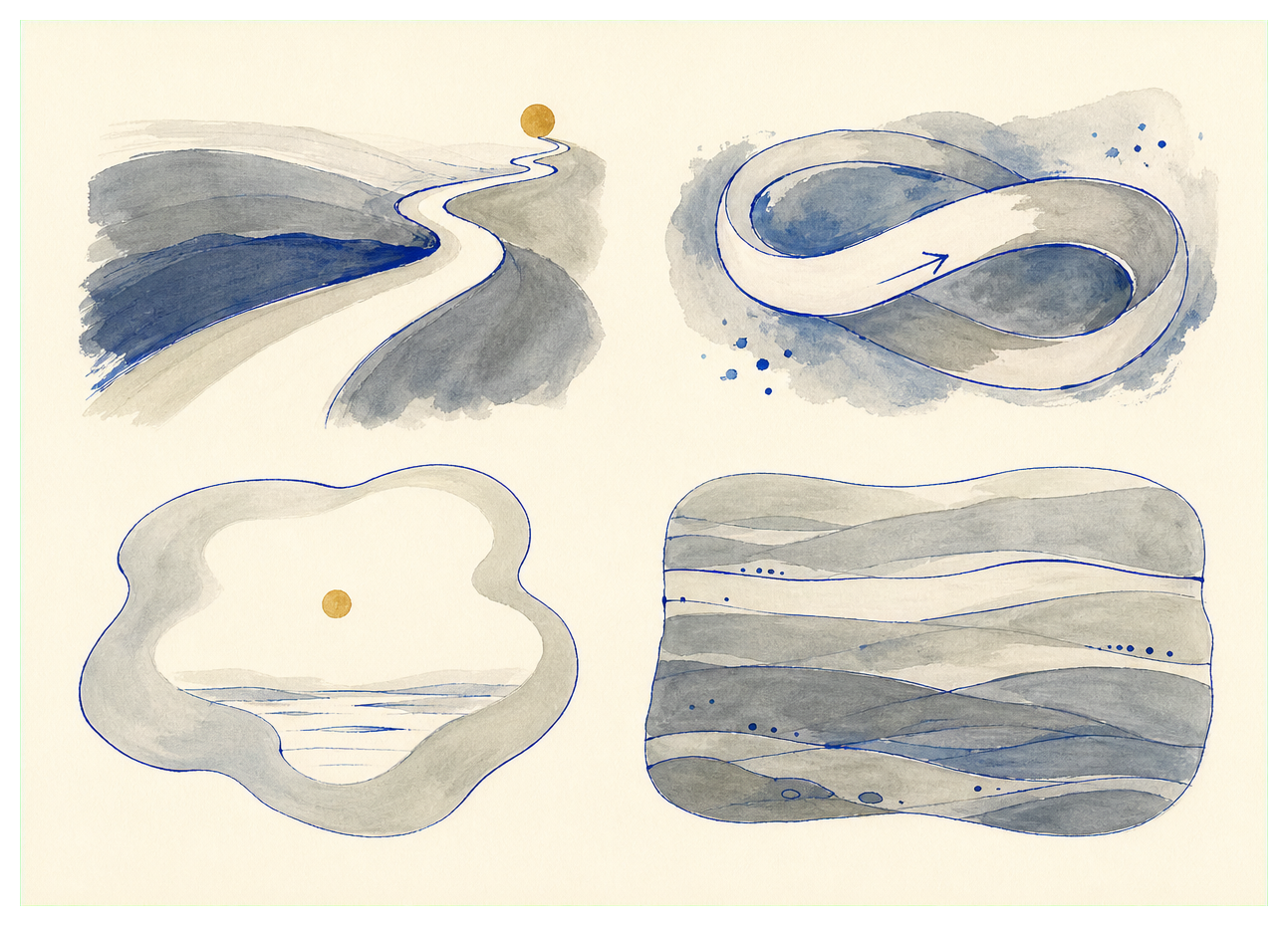
Psychological time: prediction and action
The mind uses prior experience to anticipate what may happen next. That is one reason the past influences the present. A person who has repeatedly met punishment after disagreement may predict punishment in a new disagreement, and the prediction shapes attention, bodily activation, and behavior.
The causal loop from Book I still applies here, now read as a temporal mechanism:
The loop is temporal because earlier outcomes influence current prediction. It does not require the past to exist literally in the present. It also carries correction rights. A new situation may differ from the old one; a person can gather evidence, build skill, change environment, or receive support. Repeated safe disagreement may weaken the prediction. Repeated retaliation may confirm that the current setting is genuinely unsafe. Psychological time therefore holds both continuity and update in one hand.
Memory is reconstruction and coordinate
Memory provides access to prior experience through a present act of remembering. It can carry detail, emotion, bodily response, meaning, and gaps; it can be vivid and still incomplete; and different people can remember the same event differently.
For daily self-authorship, memory has two useful functions. It offers a coordinate — “I remember learning to stay quiet in rooms like this” — which helps explain why the current event carries unusual weight. And it offers a claim to examine: what do I remember, what record exists, what remains uncertain, and what meaning have I added since?
Care becomes essential when memory concerns alleged harm, legal facts, or another person’s conduct. Imagery, dreams, body sensations, hypnosis, meditation, and suggestion cannot independently establish historical events.1
Repetition and the feeling of “again”
An old pattern can make a new event feel inevitable. The familiar body state arrives, the familiar story follows, and time seems to fold.
I call this return time as a phenomenological description. It captures the experience “I am back there” while preserving the factual distinction “I am here, remembering or reacting.” Return time can have many causes — a cue that resembles an earlier event, a current relationship that repeats an actual dynamic, exhaustion that reduces flexibility, a season or smell or song or anniversary that evokes memory, or persistent trauma symptoms that deserve qualified assessment.
The language is meant to help orientation rather than collapse it. When a safe present event feels strongly like an earlier harmful one, the orienting move is to hold both tenses at once: then, these were my conditions; now, these are my conditions; the overlap is this cue or pattern; the difference is this resource, boundary, person, knowledge, or option; and the next action belongs to the present. If orientation stays difficult after that, that is a signal to seek support rather than push the present to resemble the past.
Absorption and the spacious hour
Some activities reorganize lived time through attention. Writing, music, sport, prayer, making, conversation, and play can reduce awareness of the clock; boredom, vigilance, pain, and waiting can intensify it.
These differences matter for designing a life. A calendar allocates public time, but attention determines much of its lived texture, and interruptions, uncertainty, and monitoring can fragment an hour even when the duration is unchanged. The practical response is environmental: protect a block, reduce one interruption, define the task, end at a known time, and observe whether attention changes. This account does not need “higher frequency” to explain itself. It describes the relationship among attention, activity, context, and experienced duration.
The open field as a metaphor
The open field is my metaphor for a present in which more than one next action becomes visible. It often appears after an inherited role loosens and before a new commitment forms — the floor I was sitting on, half-packed, was one. The field can feel spacious or frightening. Familiar identity provided direction, even when the direction was costly, and without it possibility can look like emptiness.
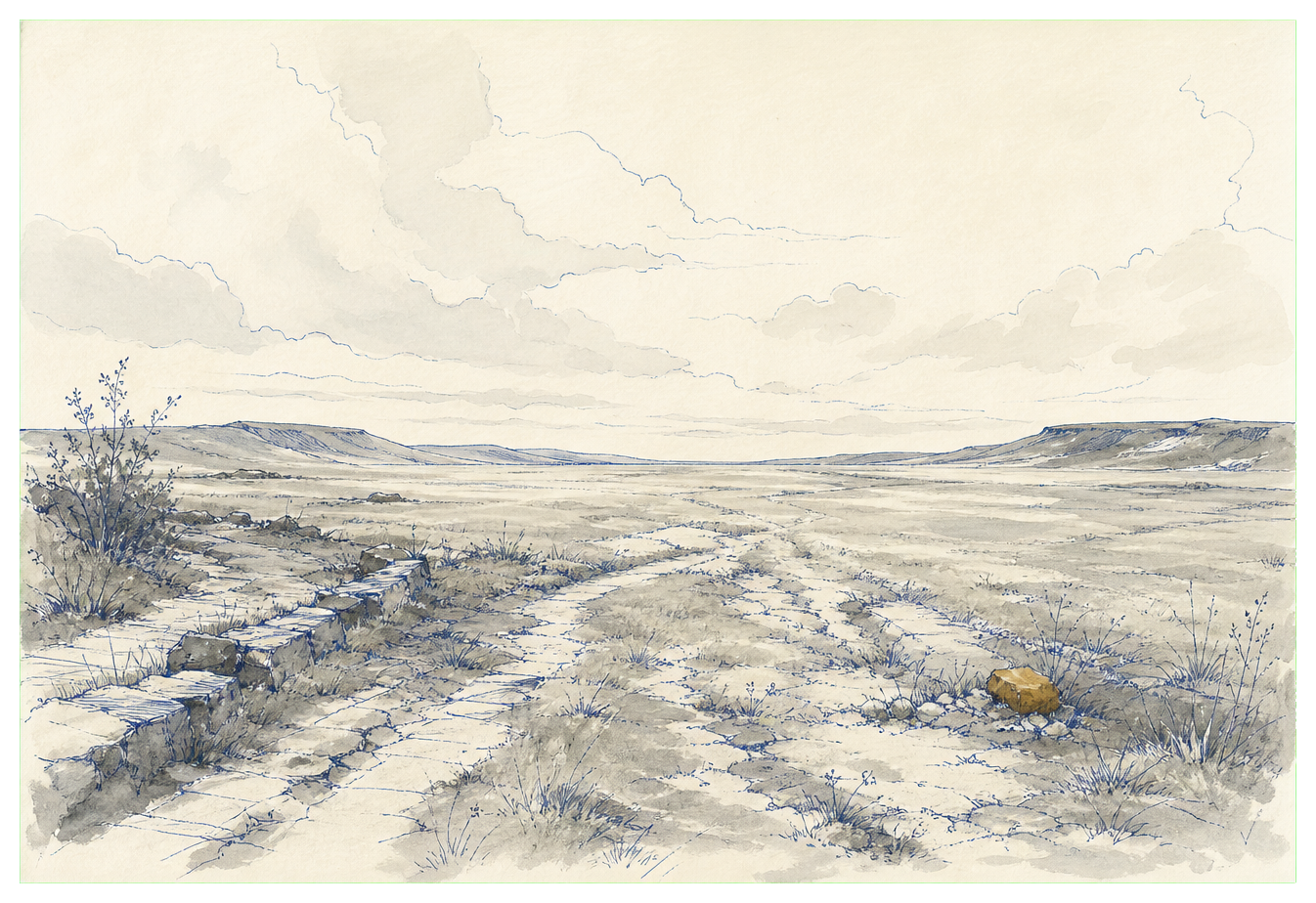
The open field should not be romanticized. Loss of structure can also reflect unemployment, illness, grief, displacement, depression, or material instability, and the person may need routine, income, care, treatment, or practical help. “Stay open” is poor advice when stabilization is the actual need. As metaphor, though, the field supports a real question: what becomes possible when the old prediction stops selecting every response?
Future memory and prospective imagination
Humans can imagine future scenes, rehearse decisions, and remember intended actions. In this book, future memory names a vivid imagined future used as a design tool. It is not a memory of an event that has already occurred.
The technique can reveal details a vague goal omits. Imagine an ordinary day after a desired change — where you are, what responsibilities exist, who is affected, what maintenance requires, and what tradeoff became necessary. Fantasy becomes planning when it returns with conditions and actions.
Synchronicity: event, pattern, meaning
Synchronicity is commonly used for a coincidence experienced as meaningful. This is the symbolic account of time, and three layers should remain distinct inside it.
- Event: two or more occurrences coincide in a describable way.
- Pattern judgment: the person experiences the coincidence as unusual or connected.
- Meaning: the person interprets the connection as guidance, symbolism, chance, divine order, selective attention, or unknown.
The event can often be recorded. The probability may be difficult to assess because people notice some coincidences and forget many nonmatches. The meaning stays interpretive. A synchronicity can still support reflection: hearing the same phrase in several places may reveal that attention is already organized around a question, and meeting someone by chance may create a genuine opportunity. The opportunity should then be assessed through ordinary behavior, consent, terms, and consequence.
Parallel realities as decision metaphor
Some metaphysical teachings describe every possible outcome as existing in parallel, with choice as movement among realities. Within that worldview, a decision is less creation from nothing than alignment with one available path.
As a practical metaphor, the model shows how small choices create divergent trajectories — sending an application, declining a request, telling the truth, taking medication, leaving a room, or repeating an old habit all change what becomes possible next. As metaphysics, literal parallel realities remain speculative in this book, and everyday decision trees do not prove them.
The metaphor earns its keep through translation. “I shifted timelines” can mean I changed a repeated response and entered a different sequence of consequences. “That reality is unavailable at my frequency” can mean my current skills, conditions, or behavior do not support that outcome. “I chose the version of me who has it” can mean I identified the actions and tolerances the goal requires. The translation preserves agency and returns the claim to observable life.
Fixed-time claims and failed prophecy
Predictions about specific future events require a record. Date, wording, source, confidence, and outcome should be preserved before the event. Ambiguous reinterpretation after failure weakens the claim, and the rule applies to prophecies, channeling, market predictions, personal intuition, political forecasts, and technological timelines alike. A failed prediction should remain failed. It can still generate learning about the model, the incentives, or the uncertainty.
Case map: the date that became a command
A teacher tells a community that a specific date will bring a collective energetic shift. Members prepare through fasting, purchases, ceremonies, and withdrawal from ordinary commitments. The date passes. Experiences vary. No shared external event matching the original promise occurs.
Several interpretations appear to absorb the failure. The shift happened invisibly. Only prepared people received it. The community’s doubt delayed it. The date was symbolic. The timeline changed because the warning succeeded. Any one of these claims may be imaginable. Together they make the original prediction impossible to fail.
The prediction register restores the record by holding the original wording and date beside the observable success criterion, the actions people took because of the claim, the material, relational, and health costs, the outcome, and — crucially — whether the new interpretation was stated beforehand or only appeared once the date had passed. The teacher may have acted sincerely. Sincerity does not remove responsibility for an unsupported fixed-time claim, and repair could include naming the failure, refunding event-specific purchases where appropriate, reviewing the process, restoring ordinary support, and making future uncertainty explicit.
The lesson extends beyond spiritual prophecy. Product launches, political forecasts, medical timelines, market predictions, and personal promises all gain authority from dates, and a date should increase accountability rather than provide a stage for retrospective symbolism.
Institutions organize time
Time is experienced personally and allocated socially. Work schedules, school calendars, prison sentences, debt terms, visa windows, care shifts, transit systems, voting periods, and medical waitlists determine whose time is treated as valuable and whose can be consumed.
Waiting is often a distribution of power. A person with status moves through a priority line. A low-wage worker loses income while waiting for a service. A customer waits on hold while the company measures staff seconds. A migrant waits inside legal uncertainty. A patient waits while symptoms continue. The inner experience of scarcity may be influenced by state, but the scarcity can also be structurally real.
Auditing the system means asking who sets the deadline and who can extend it, whose delay creates a penalty and which waiting time is unpaid or invisible, who has enough slack to recover from interruption, and what appeal exists when time allocation causes harm. This keeps “time anxiety” from being reduced to a missing inner sense that Life has your back. Sometimes the calendar itself is unjust.
Memory at collective scale
Communities remember through archives, monuments, anniversaries, textbooks, museums, testimony, ritual, family story, and law. These structures decide which past remains available to the present, and collective memory consists of institutions, records, practices, and contested interpretations rather than a single mind remembering.
Power shapes the archive. Some events leave extensive records because institutions documented themselves. Other lives appear through fragments, oral history, private letters, material traces, or testimony recorded much later. Destruction and exclusion create gaps. A responsible map distinguishes among seven classes — event evidence, official record, community memory, personal testimony, later interpretation, deliberate commemoration, and unknown — because the difference governs what a society can be asked to remember.
The distinction matters when a society says “we have moved on.” The passage of clock time does not complete repair. Accountability may require records, restitution, institutional change, education, and space for unresolved grief.
Grief time
Grief can make ordinary sequence feel disloyal. The world continues while the person’s internal calendar remains organized around a death, ending, displacement, or lost future. Others may impose milestones — the funeral ended, a year passed, a new relationship began, work resumed — and those events do not define completion.
At the same time, grief should not be romanticized as permanent suspension. A person may need practical help rebuilding sleep, food, social contact, care, income, and future plans, and support can honor the bond while helping life move. Rituals create shared time for grief; anniversaries and memorials permit return. Their value does not depend on a claim that the dead are present in a literal way. A metaphysical belief in continued relationship may coexist with the observable work of living after loss. Where recurring dates repeatedly intensify grief, a person can mark the known difficult dates and practical deadlines, decide what ritual or company or privacy or reduced workload is welcome, tell the relevant people, protect basic care, and review without assigning a completion date. Persistent inability to function, severe depression, self-harm risk, substance escalation, or dangerous isolation all call for qualified help.
Aging, mortality, and finite time
Metaphysical openness can coexist with a finite human life. Bodies age. Opportunities have windows. Relationships end. A reader does not need to decide what consciousness ultimately is in order to take mortality seriously.
Finitude gives choice its weight, and it also challenges the demand to optimize every hour. A meaningful life contains repetition, maintenance, sleep, error, waiting, and events that produce no visible achievement. The questions mortality presses are practical — which relationships need a conversation, which responsibilities need records or succession, what care preferences should be documented, which work should be finished, transferred, or released, and what ordinary experience deserves time now. They belong to legal, medical, relational, and spiritual domains, and wishes need the appropriate documents and conversations to become usable.
The open field is therefore bounded. Possibility exists inside time, body, ecology, and other people’s lives. The boundary does not make possibility meaningless. It makes creation particular.
Metaphysical time
Book II permits the larger question: could consciousness and time have a relationship deeper than subjective duration? Several broad possibilities can be imagined. Consciousness may arise within temporal physical processes. Time may arise within a more fundamental reality that includes consciousness. Both may emerge from another structure. Human categories may be inadequate to describe the relationship at all.
I do not resolve these possibilities here. My working metaphysical hypothesis sometimes treats consciousness as a context in which sequence becomes available for experience; the framing helps me consider memory, possibility, and choice together, and the claim remains speculative. The ethical test stays grounded. Does the model support responsibility for consequences? Can it tolerate failed prediction? Does it preserve care for bodies and material conditions? Does it allow another person to decline the worldview?
The floor I was sitting on
I no longer say my nervous system selects timelines. What it does is narrower and more honest: it changes which next actions I can see, and the seeing is one account among four. The clock still measures the train and the medication and the deadline. Psychological time still connects what I learned to what I predict. Lived time still enlarges the waiting minute and disappears the absorbed hour. The symbolic account still lets a recurring image open a question without answering it. And the metaphysical possibility — that sequence and consciousness share a deeper relationship — stays open precisely because I have stopped forcing the other three accounts to prove it.
Sitting on that floor, the field I had been calling a timeline looked different once I unlabeled it. The half-packed box was still there. The apartment, the work, and the relationship were still choices. What had changed was that I could hold each account to its own evidence instead of borrowing certainty from the one that sounded largest. The next move did not arrive as destiny. It arrived as an action I could take, on a particular day, inside finite time — and that was enough ground to stand on.