Meeting Protection
The hand on the brake
The first time I tried to choose outside an old role, my body did not celebrate. My chest tightened. Reasons to delay appeared with astonishing precision. I checked messages, reorganized small tasks, and waited for a cleaner moment that never quite arrived. The response felt like sabotage until I asked a different question: what danger does this system predict?
That question changed the relationship. Fear became information about anticipated harm. Avoidance became an action that reduced immediate activation. Perfectionism became an attempt to prevent exposure. People-pleasing became a way to protect belonging. Each response had a function, even when its current method created another problem. I call these responses protection (conscious or automatic, helpful or costly, proportionate or outdated) because the word directs attention toward the risk a response is trying to manage rather than toward its origin.

Fear has several jobs
Fear can respond to immediate danger, remembered danger, imagined danger, uncertainty, loss of control, social evaluation, physical sensation, or a combination of these. It can mobilize escape, confrontation, freezing, appeasement, information-seeking, vigilance, or withdrawal. Those responses are not interchangeable. A racing heart during a fire belongs to a different situation from a racing heart before a difficult conversation; the first calls for rapid safety, the second may allow time to assess the person, context, power difference, and history.
The National Institute of Mental Health notes that fear during and after danger is a natural part of the body’s response, that reactions after trauma vary, and that only some people develop persistent symptoms meeting criteria for post-traumatic stress disorder.1 That distinction protects us from turning every difficult memory into a diagnosis. It also protects us from minimizing serious symptoms: re-experiencing, avoidance, persistent arousal, changes in mood and cognition, sleep disruption, and impaired daily functioning can require professional assessment, and a reflective practice should never become a reason to delay care.
Protection has a time horizon
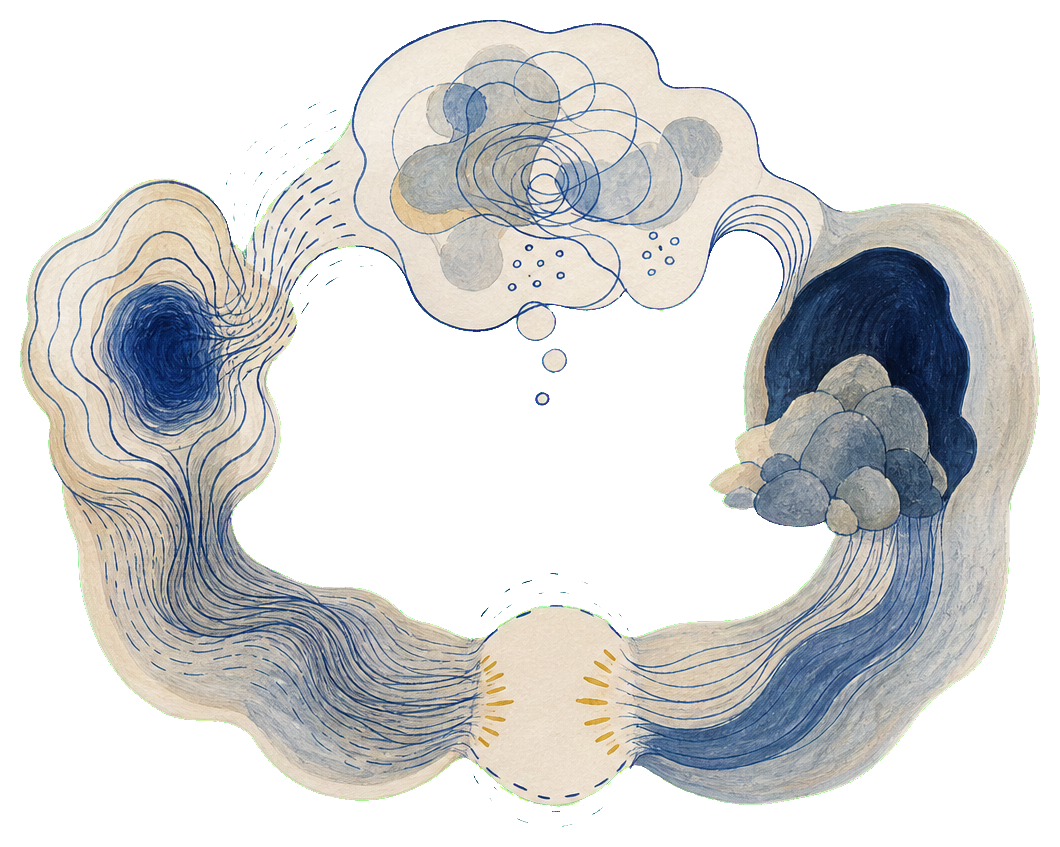
Every protective response manages a time horizon. Immediate protection asks, “How do I get through the next minute?” and it can be lifesaving. Short-term protection asks, “How do I reduce the next wave of discomfort?” Long-term protection asks, “How do I change the conditions that keep producing danger?” Problems arise when a successful immediate strategy becomes the only available long-term strategy.
Silence may protect someone during an explosive argument; years of silence can erase needs and prevent others from knowing the person. Dissociation may help a person endure an overwhelming event; persistent disconnection can interfere with work, relationship, or care. Checking a door once can respond to uncertainty; repeated checking may consume time while strengthening the sense that certainty is never complete. The useful question is not whether the response is good or bad but what time horizon it serves, what it costs, and whether the current setting offers another route.
The protector is not always an inner child
“Inner child” language helps some people approach vulnerability with care. It can also become a universal explanation imposed on experiences with different causes. A harsh inner voice may echo a caregiver, and it may also reflect a competitive workplace, religious teaching, current abuse, depression, obsessive thinking, online culture, or a person’s deliberate values expressed without skill. A fear of public speaking may connect to childhood ridicule, limited practice, present language barriers, or a realistic high-stakes audience. Origin stories should be held as hypotheses unless supported by memory or evidence, and even a vivid memory is interpreted from the present. The practical task is to understand the current cue, response, consequence, and available support.
When I use personified parts such as the Child, Critic, Guardian, or Performer, I treat them as tools for dialogue. They can make conflicting motives easier to hear. They do not establish literal separate entities inside the mind. So “my inner critic says I will fail” becomes “a prediction of failure appeared”; “my scared child is driving” becomes “a younger strategy is shaping this decision”; “my guardian refuses intimacy” becomes “distance currently feels safer than exposure.” The symbolic version may create compassion; the ordinary version creates testable language; both can coexist.
Perfectionism protects against a predicted consequence
Perfectionism often hides inside admirable words: standards, excellence, devotion, readiness, professionalism. The distinction appears in flexibility and cost. High standards can vary with consequence, while perfectionism treats error as a threat to identity, belonging, safety, or control. As a general pattern, not a clinical diagnosis, this can produce repeated checking, delay, inability to finish, refusal to begin, distress after success, or dependence on praise.

Five questions expose the layers: What level of care does the actual consequence require? Whose judgment am I predicting? What would an error mean about me? What control behavior promises to prevent that meaning? What smaller version would produce real feedback? A surgeon’s checklist and an artist’s first sketch should not share a standard. One protects a patient from foreseeable harm; the other creates material that can be developed. Perfectionism collapses both into a single identity trial.
Resistance is a relationship with cost
The phrase “what you resist persists” is memorable and often inaccurate. Resistance can stop abuse, challenge injustice, protect a boundary, and keep a dangerous impulse from becoming action; opposition does not carry the same “frequency” as the thing opposed. The useful insight inside the phrase concerns attention and reinforcement. A person can organize so much life around avoiding an experience that avoidance keeps the experience central. Someone terrified of appearing foolish may decline every beginner opportunity; the short-term relief rewards avoidance, and the lack of practice preserves the fear.
This mechanism does not require a vibrational law. It can be observed as a loop:
predicted discomfort -> avoidance -> immediate relief -> reduced learning -> stronger prediction
The exit is calibrated contact when contact is safe and appropriate. The amount matters: overwhelming exposure can intensify fear, while a reversible, tolerable experiment can create new evidence. Protection updates through experience more reliably than through slogans.
Bridging language
An affirmation can help when it organizes attention around a believable direction, and it can also create friction when it contradicts immediate experience. If someone feels unsafe, repeating “I am completely safe” may erase information. A bridge sentence holds both the present fact and the possibility: “I notice fear, and I am checking what danger is present now”; “Support feels unfamiliar, and I can identify one person or structure available today”; “I do not feel loving toward myself, and I can perform one act of care”; “I cannot guarantee the outcome, and I can prepare for the next step.” Bridge language avoids forcing the body to confirm a metaphysical claim, and it turns aspiration into an action or observation.
Emotional contracts are remembered rules
An emotional contract is a metaphor for a rule formed under pressure: “I must stay useful to belong,” “I must never become angry,” “I must manage everyone,” or “I must hide uncertainty.” No literal agreement was signed; the term names the loyalty a person can feel toward a strategy whose purpose has faded.
The contract can be examined through evidence. What event activates the rule? What consequence does obedience prevent? Who benefits from the rule now? What happened the last three times I obeyed it? What happened when I made a small exception? What present obligation would remain even if the rule changed? Some contracts survive because the predicted consequence is still real: a worker may hide disagreement because the employer punishes dissent, or a dependent family member may comply because housing is at risk. The appropriate intervention may be documentation, collective action, financial planning, legal advice, or safer employment. A private mindset change cannot substitute for material leverage. Other contracts survive through untested prediction, and these can be examined through a bounded experiment.
The framework once called the sudden recognition of a rule’s impossibility an Absurdity Snap. I now treat that as one possible cognitive shift. Insight can loosen a belief, but many patterns require repeated experience, environmental change, grief, treatment, repair, and time. No responsible method can promise an instant mechanical release.
Addiction requires more than symbolic reframing
Earlier versions of this work described addiction as “distorted devotion,” a compromised route toward union, relief, stimulation, belonging, or worth. The phrase can reveal a need beneath behavior, and it becomes dangerous if it reduces addiction to a spiritual misunderstanding.
The National Institute on Drug Abuse describes addiction as a chronic disorder involving compulsive drug seeking and use despite harmful consequences, shaped by interacting biological, environmental, and behavioral factors.2 Substance-use disorders can involve tolerance, withdrawal, overdose risk, medical complications, impaired judgment, and relapse, and behavioral patterns can also become compulsive and severely impair life. A complete response may include medical care, evidence-based therapy, medication, peer support, harm reduction, changes in environment, stable housing, treatment for co-occurring conditions, and sustained relational support. The appropriate combination belongs to the person and qualified professionals. The symbolic question “what need is this trying to meet?” can join that response. It cannot replace it.
The same care applies to food. As a general pattern, not a clinical diagnosis, eating behavior can involve hunger, access, culture, medication, metabolism, stress, disability, sensory needs, eating disorders, and many other factors. “Filling a void” is one possible personal meaning, never a universal explanation.
When the protector is also the livelihood
Soren (a composite drawn from common patterns, not one person's history) works as an independent designer. He learned early that preparation reduced criticism, and as his business grows that protection becomes part of the product: clients value his attention to detail. Then preparation expands. He works late to anticipate every question, delays invoices until every deliverable feels beyond dispute, and avoids larger contracts because more visibility means more possible judgment. Income becomes unstable, which increases the need to control every project.
The mechanism contains several loops running at once. The identity loop says he is safe only when his work cannot be criticized. The behavior loop is overprepare, delay, earn praise for detail, lose time, feel financial pressure, and overprepare more. The business loop lets unclear scope permit endless refinement while pricing omits the labor and clients learn that extra work is free. The body loop lets sleep loss increase threat sensitivity and reduce decision capacity. A single affirmation cannot change this architecture; “done is better than perfect” may even sound like permission to become careless.
Concrete actuator moves follow. Contracts define revision rounds. Prices account for review time. A preflight checklist distinguishes required quality from optional refinement. Invoices are triggered by milestones rather than a feeling of completion. A peer reviews one high-stakes deliverable. Sleep receives a boundary. Soren’s protection is not removed; it receives a more accurate job, which is to identify consequential risk and apply the agreed quality standard, and the business structure stops rewarding endless vigilance. Protection often needs environmental redesign, because a person cannot practice flexibility inside a system that rewards the costly pattern at every turn.
The ecology around a pattern
A protective response rarely lives alone; other people adapt to it. When one family member always mediates, others practice less repair. When one employee checks every detail, managers stop defining quality. When one partner always initiates, the other person’s level of investment remains hidden. When one friend answers every crisis, a wider support network may never form. Changing the response can initially make the system perform worse: conflict becomes visible, tasks are dropped, another person becomes angry, and the old arrangement appears to have been necessary. That moment needs interpretation, because a transition cost is not proof that the change is wrong; it reveals work the protector had been carrying.
Map the ecology: Who expects the response? Which task or emotion does it remove from them? What consequence appears when the response stops? Which capacity needs redistribution or development? What support makes the transition safer? The person changing may need to taper a role rather than withdraw without notice: a caregiver can create a handoff, a team can assign owners, a family can learn a repair process, a partner can hear the boundary and decide whether to contribute. Protection becomes relational architecture when others depend on its continuation.
Grief as a protective context
As a general pattern, not a clinical diagnosis, grief can change attention, sleep, motivation, memory, appetite, social tolerance, and the felt future. Protective responses may become stronger during loss because ordinary capacity is reduced, and the goal should not be rapid return to a previous baseline. Grief may require ritual, companionship, practical support, reduced workload, professional care, or time whose duration cannot be standardized. A person may avoid reminders because contact is overwhelming, or seek every reminder because distance feels like betrayal; neither response should be assigned a universal meaning.
The protection questions remain modest: What is manageable today? What obligation can be reduced? Which contact supports rather than demands? What signs indicate that more help is needed? What part of the loss has no solution and needs witness? Spiritual explanation can be especially tempting in grief: belief in continuing relationship, soul, divine purpose, or signs may offer comfort. Those interpretations belong to the grieving person; they should not be imposed, and they should not replace care for function and safety.
When compassion becomes another demand
“Thank the protector” can become an obligation to feel tenderness toward a response that has damaged a life, and some readers will feel anger, disgust, exhaustion, or nothing. Compassion is one possible relationship; neutrality is enough for the method. You can say, “This response has a history. It currently creates this cost. I am changing the conditions.” No emotional ceremony is required. The same limit applies to forgiveness: understanding why another person acted protectively does not erase responsibility or require renewed access. Protection can explain conduct without excusing it.
Several faces of protection
Protection rarely announces itself as fear; it can look active or quiet, pleasant or productive. Anger may be mobilizing defense, restoring a sense of power, or making a boundary visible. It may also conceal fear behind aggression, so the question is what violation is perceived and what action remains ethical. Numbness may be reducing overwhelming contact, or it may be exhaustion, depression, medication, dissociation, or ordinary disinterest, so the function and context matter before meaning is assigned. Humor can create connection and perspective, and it can redirect vulnerability before another person can reach it. Intellectualization can organize complexity and preserve function, and it can keep experience at a safe distance, where the question is whether thought is improving action or replacing contact. Hyper-independence can protect against unreliable support, building real capability while concealing the cost of never being witnessed or helped. Control can coordinate genuine risk, and it becomes costly when certainty is demanded from people and events that cannot provide it. Spiritualization can create meaning, hope, and ethical orientation, and it becomes protective avoidance when a metaphysical story replaces grief, evidence, treatment, or direct action. The same behavior can serve several of these functions at once, and naming the face is only the beginning.
Proportionate protection
The goal is not zero protection. A living system needs boundaries, alarms, reserves, redundancy, and escape routes. Proportionate protection matches response to probability, impact, reversibility, and available support, so a low-probability catastrophic risk may justify strong safeguards, a high-probability minor discomfort may justify tolerance and experimentation, and uncertain risk may justify information gathering. Use a four-part check: What harm is predicted (threat)? What evidence suggests it may occur (likelihood)? How severe would it be (impact)? What does the protection itself consume or prevent (response cost)? The check applies beyond emotion: a company protects data, a family saves money, a person locks a door, a community creates emergency plans. Excessive protection can prevent use; insufficient protection can expose people to avoidable harm.
Protection and consent
Meeting protection does not require obeying every fear, and it also does not require crossing a boundary to prove courage. Consent is a clean test. If a practice requires touch, disclosure, altered states, fasting, sexual energy, substances, breath restriction, public exposure, or another person’s participation, the person must have enough information and freedom to choose. A facilitator’s interpretation of “resistance” cannot override a no.
This matters because spiritual and therapeutic language can make coercion sound benevolent. “Your fear means the healing is working” may be used to dismiss a valid alarm. “Your protector is blocking abundance” can pressure a person into financial or relational risk. Protection deserves assessment, context, and a right to stop.
A protection map
Then the present can answer. The first time I tried to choose outside an old role, my chest tightened and a dozen reasons to delay arrived with astonishing precision. I no longer read that tightening as sabotage. I read it as protection doing its job (predicting a cost, asking to be heard) and then I check what danger is actually present now. The body is one place where that answer appears: sensation can reveal activation before a story becomes automatic, though sensation can also be ambiguous, and learning to tell the difference is its own work.